












The Dallas Stars found themselves without their star forward Mikko Rantanen for Tuesday’s crucial matchup against the Edmonton Oilers after the NHL’s automatic suspension protocol kicked in. Rantanen became the latest high-profile player to fall victim to one of the league’s lesser-known but clearly defined rules regarding repeat offenses. The Finnish winger received his second game misconduct penalty for a physical infraction within a three-game span, triggering an automatic one-game ban under Rule 23.6 of the NHL rulebook.
The suspension stems from a boarding major and game misconduct assessed during Saturday’s 3-2 shootout loss to the Calgary Flames, when Rantanen hit forward Matt Coronato from behind. While Coronato managed to finish the game, the penalty marked Rantanen’s second such ejection in less than a week, forcing the league’s hand despite no additional hearing from the Department of Player Safety.
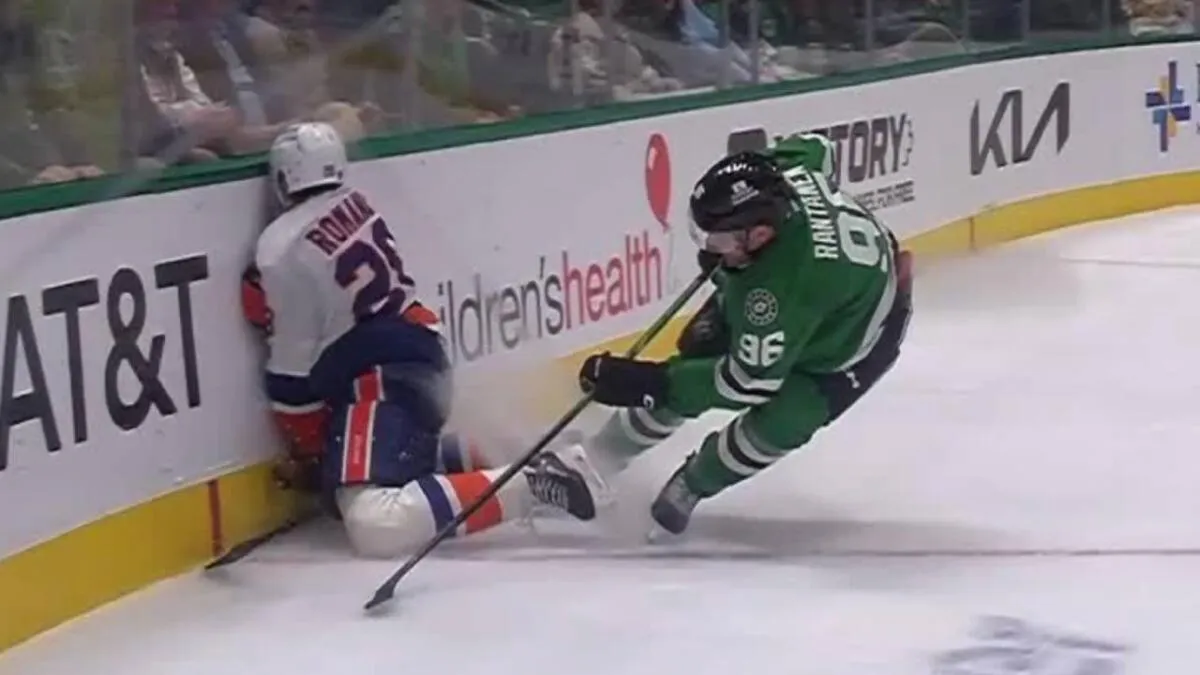
Understanding Mikko Rantanen automatic one-game suspension for two game misconduct penalties under NHL Rule 23.6
NHL Rule 23.6 operates as a progressive discipline system designed to curb repeated dangerous plays before they escalate. The rule specifically targets players who accumulate multiple game misconduct penalties in what the league categorizes as “Physical Infractions” – a classification that includes boarding, charging, elbowing, interference, and kneeing. When a player receives two such penalties within 41 consecutive regular-season games, the automatic suspension kicks in without requiring a formal hearing.
The mechanism serves as a bridge between on-ice penalties and supplemental discipline, creating a middle tier of consequences for players who repeatedly cross the line. For Rantanen, this meant his suspension was immediate and mandatory, leaving the Stars without their leading scorer for a game that carried significant playoff seeding implications against their Western Conference rivals.
The specific language and its application
Rule 23.6 states: “Any player who incurs a total of two (2) game misconduct penalties in the ‘Physical Infractions Category’, before playing in 41 consecutive regular-season League games without such penalty, shall be suspended automatically for the next League game of his team.” The rule further specifies that each subsequent violation increases the automatic suspension by one additional game.
This creates a sliding scale where a third offense would trigger a two-game suspension, a fourth would bring three games, and so on. The 41-game reset provision offers players a path to clean their record, but Rantanen’s penalties came so close together that he never had a chance to work toward that reset threshold.
Why no additional discipline was applied
Despite the severe consequences of his actions – particularly the injury to Alexander Romanov – the NHL’s Department of Player Safety chose not to impose additional supplemental discipline beyond the automatic suspension. According to sources cited by ESPN’s Greg Wyshynski, the league reviewed both incidents and determined that the automatic penalty under Rule 23.6 was sufficient punishment.
This decision highlights the distinction between the rulebook’s automatic provisions and the discretionary power of Player Safety. While the department can impose additional fines or suspensions for particularly egregious plays, they can also defer to the automatic system when the circumstances don’t warrant escalation.
The incidents that triggered Mikko Rantanen automatic one-game suspension for two game misconduct penalties
The timeline of Rantanen’s violations illustrates just how quickly a player’s season can spiral under the league’s repeat-offender provisions. What started as an uncharacteristically rough stretch transformed into a costly absence for a Stars team battling for position in the competitive Central Division.
Boarding Alexander Romanov: The first strike
The first incident occurred last Tuesday during a 3-2 loss to the New York Islanders, when Rantanen boarded defenseman Alexander Romanov late in the game. The hit drew an immediate major penalty and game misconduct, but what happened afterward made the situation far more serious. Islanders head coach Patrick Roy, who coached Rantanen in Colorado, unleashed a profane tirade directed at his former player as he left the ice.
Roy’s postgame comments reflected both disappointment and concern. “I’m going to say is [that] when you see the number, you have to lay off. Everybody knows that. You don’t go through the guy,” Roy stated. “I was in Colorado when [Rantanen] was drafted there. It’s not his style. But at the same time, that should not be part of our game.” Roy’s words carried extra weight given their history, and the injury that followed validated his anger.
The consequences were severe: Romanov required shoulder surgery and will miss five to six months, a significant blow to the Islanders’ defensive corps. Despite this outcome, the NHL chose not to issue supplemental discipline, allowing Rantanen to continue playing with a clean slate beyond the single-game misconduct.
Boarding Matt Coronato: The tipping point
Just four days later, Rantanen found himself in an eerily similar situation against the Calgary Flames. With the game tied in the second period, he delivered a boarding hit to forward Matt Coronato from behind, earning his second major and game misconduct in less than a week. Fortunately for Coronato and the Flames, the forward was able to return to the game after evaluation.
Calgary coach Ryan Huska didn’t mince words, calling it “a terrible hit” and reinforcing the league’s concerns about player safety. The similarity between the two incidents – both boarding penalties, both late in games, both resulting in game misconducts – made it nearly impossible for the league to view them as isolated events. The pattern established a concerning trend that Rule 23.6 is specifically designed to address.
Impact on Dallas Stars and playoff positioning without Mikko Rantanen
The timing of Rantanen’s suspension created immediate challenges for a Stars team already navigating the rigors of an 82-game season. Missing a player of Rantanen’s caliber for any game strains a team’s depth, but losing him against the Edmonton Oilers – last year’s Western Conference Final opponents – magnified the impact.
Statistical void and lineup adjustments
Rantanen’s production speaks for itself. Through 22 games, he leads the Stars alongside Jason Robertson with 28 points (10 goals, 18 assists), serving as a primary offensive catalyst. His absence forced coach Peter DeBoer to shuffle his top six forwards, likely elevating secondary scorers into roles they hadn’t previously occupied.
Beyond the point production, Rantanen’s 57 penalty minutes – 39 of which accumulated during this tumultuous three-game stretch – reflect a player walking an emotional edge. For a team that prides itself on discipline, this represents a concerning departure from the controlled aggression that typically defines successful playoff teams.
Western Conference implications
The Western Conference playoff race promises to be tight, with points at a premium and divisional matchups carrying extra weight. Tuesday’s game against Edmonton represented an opportunity to measure up against a conference heavyweight while potentially gaining ground in the standings. Without Rantanen, the Stars faced a formidable challenge against an Oilers squad featuring Connor McDavid and Leon Draisaitl.
The suspension also served as a wake-up call within the Stars’ locker room. Teams that make deep playoff runs rarely lead the league in major penalties, and Rantanen’s recent pattern threatened to undermine the structured, disciplined approach that championship contention requires.
What this means for Mikko Rantanen’s future and the Stars’ discipline
Moving forward, Rantanen finds himself on a tight leash where any additional physical infractions carry exponentially greater consequences. The spotlight on his play will intensify, not just from officials but from opponents who may test his composure knowing he’s walking a disciplinary tightrope.
The 41-game reset clock
The path back to a clean record requires 41 consecutive games without a physical category game misconduct. For Rantanen, that means playing nearly half a season with absolute precision in his physical play. Any boarding, charging, elbowing, or similar penalty that includes a game misconduct will automatically trigger a two-game suspension.
This pressure tests a player’s ability to adapt his style without sacrificing effectiveness. Rantanen must maintain his physical presence – an essential element of his power-forward game – while ensuring his hits fall within the league’s acceptable parameters. The margin for error has vanished.
Leadership and accountability
At 29 years old and in his 11th NHL season, Rantanen carries the responsibility of setting an example. His lack of disciplinary history before this stretch works in his favor, suggesting these incidents represent an anomaly rather than a fundamental character shift. However, the league’s system responds to actions, not intent, and the consequences are now very real.
For the Stars’ leadership group, this moment requires both support and accountability. Veterans like Jamie Benn and Tyler Seguin understand the balance between playing on the edge and playing over it. Their guidance could prove crucial in helping Rantanen navigate the games ahead while maintaining his competitive fire.
The automatic suspension under Rule 23.6 provides a valuable lesson for the entire Stars roster: even elite players face consequences when patterns emerge. For Dallas to reach its championship aspirations, discipline must complement talent, and every player must understand where the line exists.
Rule 23.6 serves as a reminder that the NHL has structured systems to address repeat offenses before they require more severe intervention. Rantanen’s case demonstrates how quickly these mechanisms activate and how costly they can be for teams in the playoff hunt. The Stars will need their star forward to adapt immediately if they hope to avoid future automatic absences during critical stretches of the season.
Frequently Asked Questions

Par Mike Jonderson
Mike Jonderson is a passionate hockey analyst and expert in advanced NHL statistics. A former college player and mathematics graduate, he combines his understanding of the game with technical expertise to develop innovative predictive models and contribute to the evolution of modern hockey analytics.