











Dallas Stars forward Mikko Rantanen will sit out Tuesday’s highly anticipated matchup against the Edmonton Oilers after receiving an automatic one-game suspension under a little-known NHL rule. The suspension stems from Rantanen incurring two game misconduct penalties for boarding within a span of just four days and fewer than 41 consecutive regular-season games, triggering a mandatory disciplinary action that caught many fans by surprise.
The Finnish winger, who leads the Stars with 28 points this season, found himself at the center of controversy after separate incidents involving New York Islanders defenseman Alexander Romanov and Calgary Flames forward Matt Coronato. While the NHL Department of Player Safety declined to hold formal hearings for either hit, Rule 23.6 of the NHL rulebook left no room for discretion, mandating an automatic suspension that has reignited discussions about player safety and the league’s disciplinary framework.
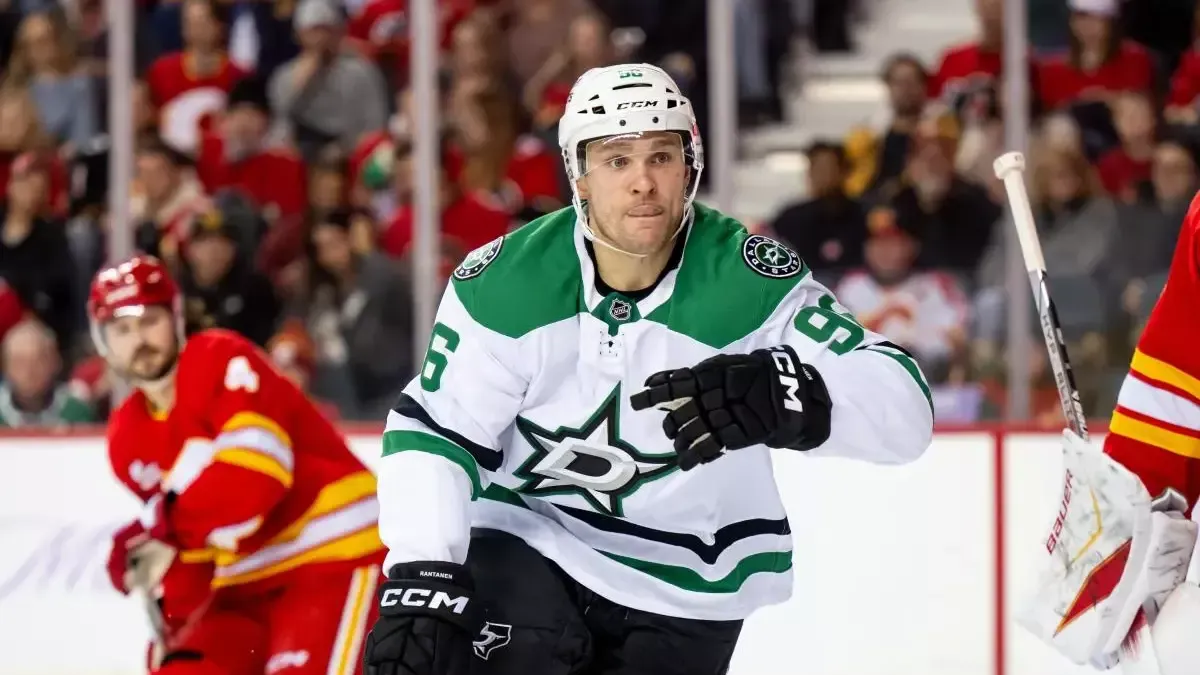
Understanding Mikko Rantanen’s automatic one-game suspension under NHL Rule 23.6
The mechanism behind Rantanen’s suspension begins with a specific and often overlooked provision in the NHL’s rulebook. Rule 23.6 states that any player who receives two game misconduct penalties in the “Physical Infractions Category” before playing 41 consecutive regular-season games without such a penalty shall be automatically suspended for the next league game. The rule further specifies that for each subsequent game misconduct penalty, the automatic suspension increases by one additional game.
This rule essentially creates a cumulative penalty system that tracks player behavior over a rolling 41-game window. Rantanen’s first game misconduct came on November 18 against the Islanders, when he boarded Alexander Romanov late in the third period. The second incident occurred just four days later in Calgary, when he delivered a similar hit to Matt Coronato from behind. Both plays resulted in five-minute major penalties and immediate ejections, putting Rantanen squarely within the parameters of Rule 23.6.
The physical infractions category encompasses several dangerous play types, including boarding, charging, elbowing, interference, and kneeing. These are considered among the most hazardous violations in hockey because they often involve players being defenseless or hit from vulnerable positions. The rule’s design aims to identify patterns of reckless behavior before they escalate, essentially giving players a chance to adjust their play after a first offense while imposing escalating consequences for repeated violations.
The specific incidents leading to suspension
The first incident occurred during a 3-2 loss to the New York Islanders on November 18. With just 28 seconds remaining in regulation, Rantanen delivered a hit to defenseman Alexander Romanov that Islanders coach Patrick Roy immediately condemned. “I’m going to say is [that] when you see the number, you have to lay off. Everybody knows that. You don’t go through the guy,” Roy fumed after the game. “I was in Colorado when [Rantanen] was drafted there. It’s not his style. But at the same time, that should not be part of our game.”
The consequences proved severe for Romanov, who required shoulder surgery and faces a recovery timeline of five to six months. The hit’s timing and outcome made it particularly controversial, occurring when the game was already decided and resulting in a significant injury to a key defenseman.
Rantanen’s second offense came just four days later in Calgary. During a 3-2 shootout loss to the Flames, he boarded forward Matt Coronato from behind late in the second period. While Coronato fortunately returned to finish the game, Flames coach Ryan Huska didn’t mince words, calling it “a terrible hit.” The incident demonstrated a pattern of behavior that, while perhaps uncharacteristic for Rantanen’s career, fell squarely within the enforcement parameters of Rule 23.6.
How the 41-game window works
The 41-game provision serves as a reset mechanism for players who maintain clean records over a significant stretch. Once a player completes 41 consecutive regular-season games without receiving a major penalty and game misconduct in the physical infractions category, previous violations are removed from their current record. However, they remain part of the player’s historical record for any future considerations.
This rolling window creates an incentive structure that rewards sustained good behavior while penalizing repeated offenses in relatively short succession. For Rantanen, the two incidents occurred within a span of just three games, making the application of Rule 23.6 automatic and unavoidable. The NHL Department of Player Safety confirmed the suspension without the need for a hearing, reflecting the rule’s clear-cut nature.
Had the incidents been more spaced out, Rantanen might have avoided the suspension entirely. The 41-game threshold typically represents roughly half an NHL season, giving players substantial opportunity to demonstrate they’ve adjusted their play. The rule’s design acknowledges that isolated incidents can happen in a physical sport while still holding players accountable for patterns of dangerous behavior.
Impact on the Dallas Stars and Rantanen’s season
Rantanen’s absence creates a significant void in the Stars’ lineup as they prepare to face the Oilers in a rematch of last year’s Western Conference final. The Finnish forward has been instrumental to Dallas’s success this season, tying with Jason Robertson for the team lead in points with 28 (10 goals, 18 assists) across 22 games. His production has been even more remarkable given his recent penalty troubles, as he simultaneously leads the entire NHL with 57 penalty minutes.
The suspension comes at a particularly challenging time for Dallas, which is navigating a competitive Central Division race. Tuesday’s game against Edmonton represents more than just a single regular-season matchup—it serves as a potential preview of another deep playoff series and carries psychological weight after the Oilers eliminated the Stars in five games last spring. Missing a top-line player of Rantanen’s caliber against a conference rival could affect not only the game’s outcome but also the team’s confidence and momentum.
Statistical implications and penalty concerns
Rantanen’s penalty minute total has skyrocketed in recent weeks, with 39 of his 57 PIMs accumulating in his past three games alone. This dramatic increase represents a departure from his typical playing style over an 11-year career that has never before included supplemental discipline beyond minor fines. His recent pattern of dangerous plays has raised questions about whether the physical nature of his game has escalated beyond his control.
The automatic suspension serves as a wake-up call that extends beyond a single missed game. If Rantanen incurs another game misconduct for a physical infraction before playing 41 more games, the automatic penalty doubles to a two-game ban. A third violation would trigger a three-game suspension, creating an escalating scale that could significantly impact his availability during crucial stretches of the season.
This progression places additional pressure on Rantanen to adjust his approach to physical play. While he has built his reputation as a skilled power forward who uses his 6-foot-4 frame effectively, the line between assertive play and dangerous hits has become increasingly thin. The NHL’s enforcement emphasis on protecting defenseless players means that even incidental contact from behind can result in major penalties if officials determine the hittee’s numbers were visible.
Team dynamics and lineup adjustments
Dallas coach Peter DeBoer must now reconfigure his forward lines without his leading scorer. The Stars have considerable depth, with Robertson, Roope Hintz, and Wyatt Johnston all capable of driving offense, but Rantanen’s unique combination of size, skill, and net-front presence creates mismatches that are difficult to replicate. His absence likely means increased responsibilities for secondary scorers and potential lineup shifts that could affect chemistry throughout the roster.
The suspension also impacts the team’s special teams. Rantanen plays significant minutes on both the power play and penalty kill, making his one-game absence felt across multiple situations. The Stars will need other forwards to step up, particularly in power-play scenarios where Rantanen’s ability to create space and finish plays has been crucial to their success this season.
From a locker room perspective, the situation presents a leadership challenge. Teammates understand the automatic nature of the suspension, but the pattern of behavior that led to it requires internal accountability. Veteran players like Jamie Benn and Tyler Seguin may need to have conversations with Rantanen about balancing physical intensity with responsible play, especially given the team’s championship aspirations.
The broader context of physical play in the NHL
Rantanen’s suspension arrives during a season of increased scrutiny on dangerous plays throughout the league. The NHL has made player safety a priority, particularly regarding hits from behind and boarding incidents where victims are defenseless. This enforcement climate makes understanding and adapting to rule interpretations more critical than ever for players who play a physical brand of hockey.
The fact that Rantanen had no prior history of supplemental discipline over his 674-game career spanning three franchises (Colorado, Carolina, and Dallas) makes this situation particularly notable. His only previous interaction with the Department of Player Safety resulted in a $2,000 embellishment fine, a minor infraction unrelated to dangerous physical play. This clean history likely contributed to the department’s decision not to hold formal hearings for either boarding incident, as they fell below the threshold for supplemental discipline when considered individually.
Evolution of Rule 23.6 and its enforcement
Rule 23.6 represents a preventive approach to discipline, identifying problematic patterns before they result in catastrophic injuries. The rule has existed in the NHL rulebook for years but rarely receives attention because most players never trigger its provisions. Its automatic nature removes subjectivity from certain disciplinary decisions, creating consistency in how serial offenders are handled.
The rule’s existence reflects the league’s understanding that dangerous plays often exist on a continuum. A player who repeatedly commits boarding penalties may be more likely to eventually cause a severe injury than one with an isolated incident. By intervening after the second offense within the 41-game window, the league aims to modify behavior before more serious consequences occur.
This approach complements the Department of Player Safety’s case-by-case review system for individual incidents. While Player Safety focuses on the severity and circumstances of each hit, Rule 23.6 operates as a separate track that tracks patterns regardless of the specific outcomes of each play. This dual-system approach allows for both nuanced consideration of individual incidents and automatic responses to repeated behaviors.
Public reaction and player education
The suspension has generated significant discussion among fans and analysts, many of whom were unaware of Rule 23.6’s existence. Social media and sports talk shows have debated whether the rule appropriately balances accountability with the inherent physicality of professional hockey. Some argue that two incidents in quick succession may represent a slump in judgment rather than a pattern requiring intervention, while others contend that any repeat offense involving dangerous hits warrants automatic consequences.
From a player education perspective, Rantanen’s situation serves as a cautionary tale for other NHL athletes. Many players may not fully understand the specific thresholds and timelines embedded in the NHL rulebook, particularly provisions like Rule 23.6 that rarely come into play. The NHLPA and individual teams may need to enhance educational efforts to ensure players understand how quickly repeated minor infractions can escalate into automatic suspensions.
The incident also highlights the importance of video review and coaching. Teams continually analyze their players’ hits to ensure they meet current standards for legality and safety. Rantanen’s two boarding penalties, particularly the second after the warning from the first, suggest either a technique issue or a judgment problem regarding when to engage physically. Dallas’s coaching staff will likely work extensively with him on positioning and decision-making to prevent future incidents.
Looking ahead: implications for Rantanen and the Stars
Rantanen returns to the Dallas lineup following Tuesday’s game against Edmonton, but the shadow of this suspension will linger. He must now navigate the remainder of the season with the understanding that another game misconduct for a physical infraction will automatically cost him two games, not one. This elevated risk requires him to recalibrate his approach to physical confrontations, particularly along the boards where boarding penalties most frequently occur.
The 41-game clock began ticking again as soon as he received his second game misconduct. He must now play 41 consecutive games without incurring another physical infraction game misconduct to clear his record. Given the remaining schedule, this means maintaining a clean record through the majority of the regular season and potentially into the playoffs, where physical intensity amplifies and officials scrutinize hits more closely.
Playoff considerations and long-term reputation
The timing of this suspension raises important questions about playoff implications. If Rantanen were to trigger another automatic suspension late in the regular season or during the playoffs, the consequences would be magnified exponentially. A two-game absence in a seven-game playoff series could swing the entire outcome, making his discipline management a strategic priority for both player and team.
Rantanen’s reputation has also taken a hit, however unfair that may seem for a player with a previously clean record. Opposing teams may now target him, knowing he’s under scrutiny and perhaps more hesitant to engage physically. Officials, aware of his recent pattern, may call borderline hits against him more readily. This heightened attention creates additional pressure for him to play a cleaner, more controlled game.
The incident may also affect contract negotiations and future opportunities, though this impact should be minimal given his overall body of work. Rantanen remains one of the NHL’s most productive power forwards, and teams value his unique skill set highly. However, any pattern of discipline issues becomes part of a player’s permanent record, potentially influencing how aggressively teams pursue him in free agency or what assurances they seek regarding his playing style.
For the Dallas Stars organization, this suspension serves as a reminder that even veteran stars require guidance on navigating the NHL’s increasingly complex disciplinary landscape. The team must balance its desire for physical, aggressive play with the reality that automatic rules like 23.6 can remove key players from important games without any appeals process. This may influence how the Stars evaluate potential acquisitions, coach current players, and emphasize safe hitting techniques in practice.
The Stars’ championship window remains open, and Rantanen’s presence is essential to their success. How he responds to this automatic suspension—whether it prompts meaningful adjustment or represents merely a temporary setback—could help determine whether Dallas returns to the conference final or advances even further. The Oilers game without him will test the team’s depth, but the longer-term question is whether Rantanen can maintain his physical edge without crossing the line that triggers further automatic penalties.
Frequently Asked Questions

Par Mike Jonderson
Mike Jonderson is a passionate hockey analyst and expert in advanced NHL statistics. A former college player and mathematics graduate, he combines his understanding of the game with technical expertise to develop innovative predictive models and contribute to the evolution of modern hockey analytics.