






The Minnesota Wild’s struggles continue to deepen as they dropped their fourth consecutive game and ninth straight to the Winnipeg Jets with a heartbreaking 4-3 overtime loss at Grand Casino Arena on Tuesday night. What made this defeat particularly painful wasn’t the result alone but the manner in which it unfolded. After battling back from a two-goal deficit to take a third-period lead, the Wild couldn’t hold on, ultimately falling victim to Kyle Connor’s overtime winner just 46 seconds into the extra frame.
This loss extends Minnesota’s worst start of the Kirill Kaprizov era, leaving them with just nine points through 11 games (3-5-3). The pattern has become all too familiar: falling behind early, mounting spirited comebacks, and finding heartbreaking ways to lose. Yet despite the disappointing result, there were glimpses of improvement in the Wild’s performance that suggest better days could be ahead if they can maintain their process and clean up critical mistakes.
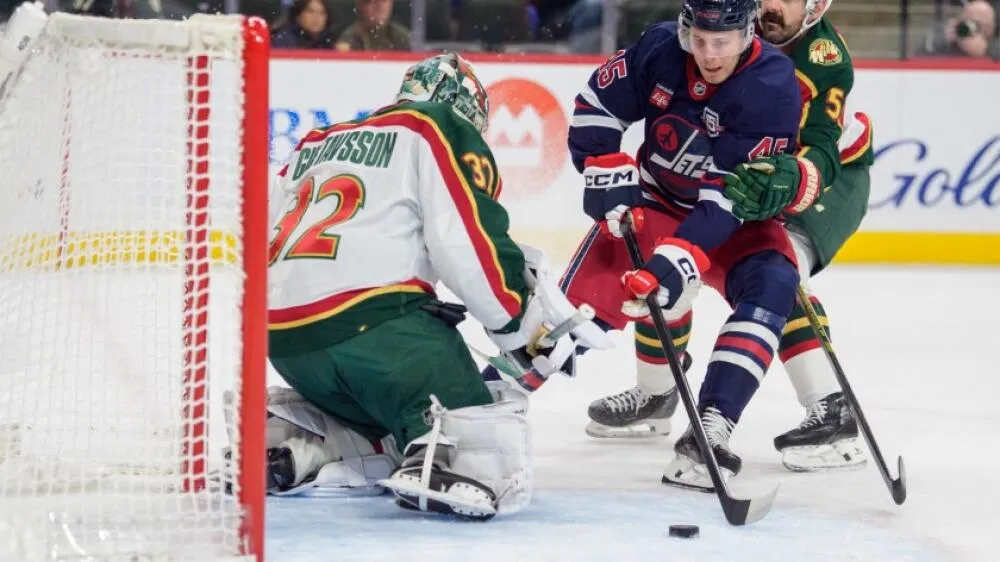
Minnesota Wild’s comeback effort shows character despite three takeaways from Minnesota Wild 4-3 overtime loss to Winnipeg Jets
The Wild’s ability to erase a two-goal deficit demonstrated resilience that has been sorely tested during their recent skid. After Gabriel Vilardi and Vladislav Namestnikov put Winnipeg ahead 2-0 within 22 seconds of each other late in the first period, Minnesota could have folded. Instead, they responded with three consecutive goals that flipped the script entirely.
Kaprizov ignited the comeback at 6:03 of the second period, backhanding home a loose puck during a goal-mouth scramble following a Jared Spurgeon shot. The goal was Kaprizov’s 401st career point, moving him past Zach Parise into fourth place on the Wild’s all-time scoring list. Spurgeon’s assist was his 300th, cementing his place as third in franchise history in that category.
Brock Faber’s fluky goal at 13:12 of the second period tied the game in bizarre fashion. His shot sailed over the net but caromed off the back boards and deflected into the net off Connor Hellebuyck’s body as the Jets goaltender scrambled back into position. “I don’t think I’ll ever see one like that again,” Faber said afterward. “But it feels good to get a bounce.”
Marcus Johansson completed the comeback early in the third period with his fourth goal in three games, deflecting a Faber point shot past Hellebuyck on the power play. The goal gave Minnesota a 3-2 lead and appeared to set the stage for a much-needed victory. The Wild held a commanding 4.44-2.42 advantage in expected goals at all situations, underlining their territorial dominance throughout the game.
However, former Wild forward Nino Niederreiter tied the game with 8:25 remaining in regulation, capitalizing on a rush with fellow ex-Minnesota player Gustav Nyquist. Then came the crushing overtime sequence: Kaprizov turned the puck over in the neutral zone, and Connor slid a shot from the slot past Filip Gustavsson to secure Winnipeg’s ninth consecutive victory over Minnesota.
Net-front presence emerges as key three takeaways from Minnesota Wild 4-3 overtime loss to Winnipeg Jets
One of the most encouraging developments for Minnesota was their increased willingness to attack the net-front area, particularly in the second and third periods. This adjustment proved crucial in mounting their comeback and represents a blueprint for future success against elite goaltenders like Hellebuyck.
In the first period, Winnipeg dominated the crease area, with both of their goals coming from right around the Minnesota net. Vilardi’s goal was a rebound opportunity, while Namestnikov’s came on a deflection. The Jets understood that generating chaos around Gustavsson was their path to success, and they executed that strategy perfectly early on.
The Wild flipped that script after falling behind 2-0. Kaprizov’s goal exemplified the new approach, as he, Matt Boldy, and Marco Rossi all took whacks at loose pucks in the crease during a scramble. The persistence paid off when Kaprizov finally jammed the puck past Hellebuyck. While Faber’s goal was fortunate, it still resulted from a shot attempt that created an unpredictable bounce.
Johansson’s power-play marker further validated this approach. Both he and Ryan Hartman crashed the net as Faber’s point shot came through, with Johansson getting a piece of it before the puck deflected off Luke Schenn and into the net. “We created chances, we got there,” Boldy explained. “Unbelievable goalie, so you’ve got to get to those places to score, and I thought we did a good job of that.”
The difference between the first period and the final 40 minutes was stark. Minnesota registered 33 shots on goal overall, with the majority coming from dangerous areas after the opening frame. They generated quality scoring chances through traffic and screens rather than relying solely on perimeter shots. Against a goaltender of Hellebuyck’s caliber, who finished with 33 saves, establishing that net-front presence was essential.
This tactical adjustment aligns with what successful teams do against top-tier goaltenders. Taking away sight lines, creating deflections, and generating second-chance opportunities are proven strategies. If the Wild can consistently implement this approach throughout 60 minutes rather than just 40, they’ll give themselves a much better chance to win games moving forward.
Critical mistakes and execution issues plague three takeaways from Minnesota Wild 4-3 overtime loss to Winnipeg Jets
Despite the improved process, Minnesota’s inability to execute in crucial moments ultimately cost them. Kaprizov’s overtime turnover epitomized a troubling trend that has plagued him early this season. For a player of his caliber and with his new contract status, those unforced errors in critical situations cannot continue.
“I see a guy that’s highly competitive, that wants to win, that wants to be a difference maker,” coach John Hynes said of Kaprizov. “I think there’s certain aspects of his game that I need to talk with him about. It’s not for a lack of effort or lack of care. I just think there’s times where you have to have some better decisions.”
The slow starts continue to be Minnesota’s Achilles heel. For the fifth consecutive game and seventh time in their past eight contests, the Wild surrendered the first goal. They are now 0-5-1 when trailing after the first period this season. Falling behind 2-0 before you’ve found your rhythm puts enormous pressure on the team to mount comebacks night after night.
Vilardi’s opening goal came at 12:16 of the first period when he batted a puck at the side of the net. Just 22 seconds later, Namestnikov’s goal doubled the lead in the most deflating way possible. A shot that was going wide bounced off him and past Gustavsson, highlighting the lack of puck luck Minnesota has experienced during this stretch. “We need to get off to better starts,” Gustavsson said bluntly. “We can’t be down two goals, three goals.”
The Wild also fell victim to a controversial penalty call that affected the game’s flow. With 0.5 seconds remaining in the second period, Boldy was called for high-sticking when replays showed it was actually the puck that hit Dylan DeMelo up high, not Boldy’s stick. The missed call wiped out what should have been a Wild power play to start the third period. Instead, the teams played four-on-four hockey. Referee Gord Dwyer apparently apologized to Marcus Foligno and even visited Boldy in the penalty box before the third period began, but the damage was done.
Perhaps most concerning is Gustavsson’s inability to make the key save in overtime. While he performed adequately with 18 stops overall, elite goaltenders steal games in those moments. Connor’s winning shot wasn’t particularly difficult—a wrist shot from the slot—but it beat Gustavsson cleanly. For a team desperate for wins, they need their goaltender to be the difference maker in tight games, similar to what teams face when analyzing Jets’ performances.
Defenseman Jake Middleton summed up the frustration: “It was probably one of our more complete 60 minutes, with players preaching sticking with the process. But moral victories don’t mean much these days.” That sentiment captures Minnesota’s predicament perfectly. They’re showing signs of playing better hockey, but results still aren’t following.
The path forward requires consistency and confidence
The Wild now sit at 3-5-3 through 11 games, their worst start since posting a 4-7 record in 2019. They’ve lost four straight Central Division games since their season-opening victory at St. Louis, and their winless streak against Winnipeg has reached nine games. With the Pittsburgh Penguins visiting on Thursday, Minnesota needs to find a way to translate improved processes into actual victories before their hole becomes too deep to climb out of.
What’s particularly frustrating for the Wild is that they genuinely deserved better against the Jets. Faber’s assessment that “I thought we were the better team” wasn’t just consolation talk. The underlying numbers supported it, with Minnesota controlling expected goals and generating more dangerous chances. But hockey is a results-oriented business, and moral victories don’t count in the standings.
The encouraging signs are there: better net-front presence, improved territorial play, and resilient responses to adversity. Marcus Johansson’s hot streak (four goals in three games) provides secondary scoring depth. Young players like Faber continue to develop and contribute. The power play converted one of four opportunities, showing some efficiency.
However, the concerning trends cannot be ignored. The slow starts, defensive breakdowns, untimely turnovers, and inability to close out games when leading must be addressed immediately. Kaprizov needs to be more disciplined with the puck in critical situations. Gustavsson needs to make timely saves. The team needs to find a way to play a complete 60 minutes rather than battling from behind constantly.
According to reports from the Star Tribune, coach Hynes emphasized that “the process of the game was a lot better, more indicative of how we can play and the type of game we need to be able to play to win.” If Minnesota can maintain that improved process while eliminating the costly mistakes, the results should eventually follow. But with each passing game, the urgency grows stronger. The Wild cannot afford to wait much longer for their fortunes to turn, as the competitive Central Division won’t wait for them to figure things out.

Par Mike Jonderson
Mike Jonderson is a passionate hockey analyst and expert in advanced NHL statistics. A former college player and mathematics graduate, he combines his understanding of the game with technical expertise to develop innovative predictive models and contribute to the evolution of modern hockey analytics.