













The Montreal Canadiens entered the 2018 NHL Entry Draft with considerable assets and high expectations. Armed with six selections in the top 90 picks, the franchise positioned itself to address critical organizational needs while building for the future. Seven years later, this draft class has proven to be one of the most impactful in recent Canadiens history, delivering multiple NHL regulars and valuable trade assets that continue to shape the roster today.
Under the leadership of then-general manager Marc Bergevin and director of amateur scouting Trevor Timmins, Montreal executed a draft strategy focused on adding speed, skill, and character to an organization desperately seeking an infusion of young talent. The approach yielded immediate dividends, though not without controversy and difficult decisions along the way.
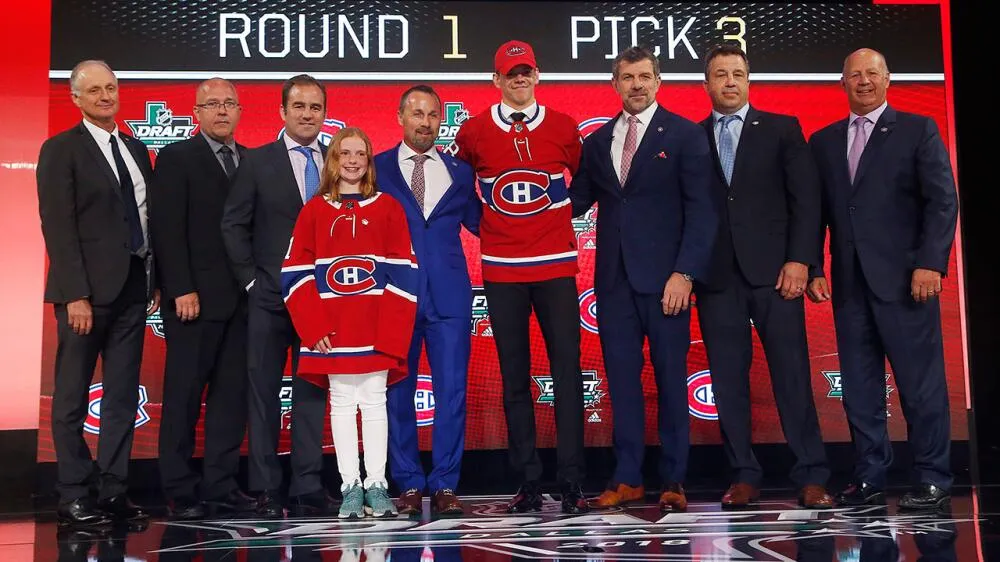
The Montreal Canadiens 2018 NHL Entry Draft analysis: Jesperi Kotkaniemi’s controversial selection
The third overall pick represented Montreal’s highest selection since 2012, and they used it on Finnish center Jesperi Kotkaniemi. The decision shocked many draft analysts who had Kotkaniemi ranked around eighth overall, with several higher-rated prospects still available. The Canadiens prioritized organizational need over pure skill, targeting a defensively responsible center with offensive upside.
Kotkaniemi exceeded expectations by making the NHL roster immediately at 18 years old, posting a respectable rookie campaign with 11 goals and 34 points in 79 games. His two-way play showed promise, and his performance during the 2020 bubble playoffs provided glimpses of his potential. In that shortened postseason, he scored four crucial goals in 10 games, demonstrating composure beyond his years.
However, inconsistency plagued his development. His sophomore season featured injuries and offensive struggles that resulted in a stint with the AHL’s Laval Rocket. While dominating at that level, questions persisted about whether he would fulfill his potential as a true number-one center. His strong 2021 playoff performance—eight points in 19 games including a memorable overtime winner against Toronto in Game 6 of the first round—couldn’t erase concerns about his regular-season production.
The relationship between Kotkaniemi and the organization deteriorated during contract negotiations following his entry-level deal. When restricted free agency arrived, the Carolina Hurricanes offered a revenge offer sheet worth $6.1 million for one year—a direct response to Montreal’s previous offer sheet to Sebastian Aho. The Canadiens declined to match, receiving a first-round and third-round pick as compensation. That first-rounder was immediately flipped to Arizona for Christian Dvorak, a player who ironically filled the two-way center role Montreal had envisioned for Kotkaniemi. While the pick itself was controversial and Kotkaniemi’s development has underwhelmed, he remains an NHL regular with Carolina, validating at minimum his status as an NHL-caliber player even if not a franchise cornerstone.
The Montreal Canadiens 2018 NHL Entry Draft analysis: middle-round gems emerge
Montreal’s success in rounds two and three transformed this draft from respectable to remarkable. With the 35th overall pick, the Canadiens selected Finnish winger Jesse Ylonen, whose speed and vision caught the attention of Finnish scout Hannu Laine. Ylonen spent three seasons developing in North America, becoming one of Laval’s most consistent performers with his ability to drive play through the neutral zone.
Ylonen earned his NHL opportunity in 2022-23, appearing in 37 games and recording 16 points. The following season saw expanded action with 59 games, though he eventually signed with Tampa Bay as a free agent. His development arc demonstrates how prospect evaluation requires patience and proper development pathways, lessons the current Canadiens management has taken to heart.
Three picks later at 38th overall, Montreal made what might be their best value selection of the entire draft. Alexander Romanov, a relatively unknown Russian defenseman, quickly announced his presence by winning the best defenseman award at the 2019 World Junior Championships. Playing as the youngest defender in the KHL for CSKA Moscow demonstrated his advanced development and readiness for professional hockey.
Romanov’s physical, defensive style made him an immediate fan favorite when he joined Montreal for the 2020-21 season. His heavy hits and shutdown ability provided exactly what the blue line needed. However, after two NHL seasons, general manager Kent Hughes included Romanov in a trade package that eventually netted Kirby Dach from Chicago. The Islanders received a punishing defender while Montreal gambled on Dach’s offensive potential as a young power forward center.
The 71st pick yielded another future NHLer in Jordan Harris. The undersized American defenseman chose to play all four years at Northeastern University, developing into a smart, positionally sound defender. There were legitimate concerns Harris might not sign with Montreal, potentially leaving for free agency after his college career. However, new management under Hughes successfully convinced Harris to join the organization, and he made his NHL debut late in the 2021-22 season.
Harris became a regular NHL defender, appearing in 121 games over two seasons with Montreal. His time with the Canadiens concluded when Hughes traded him to Columbus as part of the deal that brought Patrik Laine to Montreal. This transaction exemplifies how even later-round picks can become valuable trade currency when properly developed.
The Montreal Canadiens 2018 NHL Entry Draft analysis: evaluating the depth selections
Beyond the four players who reached the NHL, Montreal’s remaining selections provided varying degrees of value. At 56th overall, the Canadiens grabbed Swedish center Jacob Olofsson, who many considered a first-round talent. The consensus ranking had him around 30th overall, making his availability a surprise. Olofsson represented a safe selection with a high floor, though questions about his offensive ceiling persisted throughout his development.
Cam Hillis followed at 66th overall, the third center selected in this class. The Guelph Storm forward brought defensive responsibility and playmaking ability, fitting the organizational philosophy Timmins outlined at the scouting combine: “We’re looking to add skill, speed, character and work ethic… We want players that can play fast.” Hillis’s selection addressed the dire need for center prospects in a depleted organizational depth chart.
The Canadiens continued their center-focused approach by selecting Allan McShane at 97th overall. The defensively sound Oshawa Generals forward offered safe, predictable production but lacked the high-end offensive upside that might have warranted a swing-for-the-fences selection at that draft position.
Jack Gorniak at 123rd overall represented the type of high-risk, high-reward pick appropriate for the fourth round. The Wisconsin high school standout posted over two points per game and won his team’s scoring title by 26 points. His combination of speed and scoring ability offered the shooter profile Montreal lacked among its passing-oriented prospects. His development at the University of Wisconsin would prove crucial to determining whether he could translate his production against stronger competition.
Cole Fonstad (128th), Samuel Houde (133rd), and Brett Stapley (190th) rounded out the class. Fonstad and Houde fit similar profiles as smaller playmakers with defensive limitations, reminiscent of previous Montreal picks who struggled to overcome size disadvantages at higher levels. Stapley, the traditional seventh-round lottery ticket, headed to the University of Denver with more questions than answers about his NHL potential.
The Montreal Canadiens 2018 NHL Entry Draft analysis: strategic philosophy and execution
The 2018 draft represented a clear organizational shift in Montreal’s approach to talent acquisition. Rather than drafting purely on best player available, Bergevin and Timmins targeted specific profiles that addressed systematic weaknesses. The emphasis on centers—six of 11 picks—directly addressed the organization’s most glaring deficiency in both the NHL roster and prospect pipeline.
The Finnish connection proved particularly fruitful, with scout Hannu Laine identifying both Kotkaniemi, Ylonen, and Romanov. This continued a successful trend that previously brought Artturi Lehkonen to Montreal. The focus on speed and hockey IQ reflected modern NHL trends toward up-tempo, skill-based hockey rather than the grinding, defensive style that had characterized some previous Montreal teams.
Timmins’s pre-draft comments outlined the template: skill, speed, character, and work ethic. Most selections aligned with this philosophy, even if not all reached their potential. The willingness to draft Romanov—a relatively unknown quantity ranked around 184th in consensus rankings—demonstrated confidence in their international scouting network and willingness to trust their evaluations over public consensus.
The balance between safe selections and risk-taking varied throughout the draft. Early picks on Kotkaniemi and Ylonen prioritized upside with acceptable floors. Romanov represented a calculated gamble that paid enormous dividends. Middle rounds mixed safe picks like McShane with higher-ceiling prospects like Gorniak. This diversified approach maximized the probability of finding NHL talent while maintaining opportunities for impact players.
The Montreal Canadiens 2018 NHL Entry Draft analysis: long-term impact and legacy
Seven years removed from draft day, the 2018 class stands as potentially Montreal’s best since the 2007 draft that produced Max Pacioretty and P.K. Subban. Four NHL regulars from a single draft represents an exceptional hit rate. Industry research suggests that drafting two regular NHL players from any draft class qualifies as success—Montreal doubled that expectation.
The ripple effects extend beyond the players themselves. Kotkaniemi’s offer sheet compensation brought Christian Dvorak to Montreal. Romanov’s trade became part of the sequence that landed Kirby Dach, a potential long-term solution at center. Harris’s development and subsequent trade helped acquire Patrik Laine, a proven 40-goal scorer. These secondary transactions demonstrate how even prospects who don’t become franchise cornerstones can generate substantial value when properly leveraged.
From an organizational development perspective, this draft validated several key principles. International scouting networks proved their worth, particularly the Finnish and Russian contacts that identified Kotkaniemi, Ylonen, and Romanov. The willingness to trust internal evaluations over public consensus rankings separated Montreal from teams that draft by committee or public perception.
The emphasis on character and work ethic also manifested in unexpected ways. All four NHL regulars from this class demonstrated professionalism during their Montreal tenures, even when circumstances led to their departures. Kotkaniemi’s offer sheet situation, while disappointing, followed the business realities of restricted free agency. Romanov, Ylonen, and Harris all conducted themselves professionally through trades and decisions beyond their control.
Looking at how the current Canadiens roster benefits from draft decisions, the 2018 class’s impact remains visible even with most selections no longer in the organization. Dach and Laine, acquired partially through assets from this draft, represent key pieces of Montreal’s competitive window. The organizational philosophy established in 2018—prioritizing speed, skill, and character—continues to guide current management’s decision-making.
The draft’s B grade, assigned immediately after the selections, has proven generous yet fair. Montreal identified genuine NHL talent, addressed organizational needs, and created assets that continue generating value. While Kotkaniemi hasn’t become the franchise center some hoped for, and several later picks never reached professional prominence, the overall execution demonstrated competent talent evaluation and strategic thinking. In an NHL where most draft picks never play a single game, producing four regular NHL players from one class represents tangible success that impacts the organization for years afterward.

Par Mike Jonderson
Mike Jonderson is a passionate hockey analyst and expert in advanced NHL statistics. A former college player and mathematics graduate, he combines his understanding of the game with technical expertise to develop innovative predictive models and contribute to the evolution of modern hockey analytics.