







The Montreal Canadiens entered the 2024-25 season with high expectations for Sam Montembeault, their starting goaltender who had delivered a career-best performance the previous year. After posting a 2.82 goals-against average and a .903 save percentage while helping Montreal return to the playoffs for the first time in years, Montembeault earned a spot on Team Canada’s 4 Nations Face-Off roster—a testament to his breakthrough campaign. However, the 2024-25 season has told a dramatically different story, as the 29-year-old netminder has struggled to find his form between the pipes.
Montembeault’s early-season struggles have created an unexpected goaltending controversy in Montreal, with rookie Jakub Dobes seizing the opportunity to establish himself as a legitimate NHL starter. The contrast between the two goaltenders has been stark, forcing head coach Martin St. Louis to navigate a delicate situation while the Canadiens attempt to build on their playoff success. What was supposed to be a season of continued growth for Montembeault has instead become a battle to regain his confidence and reclaim his starting role.
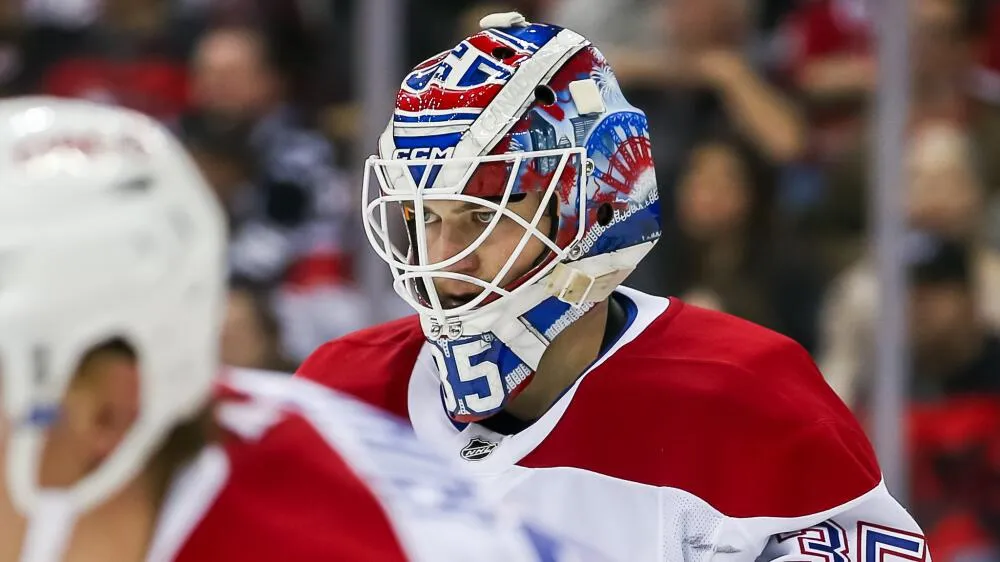
The statistical reality of Montreal Canadiens Sam Montembeault goaltending struggles 2024-25 season
The numbers paint a troubling picture for Montembeault’s 2024-25 campaign. Through his first nine starts, the Quebec native posted a 3.52 goals-against average and an .861 save percentage—a dramatic regression from his stellar 2023-24 performance. His save percentage ranks among the bottom five in the NHL, sitting fourth-worst behind only Calvin Pickard, Cayden Primeau, and Justus Annunen among goaltenders with significant playing time.
Perhaps even more concerning is Montembeault’s performance in advanced metrics, particularly goals saved above expected. With a rating of -4.4, he ranks as the third-worst goaltender in the entire league in this category, which many analysts consider the most accurate measure of goaltending performance. This statistic measures the quality of scoring chances against versus actual goals allowed, indicating that Montembeault is allowing significantly more goals than expected based on shot quality.
The game-by-game breakdown reveals a pattern of inconsistency. Only two games this season has Montembeault allowed fewer than three goals—a victory against the struggling Chicago Blackhawks early in October and a win over Utah during the final game of their lengthy road trip. On four separate occasions, he has surrendered four goals, and in a particularly painful outing against the Edmonton Oilers on October 23, he allowed six goals in a 6-5 loss that epitomized his struggles.
The contrast with his backup could not be more pronounced. While Montembeault has posted a 4-4-1 record with underwhelming statistics, Dobes has emerged as a revelation with a 2.20 GAA and .920 save percentage. The rookie’s acrobatic saves and ability to keep the Canadiens in games has made the decision of which goaltender to start each night increasingly significant—and potentially deflating when Montembeault’s name is announced.
Technical adjustments and Montembeault’s path forward with the Montreal Canadiens
Recognizing his struggles, Montembeault has taken proactive steps to address his technical deficiencies. In late October, the veteran goaltender opened up about specific changes he’s implementing to regain his form. The primary issue he identified was playing too small in the net—shrinking his presence when facing shots and struggling to maintain his positioning through traffic.
“I know what I can do and I’ve worked a lot the last four years to grow my game,” Montembeault explained to reporters. “Obviously not the best start so far, but we’re going to keep working to get to where we were at.” His self-assessment revealed that he had been pulling his hands in front of his body rather than keeping them wide, reducing his effective coverage area in the crease.
The adjustments Montembeault is making focus on fundamental positioning. He has worked extensively with goaltending coaches on his stance, ensuring his blocker and glove remain positioned outside his body frame rather than drawing inward. This seemingly simple change can make a significant difference in a goaltender’s ability to cover the net effectively and react to shots through screens.
During practice sessions, Montembeault has even resorted to studying his reflection in the glass to monitor his positioning. “I actually looked at myself in the glass the last practice,” he said. “Putting my blocker and my glove more outside and try to be more patient.” This attention to detail demonstrates his commitment to addressing the technical issues that have plagued his early-season performances.
The challenge for Montembeault lies in implementing these adjustments during game situations while maintaining his confidence. Technical changes can take time to become second nature, and the pressure of trying to reclaim his starting role while a hot rookie breathes down his neck only complicates the process. His ability to remain patient with himself while accelerating his improvement will be crucial to his success this season, as explored in depth in this analysis of Montreal’s goaltending dynamics.
Martin St. Louis’s confidence amid the Montreal Canadiens Sam Montembeault goaltending struggles 2024-25 season
Despite the concerning statistics, head coach Martin St. Louis has maintained public confidence in his struggling netminder. The coach has emphasized Montembeault’s track record and the importance of not overreacting to a difficult stretch, drawing on his own playing experience to provide perspective on slumps.
“If you ask me if I’m worried, no, I’m not worried,” St. Louis stated firmly. “Sam is a good goalie, he proved it last year. Without Sam, we wouldn’t be here last year. As a player, I’ve had starts like that, and it’s not like I’ve forgotten how to play hockey. Sam is going to be a big part of our success this year.” This public support serves multiple purposes—maintaining Montembeault’s confidence while also signaling to the team that the organization believes in their investment.
St. Louis has emphasized the cyclical nature of goaltending performance, noting that both hot and cold streaks are inevitable over an 82-game season. “I didn’t have a single idea in mind; we have two good goaltenders. Dobes is definitely having a good streak, but Monty is going to have streaks like that, too. We're well equipped in front of the net,” the coach added. This balanced approach acknowledges Dobes’s excellence while keeping the door open for Montembeault’s resurgence.
However, St. Louis’s patience has limits, and his actions speak as loudly as his words. As Montembeault’s struggles continued, the coach increasingly turned to Dobes for crucial games, effectively creating a 1A/1B goaltending situation rather than the clear starter-backup hierarchy that existed at the season’s beginning. This evolution reflects the reality that, while the organization believes in Montembeault’s ability to rebound, results ultimately matter.
The coaching staff has also attempted to provide Montembeault with favorable matchups and opportunities to rebuild his confidence. Games against weaker opponents or teams on the second night of back-to-backs have increasingly gone to the struggling veteran, giving him chances to post positive results without facing the league’s most potent offenses. Whether this strategy proves successful in restoring Montembeault’s form remains to be seen.
Team defensive breakdowns and shared responsibility
While Montembeault’s individual performance has been subpar, it’s important to acknowledge that the Canadiens’ defensive structure has occasionally failed him. Multiple games this season have featured team-wide breakdowns that would challenge even elite goaltenders. Dobes has benefited from stronger defensive efforts in several of his starts, though his ability to make spectacular saves has also helped mask some of the team’s mistakes.
The Canadiens have experienced growing pains defensively as they integrate new systems under assistant coach Jeff Blashill. Early in the season, Montreal showed inconsistency in their defensive zone coverage, leaving Montembeault exposed to high-quality scoring chances. Some of the goals he has allowed came on deflections, screens, or breakdowns that would challenge any netminder in the league.
However, this explanation only goes so far. Advanced metrics that account for shot quality still show Montembeault performing well below expectations, indicating that his struggles transcend the team’s defensive performance. When comparing his results to Dobes’s success behind the same defensive corps, it becomes clear that individual goaltending performance is playing a significant role in the divergent outcomes.
The team’s ability to maintain defensive structure has actually improved as the season has progressed, which should theoretically benefit Montembeault. Montreal’s strong start to the season demonstrates that the defensive system is functional when executed properly. As the Canadiens continue to develop their identity, Montembeault needs to capitalize on improved defensive play rather than pointing to team mistakes as the primary source of his struggles.
The Jakub Dobes factor and goaltending competition
The emergence of Jakub Dobes has completely altered Montreal’s goaltending landscape. The 24-year-old rookie has seized his opportunity with both hands, delivering consistently strong performances that have made him difficult to remove from the net. His .920 save percentage and 2.20 GAA represent not just solid numbers but elite-level goaltending that has many observers mentioning him as an early Calder Trophy candidate.
Dobes’s acrobatic style and ability to make highlight-reel saves has energized the Bell Centre crowd and given the team confidence that they can compete in any game. His performances have also changed the calculus for St. Louis when deciding which goaltender to start. What was supposed to be a clear hierarchy with Montembeault as the undisputed starter has evolved into a genuine competition where Dobes may actually hold the upper hand.
The psychological impact of this situation on Montembeault cannot be understated. Last season, he was the unquestioned starter who carried the team to the playoffs. Now, he finds himself looking over his shoulder at a rookie who is outperforming him significantly. This pressure could either motivate Montembeault to elevate his game or further compound his confidence issues.
For the Canadiens organization, Dobes’s emergence represents both an opportunity and a challenge. Having two capable goaltenders provides depth and insurance, but managing the egos and playing time of netminders is one of hockey’s most delicate tasks. The team must balance giving Montembeault opportunities to regain his form with putting the best possible lineup on the ice each night.
Looking ahead, Montreal’s goaltending future appears bright regardless of how Montembeault’s season unfolds. If he can rediscover his 2023-24 form, the Canadiens will boast one of the league’s strongest goaltending tandems. If he continues to struggle, they have a capable replacement already in the system. However, for a team with playoff aspirations and significant money invested in Montembeault’s contract, the preferred outcome is clear—they need him to find his game.
As Montreal continues its pursuit of consecutive playoff appearances, the goaltending situation remains fluid. The organization’s investment in Montembeault and St. Louis’s public confidence suggest they haven’t given up on their veteran netminder. However, in a results-oriented business, patience has limits. Montembeault’s response to this adversity will define his legacy in Montreal and determine whether the Canadiens’ playoff hopes rest on redemption or replacement.
Frequently Asked Questions

Par Mike Jonderson
Mike Jonderson is a passionate hockey analyst and expert in advanced NHL statistics. A former college player and mathematics graduate, he combines his understanding of the game with technical expertise to develop innovative predictive models and contribute to the evolution of modern hockey analytics.