






The Nashville Predators snapped a frustrating four-game winless streak with a hard-fought 2-1 victory over the Vancouver Canucks at Bridgestone Arena on Thursday night. Cole Smith’s third-period goal proved to be the difference as the Predators improved to 3-3-2 on the season, while goaltender Juuse Saros delivered a stellar 21-save performance to backstop his team to victory. For Vancouver, the loss marked their second consecutive defeat after starting their five-game road trip with three straight wins, and their power play struggles continued to haunt them in crucial moments.
The Canucks completed their road swing with a 3-2-0 record, but the manner of this defeat will leave head coach Rick Tocchet with plenty to address. Playing their fifth game in eight nights, Vancouver appeared fatigued and managed just 15 shots at even strength while being outshot 30-15 in those situations. Only Thatcher Demko’s 33-save effort kept the game within reach, but ultimately it wasn’t enough to secure points in Music City.
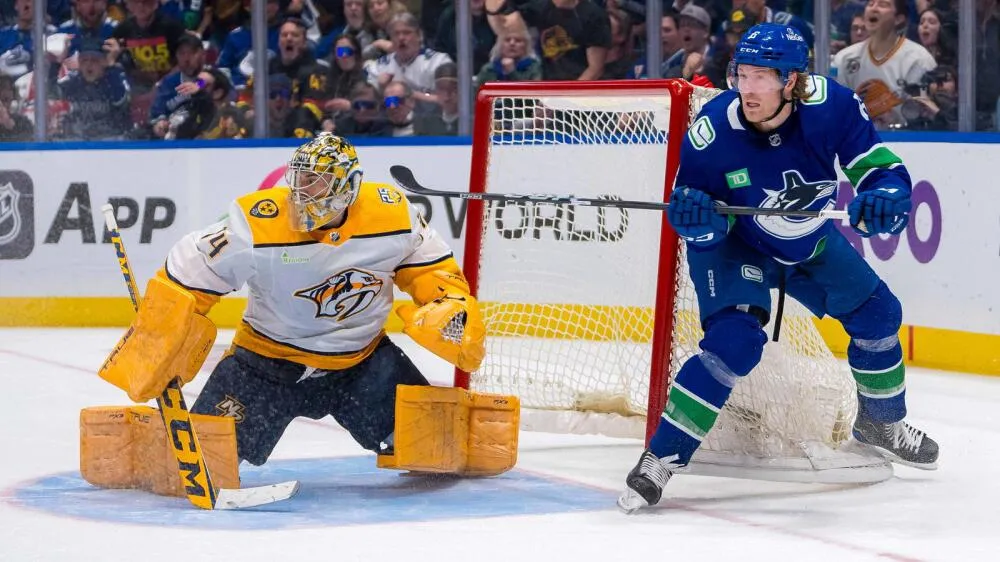
Nashville Predators 2-1 Vancouver Canucks game recap: O’Reilly opens scoring with shorthanded strike
The game remained scoreless through the opening period as both goaltenders stood tall. Ryan O’Reilly broke the deadlock at 9:01 of the second period with a shorthanded marker that exemplified the Predators’ resilience during their recent struggles. O’Reilly capitalized on a short-handed rush opportunity, unleashing a wrist shot from the left circle that beat Demko cleanly for his third goal of the season.
The goal was assisted by Spencer Stastney and came while Nashville was down a man, adding to Vancouver’s growing frustrations with their power play. According to The Hockey News, the Canucks entered the game with their special teams struggling significantly. The shorthanded goal against was their second of the season, highlighting the vulnerability of Vancouver’s man advantage unit.
For O’Reilly, the veteran center continues to prove his worth in his second season with Nashville. His ability to read the play and convert on a rush opportunity demonstrated the hockey IQ that made him such a coveted addition to the Predators’ lineup. The goal energized a home crowd that had watched their team struggle through four consecutive games without a win.
The Predators’ penalty kill unit deserves significant credit for turning defense into offense. Rather than simply trying to survive the Vancouver power play, Nashville applied aggressive pressure that created the turnover leading to O’Reilly’s goal. This aggressive approach on the penalty kill has become a hallmark of the Predators’ identity under their current system.
Nashville Predators 2-1 Vancouver Canucks game recap: Sasson provides spark with tying goal
Max Sasson continued his impressive start to the season by tying the game at 1-1 just 2:48 after O’Reilly’s opener. The 25-year-old forward utilized his speed to create separation from Justin Barron entering the offensive zone, then beat Saros with a wrist shot through the five-hole at 11:49 of the second period. Linus Karlsson earned the assist on the play.
Sasson’s goal was his third in five games this season, an impressive start for the young forward who has seized his opportunity with the big club. His ability to use his skating ability to create offensive chances has made him a difficult player to remove from the lineup, even as injured players prepare to return. The goal showcased his individual skill and confidence, qualities that have defined his early-season success.
The tying goal briefly shifted momentum back toward the visitors, who had been outplayed for much of the period. Sasson’s speed and directness provided exactly the type of spark Vancouver needed after surrendering the shorthanded goal. His recent performance raises questions about roster decisions once the Canucks get healthier, as his production has been too valuable to ignore.
For Nashville, the quick response by Vancouver prevented them from building on their momentum. The goal exposed a defensive breakdown as Barron was beaten wide, allowing Sasson the time and space to pick his spot against Saros. While the Predators would ultimately prevail, the defensive lapse served as a reminder that their game still requires tightening in critical areas.
Nashville Predators 2-1 Vancouver Canucks game recap: Smith’s third-period winner ends drought
Cole Smith emerged as the hero for Nashville, scoring the game-winning goal at 5:09 of the third period to give the Predators a 2-1 lead they would not relinquish. Smith redirected Justin Barron’s shot from the point, with the puck appearing to tick off Demko’s pad before trickling across the goal line. The goal was Smith’s second of the season and proved to be worth its weight in gold for a team desperate to end its winless slide.
The goal came as a result of sustained offensive zone pressure from the Predators, who understood the importance of striking early in the final frame. Barron’s point shot found traffic in front, and Smith did what good role players do—get to the net and create havoc. While Demko got a piece of the puck, he couldn’t prevent it from crossing the line, much to the delight of the Bridgestone Arena faithful.
Nashville’s ability to convert on the Smith goal demonstrated improved execution in key moments. During their four-game winless streak, the Predators had struggled to capitalize on scoring chances, leading to mounting frustration throughout the organization. Smith’s timely contribution provided validation that perseverance and adherence to their system would eventually yield results.
The remainder of the third period saw Nashville adopt a more defensive posture, content to protect their one-goal advantage. Saros made several key saves down the stretch to preserve the victory, showing the poise and technical excellence that has made him one of the league’s premier goaltenders. The Predators blocked shots and cleared rebounds effectively, displaying the type of team defense necessary to close out tight games.
Nashville Predators 2-1 Vancouver Canucks game recap: Canucks’ power play woes continue
Vancouver’s power play struggles remained a glaring weakness in this contest, as the Canucks went 0-for-5 with the man advantage, including a disastrous five-on-three opportunity that lasted 1:30. During that extended two-man advantage, Vancouver managed just one shot on goal, a statistic that perfectly encapsulates their special teams dysfunction. The inability to capitalize on prime opportunities has become a significant concern just eight games into the season.
The Canucks have now converted on just four of their 28 power play opportunities this season while surrendering two shorthanded goals. Those numbers place them among the league’s worst power play units, a particularly troubling development for a team that features offensive talent like Brock Boeser and Quinn Hughes. Too many passes, pucks missing the net, and a general lack of shooting mentality have plagued the unit since the season began.
Rick Tocchet addressed the power play issues in post-game comments, acknowledging that changes need to be implemented quickly. The five-on-three failure particularly stung, as those opportunities typically result in goals at a high percentage. Vancouver’s inability to generate quality chances even with a two-man advantage suggests fundamental issues with their setup and execution rather than simply bad luck.
The power play struggles proved especially costly given how tight the game remained throughout. One conversion on their five opportunities would have likely changed the outcome, but instead, the Predators’ penalty kill units repeatedly shut down Vancouver’s entries and clearance attempts. For the Canucks to achieve their season goals, fixing the power play must become an immediate priority.
Nashville Predators 2-1 Vancouver Canucks game recap: Goaltending battle showcases elite netminding
Both goaltenders delivered outstanding performances in this defensive struggle, with Juuse Saros stopping 21 of 22 shots and Thatcher Demko turning aside 33 of 35. Saros, in particular, made several crucial saves to preserve Nashville’s lead in the final minutes, including a spectacular glove save on Kiefer Sherwood that drew roars from the home crowd. His performance was exactly what the Predators needed to snap their losing streak.
Demko kept Vancouver in the game despite being outshot significantly at even strength. His 33 saves prevented this contest from becoming a lopsided affair, as Nashville generated numerous high-danger chances throughout the night. According to NHL.com, Demko’s performance under heavy workload demonstrated why he remains one of the league’s most reliable starters despite Vancouver’s defensive lapses.
The goaltending duel showcased two netminders operating at the peak of their abilities. Saros continues to be Nashville’s most valuable player, consistently giving his team a chance to win even when the skaters in front of him struggle. His positioning, rebound control, and ability to track pucks through traffic were on full display throughout the evening.
For Demko, the loss doesn’t diminish his individual performance. Playing his fifth game in eight nights while facing 35 shots requires both physical stamina and mental sharpness. The Canucks’ inability to provide adequate goal support left Demko in a difficult position, forced to be nearly perfect to steal a road victory. His efforts kept Vancouver within striking distance throughout, but ultimately the team in front of him couldn’t generate enough offense to reward his stellar play.
Nashville Predators 2-1 Vancouver Canucks game recap: Key storylines and standout performances
Brock Boeser made his return to Vancouver’s lineup after missing two games due to personal reasons, and his presence was felt immediately. The star winger led all players with five shots on goal in 20:59 of ice time, providing the type of offensive threat the Canucks had missed during his absence. His four shots on goal as initially reported showcased his willingness to shoot and create opportunities, though Vancouver couldn’t convert with him on the ice.
Kiefer Sherwood recorded the 990th hit of his NHL career during the contest, edging closer to the 1,000-hit milestone. His physical play has become a trademark of his game, providing Vancouver with an element of toughness and forecheck intensity. Sherwood’s energy and willingness to engage physically created several offensive zone possessions, though the Canucks couldn’t capitalize on the opportunities his work created.
The faceoff circle remained problematic for Vancouver, as they finished below 46% for the seventh time in eight games this season. Dot dominance may not always translate directly to wins, but the Canucks’ consistent struggles in this area limit their possession time and defensive zone efficiency. Nashville’s centers, including O’Reilly, won crucial draws that allowed them to control puck possession in key moments.
Justin Barron factored into both of Nashville’s goals, first getting beaten on the Sasson tally before redeeming himself with the primary assist on Smith’s winner. His point shot that led to the game-winner demonstrated the importance of getting pucks through traffic from the blue line. For a defenseman still establishing himself in the league, Barron’s mixed performance reflected the growing pains typical of young players learning their craft at the NHL level.
The victory moves Nashville to 3-3-2 on the season and provides much-needed relief after a challenging stretch. The Predators showed resilience by weathering Vancouver’s push after Sasson’s goal and demonstrated the defensive structure necessary to protect leads. For a team that entered the night mired in a slump, this victory could serve as the catalyst for building momentum as they navigate the early portion of their schedule.
Vancouver’s road trip concludes with a 3-2-0 record, which in isolation represents a successful journey. However, the manner of these final two defeats, combined with the glaring power play deficiencies, presents legitimate concerns as the Canucks prepare to return home. They’ll host the Montreal Canadiens in a back-to-back weekend series starting Saturday, with limited practice time to address their special teams issues before facing another test.
The Predators will look to build on this victory and string together consecutive wins for the first time this season. Their schedule provides opportunities to climb back toward .500 and establish the type of consistency that has eluded them through the season’s first two weeks. For Vancouver, fixing the power play and finding better defensive structure must take priority as they begin a homestand that could define the trajectory of their season’s opening month.

Par Mike Jonderson
Mike Jonderson is a passionate hockey analyst and expert in advanced NHL statistics. A former college player and mathematics graduate, he combines his understanding of the game with technical expertise to develop innovative predictive models and contribute to the evolution of modern hockey analytics.