







The New Jersey Devils and their fanbase received an early holiday gift this week when ESPN insider Emily Kaplan revealed an optimistic update on Jack Hughes’ recovery timeline. After suffering a freak finger injury that required surgery, the superstar center could potentially return to the lineup by Christmas, though early January remains the more likely scenario. This news provides a much-needed boost for a Devils team that has struggled offensively since losing their leading scorer.
Hughes’ injury occurred when he slipped and fell on a broken piece of glass, resulting in a deep cut on his finger that required immediate surgical intervention. The incident marked the second consecutive season that Hughes has been sidelined by a bizarre accident, following last year’s shoulder injury that ended his campaign prematurely. While the Devils initially projected an eight-week absence, recent reports suggest the damage wasn’t as severe as first feared, opening the door for an earlier-than-expected comeback.
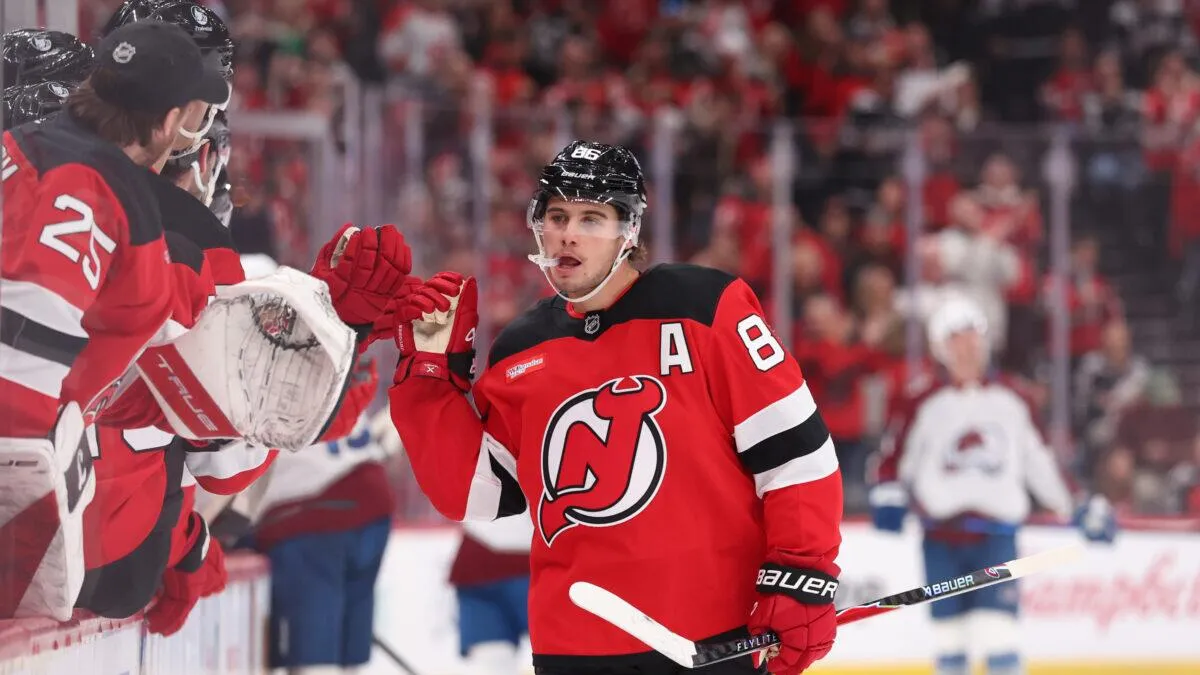
How the injury happened and initial medical outlook
The circumstances surrounding Hughes’ injury highlight the unpredictable nature of professional sports. According to multiple sources familiar with the situation, the 24-year-old center slipped and fell onto broken glass, sustaining a deep gash on his pinky finger. He quickly received stitches for the wound before undergoing successful surgery performed by Dr. Robert Hotchkiss at the Hospital for Special Surgery in New York. While the Devils’ official statement indicated an eight-week recovery period with a re-evaluation scheduled at the six-week mark, sources confirmed that Hughes avoided the worst-case scenario and could have been sidelined for significantly longer.
The initial timeline would have kept Hughes out of action until mid-January, causing him to miss approximately 27 games. Eight weeks from the date of injury points to a potential return around January 11th, when the Devils face the Winnipeg Jets. However, this prognosis was based on standard recovery protocols for such injuries, without accounting for Hughes’ exceptional conditioning and the relatively minor nature of a pinky injury compared to more complex hand or wrist problems. Medical experts note that finger injuries, while painful and requiring careful healing, often allow players to return to full strength more quickly than lower-body or core injuries that affect skating and balance.
What insiders are saying about the accelerated timeline
Multiple sources within the organization have corroborated the optimistic outlook, suggesting that Hughes’ work ethic and the specific nature of his injury create favorable conditions for an expedited return. The fact that it was a simple pinky injury rather than damage to tendons or joints in the hand means Hughes should be able to perform at 100 percent capacity as soon as medical clearance is granted. Unlike shoulder or knee injuries that require extensive rehabilitation to rebuild strength and mobility, finger injuries primarily involve waiting for tissue healing while maintaining overall conditioning.
The Christmas timeline has significant implications beyond just getting their star player back earlier. A return around the holiday break would mean Hughes misses roughly 20 games instead of 27, potentially preserving the Devils’ standing in the ultra-competitive Metropolitan Division. With the team currently sitting atop the division at 12-4-1, maintaining that position through Hughes’ absence becomes paramount. Every game matters in a division where playoff positioning can come down to single points, and having Hughes back even one week earlier could be the difference between home-ice advantage and starting the postseason on the road.
Devils’ offensive struggles highlight Hughes’ irreplaceable value
The stark reality of Jack Hughes’ importance to the Devils’ offense has become painfully clear during his absence. The team has managed just one goal across eight periods of play since Hughes exited the lineup, including a shutout loss to the Florida Panthers where Sergei Bobrovsky needed only a single goal to secure the victory. This scoring drought represents the first time all season the Devils have been held scoreless, exposing just how dependent the offense has become on their star center’s creativity and playmaking ability.
Head coach Sheldon Keefe has scrambled to find line combinations that can generate offense in Hughes’ absence, but the results have been discouraging. Nico Hischier, normally a reliable secondary scorer, has just four goals on the season and has been unable to elevate his game to fill the void. Timo Meier, expected to be a primary offensive weapon, managed only a single shot against the Panthers despite strong board play and physical presence in the middle of the ice. Even Jesper Bratt, who logged 20 minutes and fired six shots on goal, hasn’t been able to translate his efforts into tangible results.
Playoff positioning and Olympic aspirations
Despite the offensive struggles, the Devils have managed to maintain their position atop the Metropolitan Division, a testament to strong goaltending from Jake Allen and a defense that has largely held opponents in check. However, the team cannot afford to slip much further if they hope to secure home-ice advantage throughout the Eastern Conference playoffs. Every point lost during Hughes’ absence makes the path to a deep postseason run more difficult, and the team can only lean on goaltending and defense for so long before the lack of scoring becomes a fatal flaw.
The return timeline also carries implications for international competition. According to Kaplan’s reporting, Hughes is still expected to be named to Team USA’s Olympic roster despite his injury. The Olympics represent a career-defining opportunity for Hughes to showcase his talents on the world stage, and the accelerated recovery timeline ensures he won’t have to choose between his NHL commitments and national team aspirations. A return in late December or early January would give Hughes several weeks to regain his form before Olympic competition begins.
Team USA considerations and roster implications
The possibility that Hughes might return by Christmas could influence Team USA’s roster construction and preparation strategies. National team coaches often build contingency plans around injured star players, but knowing that Hughes should be available and at full strength allows them to focus on integrating him into the system rather than searching for replacement options. His dynamic skill set and experience in high-pressure situations make him an invaluable asset to the American squad, and his presence elevates the team’s medal prospects significantly.
For the Devils, the Olympic break creates an interesting dynamic in Hughes’ recovery timeline. If he returns in early January, he’ll have approximately six weeks of game action to round back into form before the NHL schedule pauses for the Olympics. This period would allow him to rebuild chemistry with linemates while still having the Olympic tournament as a secondary goal to work toward. The timing could prove perfect for Hughes to peak at the right moment for both his country and his club.
Looking ahead: What Hughes’ return means for the new jersey devils
The prospect of Jack Hughes returning to the Devils lineup by Christmas represents far more than just getting a star player back earlier than expected. It signals a potential turning point in a season that has suddenly shown cracks in the foundation despite strong early results. The offensive system built around Hughes’ unique combination of speed, vision, and finishing ability simply cannot function at the same level without him on the ice. His return instantly transforms the Devils from a team struggling to score into one of the most dangerous offensive units in the league.
Head coach Sheldon Keefe will face interesting lineup decisions once Hughes is cleared to play. The chemistry that existed before the injury may need to be rebuilt, and Keefe must determine whether to reunite Hughes with his previous linemates or explore new combinations that emerged during his absence. The team’s power play, which has sputtered without its primary playmaker, should immediately improve with Hughes quarterbacking the top unit. Even at 100 percent health, Hughes may need a game or two to rediscover his timing and rhythm after weeks away from live action.
The bigger picture for New Jersey’s championship aspirations
The Devils’ championship window is officially open, and Jack Hughes stands at the center of their Stanley Cup ambitions. While the team has built impressive depth throughout the roster, there’s no replacing a generational talent like Hughes. His ability to control the pace of play, create scoring chances out of nothing, and elevate the performance of those around him makes him the engine that drives New Jersey’s offense. Getting him back earlier than expected doesn’t just help the team survive his absence—it potentially saves the season from derailing during a critical stretch.
The Metropolitan Division remains one of the NHL’s most competitive, with the New York Rangers, Carolina Hurricanes, and Washington Capitals all capable of putting together extended winning streaks. The Devils cannot afford to tread water for two months and expect to maintain their division lead. Every game without Hughes represents a risk to their playoff positioning and potential home-ice advantage. A Christmas return gives the team a legitimate chance to not just survive this adversity but emerge from it stronger and more determined.
For Hughes personally, this injury represents another frustrating setback in what has otherwise been a career-defining season. He was on pace for career highs across all offensive categories, having already amassed 10 goals and 20 points in just 17 games. The silver lining is that finger injuries typically don’t have long-term effects on performance, and the accelerated timeline suggests he can pick up right where he left off. The Devils’ championship hopes may depend on it.
Frequently Asked Questions

Par Mike Jonderson
Mike Jonderson is a passionate hockey analyst and expert in advanced NHL statistics. A former college player and mathematics graduate, he combines his understanding of the game with technical expertise to develop innovative predictive models and contribute to the evolution of modern hockey analytics.