









The New York Rangers will be without their captain J.T. Miller for at least one contest after the veteran forward suffered an upper-body injury during Saturday’s matinee against the Philadelphia Flyers. Coach Mike Sullivan confirmed Sunday that Miller remained in New York for further evaluation and did not travel with the team to Nashville, where the Rangers face the Predators in the second half of a back-to-back set. The injury occurred late in regulation when Flyers defenseman Nick Seeler delivered a heavy hit that sent Miller awkwardly to the ice, leaving the 32-year-old visibly favoring his right arm or shoulder as he skated directly to the locker room with approximately eight minutes remaining in the game. Despite their captain’s absence, the Rangers mounted an impressive comeback, erasing a two-goal deficit before securing a dramatic 5-4 shootout victory.
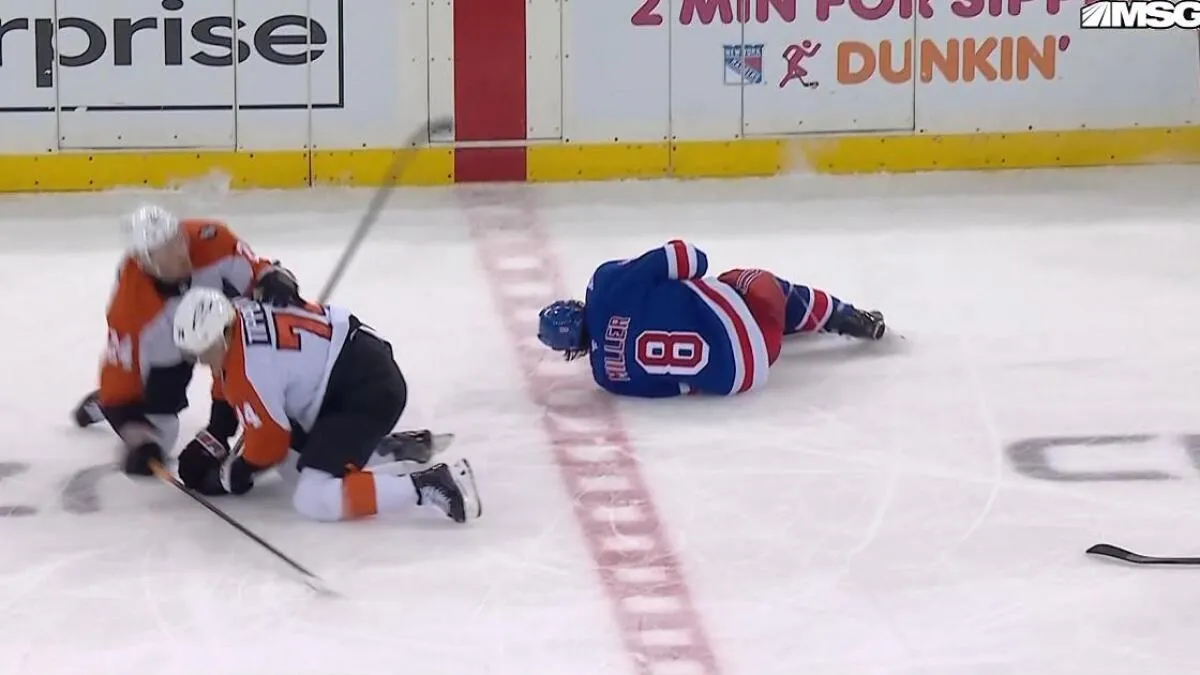
How the New York Rangers captain J.T. Miller upper-body injury occurred
The sequence that sidelined Miller unfolded with roughly nine minutes left in regulation during a tightly contested game at Madison Square Garden. Replays show Miller carrying the puck through the neutral zone when Seeler lined him up for what appeared to be a clean but forceful body check. The impact spun Miller around and caused him to land awkwardly on his right side. Immediately after the play, Miller made his way to the bench cradling his right arm, wincing in visible discomfort before heading down the tunnel for medical attention.
Teammates watched the concerning scene unfold from the bench. “You don’t want to lose any teammates,” center Mika Zibanejad said after the game. “When you see your captain go down and you don’t see him come back that, obviously becomes (a situation) for us to step up and everyone has to do a little more when a guy like that leaves. Just hoping everything is OK.” The Rangers’ medical staff quickly took Miller to the back for evaluation, and he never returned to the contest.
The timing proved particularly challenging for New York, as Miller had been the team’s hero just two nights earlier, scoring the overtime winner against the St. Louis Blues. His absence left a significant void in the lineup, especially during overtime where his two-way play and clutch scoring ability have made him the Rangers’ most reliable weapon. As the game progressed to a shootout, head coach Mike Sullivan had to adjust his typical strategy without his captain available for selection.
Impact on the Rangers’ 2025-26 season trajectory
Miller’s injury comes at a critical juncture for a Rangers team fighting to maintain its position in the competitive Metropolitan Division. The versatile forward has logged heavy minutes in all situations this season, accumulating 10 goals and 12 assists across 35 games while anchoring the team’s top line. His leadership role extends far beyond the score sheet, as he was named captain before training camp and has embraced the responsibility of guiding a roster with Stanley Cup aspirations.
The Rangers have already navigated significant injury challenges this season, most notably losing star defenseman Adam Fox to a shoulder injury that has sidelined him for weeks. The team has struggled defensively in Fox’s absence, surrendering four short-handed goals over the past six contests and showing vulnerability on the penalty kill. Miller’s potential extended absence would test New York’s depth in ways the coaching staff had hoped to avoid during this crucial stretch of the schedule.
Adding another layer of complexity, Miller is widely believed to be under consideration for the U.S. Olympic team that will compete in the upcoming international tournament. His two-way effectiveness, faceoff prowess, and veteran experience make him an attractive candidate for the American squad. However, any significant injury that forces him to miss multiple games could cloud that possibility and potentially jeopardize his selection. The timing proves particularly unfortunate, as Team USA’s management group continues evaluating candidates while the NHL season progresses.
Team response and leadership void
Saturday’s comeback victory showcased the Rangers’ resilience but also highlighted how deeply Miller’s absence was felt throughout the lineup. Artemi Panarin, who scored a crucial goal in regulation, expressed concern for his teammate: “It’s pretty sad that he had to leave the game, but I hope that he’ll be all right.” The sentiment echoed throughout the locker room, where players understand the emotional and tactical impact of losing their leader.
Vincent Trocheck, who scored the first Rangers goal since November 12 and later added the shootout winner, emphasized the importance of the team’s third-period response. “It’s huge for us,” Trocheck said. “The confidence, we need that. We need to know when we’re down a couple goals, we can still make it a game and come back. It was nice to see the resilience of our team.” That resilience will need to become a defining characteristic if Miller misses extended time.
Coach Sullivan spoke about the mental toughness required to overcome both on-ice adversity and the loss of a key player. “It requires a certain mental toughness, just the ability to shrug things off… We talk with the guys a lot about having a next shift mindset or next play mindset. Just staying in the moment and as long as we have that, you see what you saw in the third period.” That philosophy will be tested repeatedly as the Rangers await clarity on their captain’s condition.
What the injury means for upcoming Rangers games
With Miller remaining in New York for evaluation while the team traveled to Nashville, the Rangers face immediate questions about their lineup construction for Sunday’s game against the Predators. Sullivan was noncommittal about any potential recall from the AHL, suggesting the team would first assess its existing roster options before making external moves. The Rangers have several forward candidates who can absorb additional minutes, but none can truly replicate Miller’s unique combination of physical play, offensive creativity, and defensive responsibility.
The timeline for Miller’s return remains deliberately vague, with the organization using the “at least one game” designation while awaiting comprehensive medical imaging. Upper-body injuries can range from minor contusions to more serious shoulder separations or broken bones, making the evaluation process critical to determining an accurate recovery window. The Rangers have historically been cautious with their captain, particularly given his importance to both the current roster and the franchise’s long-term plans.
For now, the team must prepare for the possibility of multiple games without Miller, beginning with the difficult matchup in Nashville. The Predators present a formidable challenge with their aggressive forechecking and strong defensive structure, areas where Miller’s two-way acumen typically proves invaluable. His absence places additional pressure on Zibanejad, Panarin, and the Rangers’ other top forwards to drive offense while maintaining defensive discipline.
Long-term implications for New York Rangers playoff positioning
Beyond the immediate game-to-game adjustments, Miller’s injury could significantly impact the Rangers’ standing in the Metropolitan Division race. New York entered Sunday’s action positioned in the thick of the playoff picture, but the division features several elite teams capable of creating separation. Every point becomes precious in this environment, and losing a player who contributes in all situations for any extended period creates a substantial challenge.
The Rangers’ forward depth will face its sternest test yet, with players like Alexis Lafrenière and Kaapo Kakko needing to elevate their production to compensate for Miller’s missing offense. The coaching staff may also need to adjust special teams units, as Miller plays prominent roles on both the power play and penalty kill. His faceoff prowess—particularly in defensive zone situations—represents another tangible loss that affects the team’s ability to control possession in critical moments.
Management’s approach to the trade deadline could also be influenced by this injury situation. If Miller’s recovery extends beyond a week or two, general manager Chris Drury might be forced to accelerate his timeline for adding forward depth. The Rangers have been linked to various trade targets around the league as they seek to build a championship-caliber roster, and an injury to a core player often clarifies organizational priorities when evaluating potential acquisitions.
The Nick Seeler hit and player safety considerations
While the hit from Seeler appeared clean upon initial review, the play reignites ongoing discussions about player safety and how the league handles collisions that result in injuries. Seeler has no reputation as a dirty player, and the check seemed to be a textbook example of finishing a play within the rules. However, the unfortunate outcome serves as a reminder of hockey’s inherent physicality and the fine line between clean hits and dangerous plays.
The NHL’s Department of Player Safety typically reviews all plays resulting in injury, though supplemental discipline seems unlikely given the clean nature of the hit. Miller’s positioning and the suddenness of the impact contributed to the awkward landing, factors that often mitigate responsibility for the delivering player. Still, the Rangers organization will likely review the play internally to determine if Miller could have better protected himself in that situation.
This incident also highlights the importance of proper technique when absorbing contact. Players at all levels are taught to keep their heads up and anticipate hits, but the speed of the modern game sometimes makes that impossible. The Rangers’ coaching staff may use this as a teaching moment for younger players about situational awareness and how to minimize injury risk when navigating through high-traffic areas of the ice.
New York Rangers captain J.T. Miller upper-body injury: Road to recovery and return
As Miller undergoes evaluation back home, the Rangers will implement their standard injury management protocol, which includes input from team physicians, specialists, and the player’s own feedback about his condition. The organization has invested heavily in its medical and training staff, recognizing that proper diagnosis and rehabilitation are crucial to preventing recurring issues. For a player of Miller’s age and importance, the team will almost certainly take a conservative approach rather than rushing him back before he’s fully healed.
The recovery timeline will depend heavily on the specific nature of the injury. If Miller escaped with nothing more than a stinger or deep bruise, he could potentially return within a few games. More significant soft tissue damage might require 2-3 weeks of recovery, while any structural damage could extend his absence to a month or longer. The Rangers have no incentive to push their captain given the season’s length and the ultimate goal of peaking for the Stanley Cup playoffs.
Teammates and coaches alike expressed optimism that Miller’s injury won’t keep him sidelined long-term, though they acknowledged the uncertainty inherent in the situation. The Rangers’ ability to stay competitive during his absence will play a significant role in determining how patient the organization can afford to be with his recovery. A winning streak would allow the medical staff to be extra cautious, whereas struggling might create pressure to accelerate the timeline.
New York Rangers captain J.T. Miller upper-body injury out for at least one game: What it means for the championship picture
The Rangers entered the season with legitimate Stanley Cup aspirations, and those hopes remain intact even as they navigate this injury setback. Championship teams inevitably face adversity over an 82-game schedule, and how they respond to losing their captain will reveal much about the group’s character. Saturday’s comeback victory provided an encouraging first data point, showing the roster can dig deep when circumstances demand it.
The organization’s depth will be tested in ways it hasn’t yet this season. Every player must elevate his game to fill the collective void left by Miller’s absence. Young players like Brennan Othmann, who showed fight by battling Nicolas Deslauriers after the hit, demonstrated the competitive spirit that championship runs require. Those contributions become even more vital when star players are unavailable.
Ultimately, Miller’s injury serves as an early-season crucible for these Rangers. How they navigate the next several games without their leader will either strengthen their resolve or expose vulnerabilities that must be addressed before the playoff push begins in earnest. The team’s response to this challenge may ultimately prove more important than any single injury’s impact on the standings.
Internal links:
- New York Rangers rally past Philadelphia Flyers 5-4 shootout with J.T. Miller injury comeback effort
- J.T. Miller’s captaincy struggles: New York Rangers captain underperforming in 2025-26 season
External links:
- ESPN: Rangers captain Miller out with upper-body injury
- Associated Press via Yahoo Sports: Rangers captain J.T. Miller won’t play at the Predators because of injury
Frequently Asked Questions

Par Mike Jonderson
Mike Jonderson is a passionate hockey analyst and expert in advanced NHL statistics. A former college player and mathematics graduate, he combines his understanding of the game with technical expertise to develop innovative predictive models and contribute to the evolution of modern hockey analytics.