






The New York Rangers balanced lineup first time this season has finally become a reality, and it couldn’t have come at a better moment. After struggling through a historically poor start at Madison Square Garden and watching their offensive production plummet to near-bottom of the league standings, the Blueshirts secured a critical piece of their puzzle. The return of Vincent Trocheck from injury, combined with the promotion of highly-touted prospect Gabe Perreault from Hartford, has given head coach Mike Sullivan the depth and flexibility he desperately needed to construct a competitive roster from top to bottom.
This newfound balance represents more than just getting healthy bodies back on the ice. It’s about restoring the natural order of a lineup that was forced to operate with square pegs in round holes for far too long. Players who excel in bottom-six roles were thrust into top-six responsibilities, while Mika Zibanejad was shoehorned back to center when Sullivan’s original plan called for him to play wing. The ripple effects of these adjustments manifested in the Rangers’ abysmal offensive output, ranking 28th in the NHL with just 41 goals through their first stretch of games. Now, with every player slotting into their appropriate role, the Rangers have a legitimate chance to turn their season around.
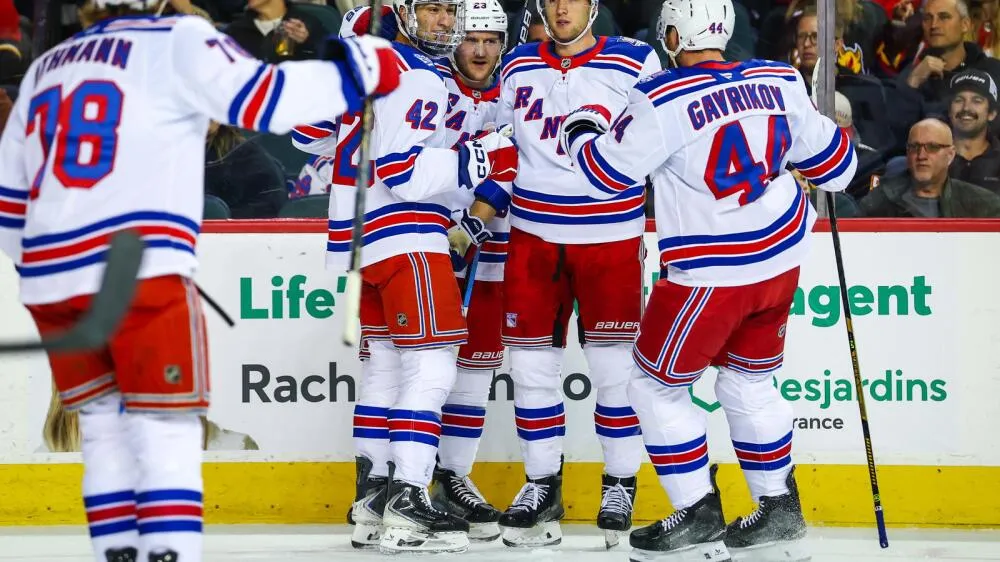
Vincent Trocheck’s return anchors the New York Rangers balanced lineup first time this season
Vincent Trocheck’s absence loomed larger than anyone anticipated when he went down with an upper-body injury after playing just one and a half games. The veteran center missed 14 consecutive contests, and during that span, the Rangers’ offensive structure crumbled. His return to the lineup marked a watershed moment, allowing Sullivan to finally deploy the configuration he envisioned from day one.
Back on his familiar line with Artemi Panarin and Alexis Lafrenière, Trocheck wasted no time making an impact. In the 6-3 victory over the Nashville Predators that ended the Rangers’ dreadful 0-6-1 home start, this line accounted for eight points, with Trocheck contributing two assists. The chemistry was instantaneous, a reminder of why this trio has been so effective when healthy.
Beyond his offensive contributions, Trocheck’s value extends to both special teams units. He’s a crucial component of the power play, providing net-front presence and creating chaos in high-danger areas. On the penalty kill, his defensive acumen and faceoff prowess make him indispensable. The Rangers’ special teams struggled mightily in his absence, and his return should stabilize both units moving forward.
The cliché holds true: you don’t know what you have until it’s gone. Trocheck’s injury forced the coaching staff to make uncomfortable adjustments that cascaded throughout the entire lineup. His return doesn’t just fill one hole—it fixes multiple roster problems simultaneously, allowing every forward to play at their optimal position.
Gabe Perreault’s promotion completes the top-six puzzle
The call-up of Gabe Perreault from the Hartford Wolf Pack represented the final piece needed to achieve the New York Rangers balanced lineup first time this season. The 2023 first-round pick had been tearing through the American Hockey League, registering five goals and 10 points in nine games. His performance demanded recognition, and the Rangers’ desperate need for offensive firepower created the perfect opportunity.
Immediately slotted onto the top line with Zibanejad and J.T. Miller, Perreault announced his presence in his NHL debut. He hit the post in the first period, narrowly missing what would have been a storybook first goal. Undeterred, he followed up with a beautiful setup to Lafrenière on the power play in the second period, earning his first NHL point. The 19-year-old looked comfortable against NHL competition, displaying the vision and playmaking ability that made him such a coveted prospect.
Perreault’s skill set fills a specific need in the Rangers’ top six. His ability to distribute the puck and create offensive chances provides another dimension to a forward group that has struggled to generate consistent scoring. While he’s still developing physically and learning the nuances of the professional game, his hockey IQ and offensive instincts are NHL-ready.
The Rangers have invested significant draft capital in young forwards, and Perreault’s emergence could signal the start of a youth movement that revitalizes the roster. If he can maintain his performance level and prove he deserves to stay in the NHL for the remainder of the season, it will benefit both his development and the team’s immediate playoff aspirations. His success directly correlates to team success—a rising tide that could lift all boats.
Bottom-six forwards settle into appropriate roles with New York Rangers balanced lineup first time this season
Perhaps the most underrated benefit of finally achieving a balanced lineup is what it means for the Rangers’ depth forwards. Players like Connor Sheary and Taylor Raddysh, who were asked to shoulder top-six responsibilities during the injury crisis, can now return to roles where they’re most effective. These are solid NHL players, but expecting them to drive offense consistently in premium minutes sets them up for failure.
With Trocheck and Perreault anchoring the top six, Sheary and Raddysh slide down to more manageable third and fourth-line assignments. They face softer competition, deploy in different game situations, and can focus on the gritty, detail-oriented hockey that makes bottom-six units successful. The defensive responsibilities remain, but the pressure to produce offense diminishes significantly.
Will Cuylle represents an interesting case study in this restructured lineup. While capable of playing top-six minutes—and having done so effectively at times—his placement on the third line creates favorable matchup advantages. He’ll draw easier defensive assignments while maintaining his physical, forechecking style of play. This positions him to be even more productive than if he were playing higher in the lineup against tougher competition.
The Rangers’ forward depth extends beyond the current roster. Healthy scratches like Juuso Parssinen and Johnny Brodzinski provide insurance against future injuries. This organizational depth is characteristic of legitimate Stanley Cup contenders. Teams need 15 capable forwards, not just 12, and the Rangers finally have that luxury. When Matt Rempe returns from his long-term injury, Sullivan will have even more options to mix and match based on opponent or game situation.
Mike Sullivan’s lineup experimentation throughout the season
Before achieving balance, Sullivan spent weeks trying different combinations in search of offensive chemistry. The coaching staff experimented extensively, including a notable attempt to separate Panarin and Zibanejad in late October. That configuration placed J.T. Miller alongside Panarin, with Raddysh on the top line, while Zibanejad centered a second unit with Lafrenière and Sheary.
The “kid line” concept emerged during this experimental phase, featuring Cuylle, Noah Laba, and Brennan Othmann together. This trio represented an investment in youth and energy, though results were inconsistent. Othmann, recently called up from Hartford with something to prove, brought desperation and compete level to his game. Laba and Cuylle, both searching for offensive rhythm, showed flashes without sustained production.
Sullivan’s fourth line has remained relatively stable throughout these changes. Sam Carrick and Adam Edström have developed chemistry playing together almost exclusively. When Rempe went down with an upper-body injury, Parssinen filled the void. This line prioritizes defensive responsibility and energy over offensive production, though Carrick has shown surprising finishing ability when given chances.
The constant shuffling wasn’t ideal, but it was necessary given the circumstances. Sullivan needed to find combinations that could generate offense while the team’s offensive leaders struggled. Some experiments showed promise; others fell flat. The silver lining is that Sullivan now understands which players work well together and which combinations should be avoided moving forward.
Road warriors meet home disappointment in early season split
Despite the organizational chaos and lineup instability, the Rangers entered this period with an intriguing split personality. Their 7-1-1 road record demonstrated they could compete and win away from Madison Square Garden, while their 0-6-1 home mark represented a historic embarrassment. The six total goals scored in those first seven home games highlighted the offensive drought plaguing the team.
The victory over Nashville that broke the home losing streak felt like a cathartic release. Scoring six goals in a single game doubled their previous home output for the entire season. The fans who had endured weeks of frustration finally had something to celebrate, and the players visibly relaxed after shedding that burden. Sometimes, a team just needs one breakthrough performance to remember how to win.
The standings remain competitive despite the early struggles. Tied in points with the wild-card teams at 18, the Rangers sit just five points behind first place in the Metropolitan Division. Their road success has kept them within striking distance, preventing the season from spiraling into disaster. If they can translate that road form to home ice now that they have a balanced roster, they’re well-positioned to make a playoff push.
The Metropolitan Division’s competitiveness works in the Rangers’ favor. Unlike other divisions where one or two teams dominate, the Metro features several clubs bunched together in the standings. A modest winning streak could vault the Rangers from playoff bubble to divisional contender. Conversely, continued struggles could see them fall out of the picture entirely. The next 20 games will define their season trajectory.
Looking ahead with the New York Rangers balanced lineup first time this season
The true test begins now. Having finally assembled the lineup Sullivan envisioned, the Rangers must prove these changes translate to sustainable success. One victory over Nashville, no matter how convincing, doesn’t erase the systematic problems that plagued the season’s first six weeks. The team needs to build consistency, string together wins, and establish an identity beyond being merely a good road team.
Health remains the biggest variable. The Rangers built their balanced lineup on the assumption that Trocheck stays healthy and Perreault continues developing. Any additional injuries to key forwards could send them spiraling back into the chaos they just escaped. Depth helps mitigate this risk, but there’s only so much shuffling a roster can withstand before it impacts performance.
The offensive production must improve league-wide for this balance to matter. Ranking 28th in goals scored is unacceptable for a team with playoff aspirations, regardless of lineup configuration. Stars like Panarin, Zibanejad, and Miller need to elevate their games. Secondary scoring from players like Lafrenière, Cuylle, and now Perreault must materialize consistently. If the goals don’t come, lineup balance becomes academic.
The Metropolitan Division race promises to be fierce, with multiple teams vying for playoff positioning. The Rangers possess the talent and depth to compete with anyone when firing on all cylinders. Whether they can maintain the New York Rangers balanced lineup first time this season and build momentum from this point forward will determine if they’re playoff contenders or pretenders. The pieces are finally in place—now it’s time to prove they fit together as seamlessly as hoped.

Par Mike Jonderson
Mike Jonderson is a passionate hockey analyst and expert in advanced NHL statistics. A former college player and mathematics graduate, he combines his understanding of the game with technical expertise to develop innovative predictive models and contribute to the evolution of modern hockey analytics.