




The definitive ranking of NHL all time goal leaders
The pursuit of goals has defined hockey’s greatest players for generations. Every snap of the wrist, every perfectly timed one-timer, and every clutch overtime winner contributes to a legacy that transcends individual games and seasons. In April 2025, the hockey world witnessed history when Alex Ovechkin finally surpassed Wayne Gretzky’s seemingly untouchable mark, cementing his place atop the most prestigious individual record in professional hockey. Understanding the NHL all time goal leaders requires examining not just the numbers, but the eras, playing styles, and sheer determination that separated these legends from their peers.
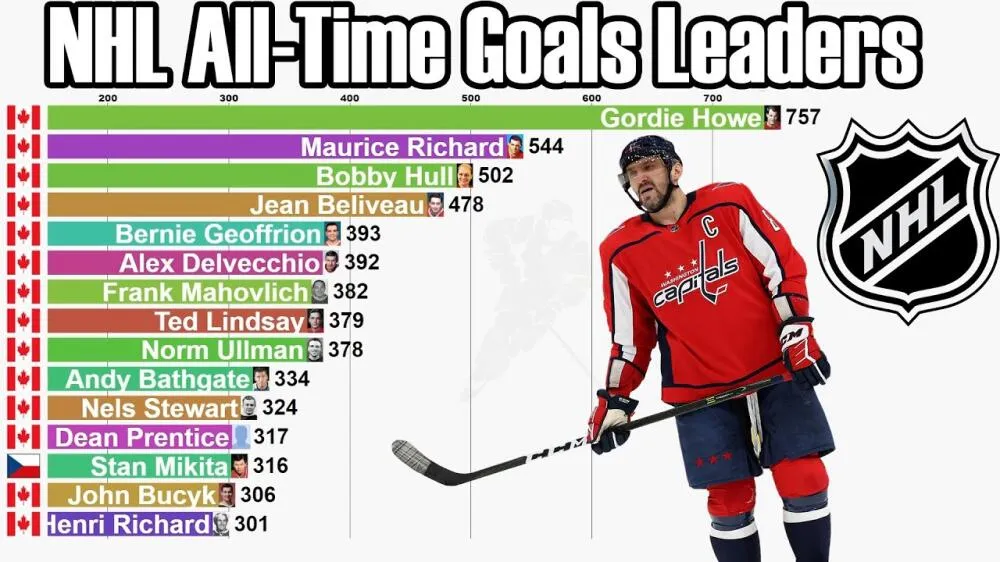
The new king: Alex Ovechkin’s historic achievement in NHL all time goal leaders
Alexander Ovechkin’s ascent to the top of the NHL all time goal leaders list represents one of the most remarkable achievements in sports history. On April 6, 2025, the Washington Capitals captain scored his 895th career goal against the New York Islanders, breaking Wayne Gretzky’s record that had stood for nearly three decades. The Russian superstar now sits at 898 goals and counting, with no signs of slowing down as he enters the twilight of his career.
What makes Ovechkin’s accomplishment even more impressive is the era in which he achieved it. Modern defensive systems, improved goaltending equipment, and the evolution of shot-blocking techniques have made goal-scoring significantly more difficult than in previous generations. Yet Ovechkin maintained an elite scoring pace throughout his career, averaging more than 0.60 goals per game over 1,497 NHL contests.
The Great Eight’s signature weapon has always been his devastating one-timer from the left circle on the power play. This shot, which goalies have studied for nearly two decades, remains nearly unstoppable when Ovechkin gets it off cleanly. His ability to find space in what became known as “Ovechkin’s office” demonstrates not just physical skill but hockey intelligence that allowed him to adapt his game as defenses focused increasingly on stopping him.
After breaking the record, Ovechkin admitted to having doubts along the way. The 2020-21 shortened season and a fractured leg in 2024 threatened to derail his chase, but his determination never wavered. Wayne Gretzky himself was present for the historic moment, later stating, “I’m not sure who’s going to get more goals than that,” a testament to the magnitude of Ovechkin’s achievement.
Ovechkin’s journey to the top exemplifies consistency and durability. Unlike some scorers who burned bright but briefly, the Capitals captain maintained elite production for two full decades. His 52-goal season at age 39 in 2024-25 proved that even as Father Time catches up, his goal-scoring instincts remain sharp enough to compete with players half his age.
Wayne Gretzky: The Great One’s enduring legacy among NHL all time goal leaders
Wayne Gretzky held the NHL all time goal leaders position for 28 years after surpassing Gordie Howe in 1994. His 894 career goals seemed untouchable for nearly three decades, a record many believed would never fall. What makes Gretzky’s goal-scoring achievement even more remarkable is that goals represent only a fraction of his offensive dominance—he is still the all-time leader in assists and total points by margins that may truly never be surpassed.
Playing primarily in the high-scoring 1980s and early 1990s, Gretzky revolutionized offensive hockey with his supernatural vision and anticipation. He didn’t possess a powerful shot like Ovechkin or Bobby Hull, but his ability to see plays develop before anyone else allowed him to find scoring chances others couldn’t imagine. His 92-goal season in 1981-82 remains a single-season record that appears utterly unbreakable in the modern NHL.
Gretzky scored his goals across 1,487 games with four different teams—the Edmonton Oilers, Los Angeles Kings, St. Louis Blues, and New York Rangers. His versatility and consistency across different systems and linemates demonstrated that his success wasn’t system-dependent but rather a product of generational talent. Even as he aged and lost a step physically, his hockey IQ allowed him to remain an elite scorer into his late thirties.
The Great One’s graciousness in passing the torch to Ovechkin has been a highlight of this historic chase. Rather than showing bitterness about losing his record, Gretzky has been Ovechkin’s biggest cheerleader, recognizing the difficulty of the achievement and the respect it deserves. This sportsmanship has added a touching human element to one of hockey’s greatest statistical races.
Gretzky’s 894 goals came with remarkable efficiency, requiring fewer games than any other player in the top five of the NHL all time goal leaders. His goals-per-game average of 0.601 trails only Ovechkin among the top goal scorers, highlighting that despite playing in a higher-scoring era, his production still required exceptional talent and consistency.
Mr. Hockey: Gordie Howe’s unmatched longevity in NHL all time goal leaders history
Gordie Howe’s 801 career goals stood as the NHL’s all-time record for nearly two decades until Gretzky surpassed him in 1994. What makes Howe’s achievement particularly astounding is the era in which he played and the physical toll he endured. Playing in the six-team NHL and later through expansion, Howe faced elite competition every single night while playing a punishing two-way game that would be considered brutal by modern standards.
Howe’s career spanned an incredible 26 NHL seasons from 1946 to 1971 with the Detroit Red Wings, followed by a brief stint with the Hartford Whalers in 1979-80. His longevity remains unmatched—he played professional hockey across five different decades, competing against players young enough to be his children and, in some cases, his grandchildren. His durability and consistency allowed him to accumulate goals at a steady pace year after year.
Unlike pure goal scorers, Howe was the prototypical power forward before the term existed. Standing 6-foot and weighing 205 pounds, he combined offensive skill with physical dominance and an edge that kept opponents honest. His ability to score, pass, and defend while also dropping the gloves when necessary made him the most complete player of his generation.
Howe’s 801 goals came across 1,767 NHL games, reflecting both the longer nature of careers in his era and his remarkable ability to avoid serious injury. In an age without modern sports medicine, nutrition science, or training techniques, Howe’s consistency speaks to both natural durability and an exceptional work ethic. He proved that longevity could be just as valuable as peak performance in climbing the NHL all time goal leaders list.
The respect Howe commanded from multiple generations of players cemented his “Mr. Hockey” nickname. Players who competed against both Howe and later stars consistently cited him as one of the toughest and most skilled opponents they ever faced, regardless of his age.
The European legends: Jaromir Jagr and his place among NHL all time goal leaders
Jaromir Jagr’s 766 career goals place him fourth on the NHL all time goal leaders list, and his achievement carries special significance as the highest-scoring European-trained player in league history. The Czech legend’s career spanned an incredible 24 NHL seasons with nine different teams, demonstrating adaptability and longevity that few players have matched. Jagr played his final NHL game at age 45, still producing at a respectable level.
What separated Jagr from other elite scorers was his unique combination of size, strength, and skill. At 6-foot-3 and 230 pounds, he used his powerful frame to protect the puck along the boards and in front of the net like few offensive players could. His signature move—shielding the puck with his body while controlling it one-handed—became nearly impossible to defend and allowed him to create scoring chances from seemingly nothing.
Jagr’s goal-scoring production remained remarkably consistent throughout his lengthy career. He scored 20 or more goals in 17 different seasons and led the NHL in goals five times. Unlike players who peaked early and faded, Jagr maintained elite production into his forties through obsessive fitness routines and an unmatched work ethic. Stories of his postgame workouts and dedication to conditioning became legendary among teammates.
The Czech superstar’s impact extended beyond his individual achievements. He paved the way for European players in the NHL, proving that international talents could not only compete but dominate in North America. His success influenced generations of European players who followed, from Ovechkin to Patrik Laine to Auston Matthews (whose mother is Swiss, giving him dual citizenship).
Jagr’s career earnings and continued playing in various leagues worldwide after leaving the NHL demonstrated his pure love for the game. Even after accomplishing everything possible in professional hockey, he continued chasing pucks into his fifties, playing in the Czech league and maintaining a level of fitness that put younger players to shame.
The Golden Brett: Brett Hull’s shooting prowess in NHL all time goal leaders rankings
Brett Hull’s 741 career goals place him fifth among the NHL all time goal leaders, and many historians argue he possessed the purest shot in hockey history. The son of legendary Bobby Hull, Brett carved out his own distinct legacy with a release so quick and accurate that goalies often couldn’t track the puck until it was already in the net. His shooting technique became the subject of study for generations of young players trying to emulate his success.
Hull’s career took a unique path compared to other elite goal scorers. After being selected in the sixth round of the 1984 draft by the Calgary Flames, he struggled initially to find his role before exploding offensively with the St. Louis Blues. From 1989 to 1992, Hull scored 228 goals in just 244 games, including consecutive seasons of 72, 86, and 70 goals—a three-year stretch of goal-scoring dominance matched by few in NHL history.
What made Hull’s scoring ability particularly dangerous was his positioning and anticipation. He had an uncanny ability to find soft spots in defensive coverage and get his stick free for shots. Nicknamed “The Golden Brett,” he didn’t need much space or time—a few inches and a fraction of a second were enough for him to unleash a shot that goalies had little chance of stopping.
Hull’s career spanned 1,269 games with five different teams—Calgary, St. Louis, Dallas, Detroit, and Phoenix. He won two Stanley Cups, including the controversial 1999 championship with Dallas where his Cup-winning goal came with his skate in the crease, sparking debates that continue to this day. Regardless of the controversy, his playoff performances proved he could score when championships were on the line.
Beyond his on-ice accomplishments, Hull’s personality and outspokenness made him one of hockey’s most entertaining figures. His willingness to speak candidly on various hockey topics, from rules to league management, earned him both fans and critics but never diminished respect for his goal-scoring abilities.
The evolution of goal scoring and what it means for future NHL all time goal leaders
The nature of goal-scoring in the NHL has evolved dramatically throughout the league’s history, making direct comparisons between eras challenging but fascinating. In the 1980s, when Gretzky dominated, teams regularly scored five or six goals per game. By contrast, modern NHL games often feature final scores of 3-2 or even 2-1, with defensive systems and goaltending equipment creating a significantly lower-scoring environment.
Ovechkin’s achievement of topping the NHL all time goal leaders in this defensive era amplifies the impressiveness of his record. Modern goalies wear equipment that covers nearly every inch of the net when properly positioned, and defensive systems like the neutral zone trap and shot-blocking culture have made clean shooting lanes harder to find than ever before. The fact that Ovechkin maintained elite goal-scoring rates despite these obstacles speaks to his adaptability and skill.
The power play has become increasingly important in modern goal-scoring, with the best players accumulating significant portions of their goals with the man advantage. Ovechkin has scored over 300 power-play goals, using his position in the left circle to devastating effect. This specialization represents a shift from earlier eras when power-play production was more evenly distributed among forward lines.
Looking forward, the question becomes whether anyone will challenge Ovechkin’s record. Young stars like Auston Matthews and Connor McDavid possess elite goal-scoring ability, but maintaining that level for 20 seasons while avoiding serious injury represents a monumental challenge. The physical demands of the modern game and the compressed schedules make longevity harder to achieve than in previous generations.
Analytics and sports science have also changed how goal-scoring is approached and evaluated. Teams now track shot quality, expected goals, and dozens of other metrics that weren’t available to previous generations. This data-driven approach has influenced everything from shot selection to line combinations, potentially impacting how future stars will accumulate goals compared to the current NHL all time goal leaders.
The NHL all time goal leaders represent hockey’s most elite fraternity, a collection of players who combined skill, durability, and an unrelenting drive to light the lamp. From Gordie Howe’s punishing power-forward style to Wayne Gretzky’s supernatural anticipation to Alex Ovechkin’s unstoppable shot, each generation has produced goal scorers who defined their eras. Ovechkin’s ascension to the top of this historic list represents the culmination of a nearly two-decade pursuit that captivated hockey fans worldwide.
As the game continues to evolve, future players will chase Ovechkin’s record just as he pursued Gretzky’s. Whether anyone can match his combination of elite skill, remarkable health, and sustained excellence remains to be seen. For now, hockey fans can appreciate that they witnessed one of sport’s greatest records fall to a player whose dedication to his craft never wavered. The Great Eight’s legacy as the NHL’s all-time leading goal scorer will inspire generations of young players to perfect their shots and dream of joining this exclusive club of hockey immortality.

Par Mike Jonderson
Mike Jonderson is a passionate hockey analyst and expert in advanced NHL statistics. A former college player and mathematics graduate, he combines his understanding of the game with technical expertise to develop innovative predictive models and contribute to the evolution of modern hockey analytics.