





The upcoming NHL draft season is officially underway, and scouts across the league are already circling their calendars for June 2026. This draft class features a unique blend of elite talent, with several prospects making the jump to NCAA hockey following recent rule changes that allow Canadian Hockey League players to compete collegiately. The 2026 NHL draft brings a compelling mix of dynamic forwards, physically imposing power players, and a deep pool of right-handed defensemen that has NHL front offices salivating. With the season now in full swing across multiple leagues including the NCAA, CHL, and European circuits, it’s time to examine the prospects who could hear their names called early next summer.
From Whitehorse to State College, and from Windsor to Stockholm, this year’s top prospects are already making their mark. NHL Central Scouting recently released its preliminary players to watch list, identifying 27 A-rated prospects considered potential first-round selections. The quality and depth of this class suggests that teams finishing near the bottom of the standings could land franchise-altering talent, particularly if they’re in need of premium defensemen or skilled forwards with size.
The undisputed leader among NHL draft 2026 top prospects to watch
Gavin McKenna has been the name on everyone’s lips since he dominated the Western Hockey League last season. The Penn State freshman forward didn’t just lead Medicine Hat to success—he obliterated the competition with 129 points in just 56 games, earning CHL Player of the Year honors. His decision to forgo his final WHL seasons and jump to the NCAA has been one of the biggest storylines of the college hockey season.
At just 17 years old, McKenna is already the fourth youngest player in men’s college hockey, yet he’s showing no signs of being overwhelmed by the jump in competition. Through his first six games at Penn State, he’s recorded six points and has seamlessly integrated into Guy Gadowsky’s offensive system. What makes McKenna special isn’t just his production—it’s the way he elevates everyone around him with his elite playmaking ability and hockey sense.
“When it comes to thoughts on Gavin McKenna, ‘impressive’ is always part of the response,” said NHL Central Scouting director Dan Marr. “He’s ultra-focused and prepared for the new experiences and challenges he’ll face at the NCAA level. Immediately, his elite smarts and skills have stood out.”
McKenna’s offensive arsenal includes elite vision, creativity at full speed, and the ability to turn defenders into pretzels with his puck-handling skills. He draws defensive coverage like a magnet, which creates space for his linemates. His power-play goal against Arizona State—a perfectly placed shot under the bar after receiving a seam pass—showcased both his finishing ability and his knack for finding dangerous ice.
The Whitehorse native has embraced the pressure that comes with being projected as the No. 1 overall pick. In his own words: “That really motivates you. When you see other guys and hear about other names, it motivates you to stay at the top.” His lean 5-foot-11, 170-pound frame will continue to fill out as he competes against older, stronger NCAA opponents, which should only enhance his already impressive skill set.
Elite defensemen leading the NHL draft 2026 top prospects to watch
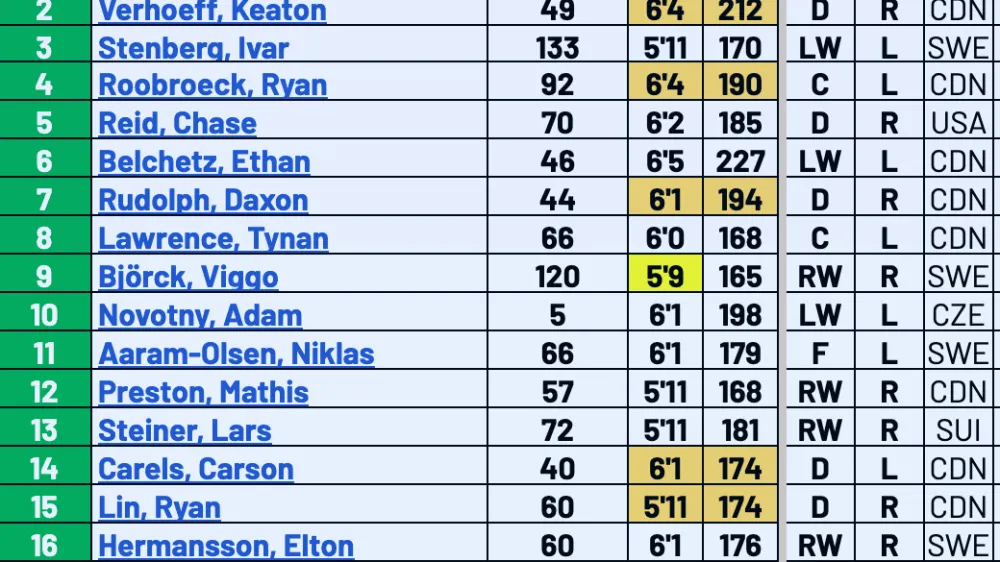
Keaton Verhoeff presents the most intriguing challenge to McKenna’s presumed top-overall status. The 6-foot-4 right-handed defenseman from the University of North Dakota possesses the type of profile that keeps NHL general managers awake at night—in a good way. Size, handedness, defensive prowess, and offensive instincts rarely combine in one package, but Verhoeff checks every box.
Central Scouting’s comparison of Verhoeff to Washington Capitals defenseman John Carlson speaks volumes about his potential impact. He’s a minutes-eating defender who excels in every situation, from power play to penalty kill. After posting 45 points in 63 games as a WHL rookie with Victoria, Verhoeff has made the jump to the NCAA with North Dakota, where he’s already contributing with three points in four games.
What separates Verhoeff from other defensive prospects is his completeness. He makes smart first passes to exit the zone, possesses an NHL-caliber shot, and demonstrates the hockey sense to facilitate offense without compromising defensive responsibilities. According to NHL Central Scouting, “He has the size and range to be a very good defender and also has very good offensive instincts. He can run a power play and is very good at recognizing opportunities.”
Ryan Lin might not generate the highlight-reel moments that other prospects produce, but scouts appreciate his quiet effectiveness. The Vancouver Giants defenseman is the type of player who goes unnoticed precisely because he rarely makes mistakes. His ability to shut down plays early with proper angles, active stick work, and exceptional reads makes him invaluable in all situations.
Lin’s hockey IQ and decision-making are among his strongest attributes, allowing him to consistently make the simple play and transition his team effectively. He’s expected to log 30 minutes per game for Vancouver this season, providing ample opportunity to showcase his two-way capabilities. While his 5-foot-11 frame might concern some teams, his compete level and defensive acumen could make him a top-15 selection.
Physical specimens among NHL draft 2026 top prospects to watch
The NHL made its preferences clear in the 2025 draft by selecting big defensemen and skilled forwards with bite. Ethan Belchetz embodies exactly what modern NHL teams are seeking in power forwards. At 6-foot-5 and 228 pounds, Belchetz is impossible to miss on the ice, but his value extends beyond his imposing frame.
Through 13 games with the Windsor Spitfires, Belchetz is tied for the OHL lead with 10 goals and 16 points total. His development in learning to leverage his physical tools has been remarkable. He’s become adept at protecting pucks along the wall, bumping opponents off balance, and muscling his way to high-danger areas. Central Scouting’s Nick Smith notes: “He’s a size and strength-type prospect who projects as that power forward. He’s tough to handle down low and is a beast in the blue paint.”
The comparison to Brady Martin and Porter Martone from the 2025 class is instructive. Teams that need a physical presence who can also contribute offensively will be drawn to Belchetz. His improvements in footwork, agility, and even hand speed have elevated his draft stock significantly. If he continues trending upward, a top-10 selection isn’t out of the question.
Ryan Roobroeck presents one of the most intriguing projection questions in this draft class. The 6-foot-4 forward led Niagara in scoring during his draft-minus-one season and now enters his third OHL campaign with significant questions about his positional future. Will he develop into a play-driving center, or is his long-term role on the wing?
The answer to that question will significantly impact his draft position. Roobroeck possesses NHL-quality shooting, reliable special teams play, and good skating for his size. If he can prove capable of playing center, showcasing improved playmaking and physical engagement, he could skyrocket into top-10 consideration. His late-September birthday means this is his third OHL season, giving him a maturity advantage over some peers.
Dynamic playmakers redefining NHL draft 2026 top prospects to watch
Mathis Preston was one of the most electrifying players at the Hlinka-Gretzky Cup, and his combination of smooth skating and elite hockey sense makes him must-watch television. The Spokane Chiefs forward is a crafty playmaker whose offensive instincts constantly position him perfectly to create high-danger scoring chances for teammates.
Preston’s evasiveness and quick hands allow him to execute plays that other prospects can’t envision. He draws defenders toward him before making the pass that unlocks opposing defenses. With his late-July birthday, Preston projects to be one of the biggest offensive producers among draft-eligible players this season. If he maintains his development trajectory, he’s a lock for top-10 consideration as a high-ceiling NHL winger.
Tynan Lawrence comes off a remarkable USHL season where he captured the Clark Cup MVP as a 16-year-old—no small feat for a young center. Now committed to Boston University for 2026-27, Lawrence will spend his final junior season with Muskegon demonstrating why scouts rave about his instincts on both sides of the puck.
Lawrence excels in transition, making plays at speed off the rush, and his smooth catch-and-release allows him to threaten from distance. He’s expected to anchor both power play and penalty kill units for the Lumberjacks, showcasing his two-way reliability. Scouts appreciate his work rate and hockey IQ, with some believing he has the potential to dominate the USHL in ways that could push him into top-10 territory.
International stars among NHL draft 2026 top prospects to watch
Ivar Stenberg might have the highest pure skill level of any prospect not named Gavin McKenna. The Swedish winger, who narrowly missed eligibility for the 2025 draft by just two weeks, is torching the Swedish Hockey League with Frölunda. Through 12 games, he’s registered 10 points while competing against men, which speaks to his readiness for professional hockey.
Stenberg’s skating, creativity, and skill make him a constant threat in transition. According to Jukka-Pekka Vuorinen, NHL Director of European Scouting: “He has elite skating, puck control and creativity, making him a constant threat. His ability to shift tempo and direction while maintaining possession stands out, and he’s shown strong playmaking.” Playing in the SHL during your draft year provides invaluable experience against professional competition, and Stenberg appears more than capable of thriving in that environment.
His ability to run a power play, facilitate offense with speed, and make his teammates better projects him as a potential top-line NHL winger. If he continues developing his play away from the puck, he could challenge for a top-five selection.
Marcus Nordmark represents another intriguing Swedish prospect with elite offensive capabilities. Playing for Djurgåden’s junior team, Nordmark has exploded for 18 points in just 10 games, showcasing strong hands, a dangerous shot, and excellent passing vision. While scouts note he doesn’t always display the highest competitive drive without the puck, his offensive ceiling is undeniable.
Hidden gems to monitor throughout the season
Viggo Björck broke scoring records in Sweden’s junior leagues before being moved up to play in the World Junior Summer Showcase despite being underage for that competition. The creative center from Djurgården possesses quality playmaking ability and elite hockey sense that allows him to control games through his vision and decision-making.
Björnck’s acceleration, quick release, and above-average puckhandling make him a well-rounded offensive center prospect. He’s strong on pucks, defensively sound, and projects as an NHL center if he grows a couple of inches. His development throughout the season could see him crack the top-five conversation come draft day.
Chase Reid’s trajectory has caught scouts’ attention, particularly after his point-per-game Division I season in the OHL. The right-handed defenseman with Sault Ste. Marie blends smooth mobility with high-end offensive instincts and quality transition play. Reid will be relied upon to lead the Greyhounds’ blue line this season, playing heavy matchups while producing offense.
If Reid’s defensive game continues improving and he becomes elite on both sides of the puck in transition, he’ll position himself as one of the draft’s premier defensive prospects. According to ESPN’s draft analysis, Reid has the raw talent to develop into a legitimate top-pairing defender at the NHL level.
Daxon Rudolph’s development accelerated dramatically in the second half of last season with Prince Albert, and he enters this campaign as the Raiders’ defensive leader. The right-handed defenseman possesses the skating ability to defend rushes with strong gap control while contributing offensively through his ability to beat defenders and create high-danger chances.
Luke Schairer stands as the lone A-rated prospect from USA Hockey’s National Team Development Program Under-18 team, which speaks to both the international depth of this class and his individual qualities. The 6-foot-3 right-handed defenseman from Charlotte, North Carolina, is committed to Boston University and has the size and skill combination that NHL teams covet.
What the NHL draft 2026 top prospects to watch mean for rebuilding teams
This draft class offers exceptional value beyond just the top pick, particularly for teams seeking defensive help. The depth of right-handed defensemen—Verhoeff, Lin, Villeneuve, Gustafsson, Reid, Schairer, and Rudolph—means that teams picking anywhere in the top 20 could land a potential top-pairing defender.
The NCAA rule change allowing CHL players to compete collegiately has fundamentally altered the development landscape. McKenna’s decision to attend Penn State rather than remain in the WHL represents a seismic shift that will impact future draft classes. “The NCAA rule change has already significantly changed the hockey landscape to the benefit of the players by providing options for their hockey pursuits,” noted Dan Marr.
For teams like the San Jose Sharks, Chicago Blackhawks, or other rebuilding franchises, this draft offers opportunities to add either a franchise center in McKenna, a potential No. 1 defenseman in Verhoeff, or any number of high-ceiling prospects who could accelerate their rebuild. The physical tools available throughout this class align perfectly with the modern NHL’s emphasis on size, skill, and skating.
As the season progresses and these prospects compete across various leagues, their draft positions will fluctuate based on performance, development, and team needs. What remains certain is that the 2026 NHL draft class features genuine star potential at the top and impressive depth throughout the first round. NHL teams that finish near the bottom this season will have a legitimate opportunity to select a player who can change their franchise’s trajectory for the next decade. The race for the top pick—and the right to select Gavin McKenna—should provide compelling drama as the season unfolds, but teams selecting in the top 10 should feel confident they’ll land an impact prospect regardless of where they pick.

Par Mike Jonderson
Mike Jonderson is a passionate hockey analyst and expert in advanced NHL statistics. A former college player and mathematics graduate, he combines his understanding of the game with technical expertise to develop innovative predictive models and contribute to the evolution of modern hockey analytics.