









Dallas Stars forward Mikko Rantanen became the latest player to trigger an obscure NHL disciplinary rule when he received an automatic one-game suspension for accumulating two game misconduct penalties within a four-day span. The suspension, mandated by Rule 23.6 of the NHL rulebook, stemmed from separate boarding incidents involving New York Islanders defenseman Alexander Romanov and Calgary Flames forward Matt Coronato. While the NHL Department of Player Safety declined to issue additional supplemental discipline for either hit, the automatic provision left the 29-year-old star watching from the press box as his teammates faced the Edmonton Oilers.
The sequence of events highlights a rarely invoked regulation designed to curb repeated dangerous play. Rantanen, who signed an eight-year, $96-million contract extension this past offseason, had never faced suspension in his 11-year career spanning 674 games with Colorado, Carolina, and Dallas. His sudden accumulation of major penalties represents an uncharacteristic turn for a player who leads the Stars with 28 points through 22 games.
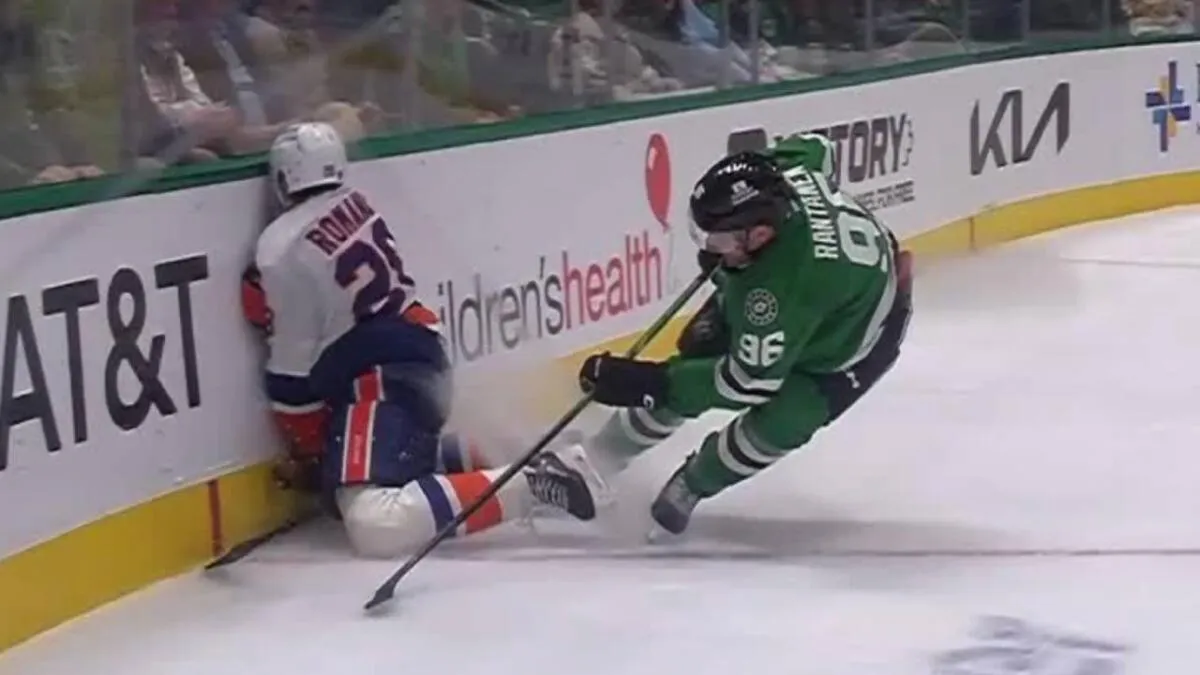
What triggered Mikko Rantanen’s automatic suspension under NHL Rule 23.6
The suspension resulted from two specific incidents that both resulted in game misconducts for boarding, placing them squarely within what the NHL categorizes as “Physical Infractions.” Neither hit drew additional scrutiny from the Department of Player Safety in the form of a hearing or extended ban, but their proximity triggered the automatic provision that many fans—and apparently some players—didn’t realize existed.
The Romanov hit that started the countdown
On November 18, during a 3-2 loss to the New York Islanders, Rantanen delivered a forceful hit from behind on defenseman Alexander Romanov with less than a minute remaining in regulation. The play resulted in a five-minute major for boarding and an automatic game misconduct. Islanders coach Patrick Roy, who drafted Rantanen while serving as Colorado’s bench boss, didn’t hold back in his post-game assessment.
“I’m going to say is [that] when you see the number, you have to lay off. Everybody knows that. You don’t go through the guy,” Roy fumed. “I was in Colorado when [Rantanen] was drafted there. It’s not his style. But at the same time, that should not be part of our game.”
The consequences proved severe. Romanov required shoulder surgery and will miss five to six months, yet the NHL chose not to impose additional discipline. League officials reportedly cited slight contact from Islanders forward Scott Mayfield as a mitigating factor, suggesting it altered Rantanen’s trajectory—an explanation that drew criticism from safety advocates.
The Coronato boarding that sealed the suspension
Just four days later, on November 22, Rantanen found himself in similar territory. During a 3-2 shootout loss to the Calgary Flames, he boarded forward Matt Coronato from behind late in the second period. Coronato fortunately returned to the game after evaluation, but Calgary coach Ryan Huska condemned the hit as “terrible.” The play again resulted in a major penalty and game misconduct, setting Rantanen’s automatic suspension in motion.
What made the Coronato hit particularly concerning was Rantanen’s apparent lack of adjustment following the Romanov incident. Taking at least five strides before contact, the play met criteria for charging as well as boarding—suggesting a pattern rather than isolated mistakes. The NHL Department of Player Safety again declined a hearing, allowing Rule 23.6 to dictate the consequences.
Understanding the obscure Rule 23.6 provision
Rule 23.6 states that “any player who incurs a total of two game misconduct penalties in the Physical Infractions Category, before playing 41 consecutive regular-season games without such penalty, shall be suspended automatically for the next League game.” This little-known regulation essentially creates a probationary period following a major infraction. The rule covers violations like boarding, charging, elbowing, interference, and kneeing—any offense that warrants both a major penalty and game misconduct.
For Rantanen, the math was simple: two game misconducts in three games meant an automatic one-game ban. The rule also includes escalating penalties, with each subsequent misconduct adding another game to the automatic suspension. Had Rantanen committed a third offense before playing 41 clean games, he would have faced a two-game suspension automatically. You can read more about how the 41-game window affects player discipline at NHL Insight’s breakdown of the rule.
The impact on Dallas Stars’ lineup and performance
The suspension arrived at a challenging moment for Dallas, which had climbed to the top of the Central Division standings behind Rantanen’s offensive production. His absence against Edmonton, a rematch of last year’s Western Conference Final, forced coach Peter DeBoer to shuffle his top-six forward group at a time when chemistry matters most.
Balancing offensive production with penalty problems
Rantanen’s statistical profile this season reveals a Jekyll-and-Hyde dynamic. His 28 points (10 goals, 18 assists) tie him with Jason Robertson for the team lead, establishing him as a primary offensive engine. However, his 57 penalty minutes also lead the Stars—and the entire NHL—by a significant margin. More alarmingly, 39 of those minutes have come in his last three games, coinciding exactly with his disciplinary troubles.
This dichotomy presents a strategic dilemma for Dallas. The Stars signed Rantanen to generate elite-level offense, not to lead the league in penalty minutes. His physical edge has historically been an asset, but when it escalates into reckless territory, it actively harms the team. The automatic suspension cost Dallas its top producer against a conference rival, while the extended penalties have repeatedly forced teammates to kill unnecessary minutes.
The Edmonton matchup consequences
Missing the Edmonton game represented more than just one contest in November. The Oilers represent a key measuring stick for Western Conference contenders, and their high-powered offense led by Connor McDavid and Leon Draisaitl exposes any lineup weakness. Without Rantanen, the Stars lost their top right-wing scorer and power-play quarterback, forcing Robertson to carry an even heavier load.
The timing also proved frustrating from a momentum standpoint. Dallas had won five of seven games before the suspension, with Rantanen contributing multiple multi-point performances. Inserting a depth forward into a top-line role against Edmonton’s formidable attack created a mismatch that DeBoer had to scheme around, potentially affecting line combinations for subsequent games as he searches for optimal chemistry.
NHL Player Safety faces criticism over handling of Rantanen hits
The controversy surrounding Rantanen’s suspension extends beyond the player himself. Many observers argue that the NHL Department of Player Safety missed opportunities to send stronger messages after both hits, potentially preventing the second incident altogether.
Questions about leniency after Romanov injury
The decision not to suspend Rantanen for the Romanov hit drew immediate scrutiny. Romanov’s five-to-six-month absence represents a devastating blow to the Islanders’ defensive corps, yet the league cited incidental contact from Mayfield as justification for leniency. Critics, including analysts at The Hockey News, argued this reasoning set a dangerous precedent.
“The NHL’s decision not to suspend Rantanen for the hit on Romanov risked setting a troubling precedent,” one analysis noted. “Hockey is a contact sport, yet such leniency could encourage players to take liberties that endanger their peers.” The optics proved particularly problematic when Rantanen committed a similar offense days later, suggesting the warning went unheeded.
The business of discipline in the modern NHL
Some observers have suggested that the league’s increasingly close relationship with sports betting creates pressure to keep star players on the ice. A 2018 Nielsen Sports study estimated that NHL revenue could increase by at least $216 million annually from sports betting—a figure that has likely grown considerably. While there’s no direct evidence of betting considerations influencing Rantanen’s case, the broader trend of relatively lenient discipline for star players fuels suspicion.
The Department of Player Safety’s mandate should prioritize protecting players regardless of their status or team. When a player accumulates two game misconducts for dangerous hits in less than a week—one causing a season-ending injury—the automatic one-game suspension may feel insufficient. The league could have exercised its discretionary authority to add games, as Rule 23.6 explicitly states that automatic suspensions represent the minimum penalty, not the maximum.
Resetting the disciplinary clock
For Rantanen, the path forward now involves a 41-game probationary period. According to Rule 23.6, “When a player has played in 41 consecutive regular League games without being assessed a major and a game misconduct in the Physical Infractions Category, he will have the previous game misconduct penalties removed from his current record.” This means Rantanen must play nearly half a season of clean hockey before his slate is wiped clean.
The full implications of this rule and its application to Rantanen’s case are explored in detail at NHL Insight’s comprehensive overview, which breaks down how the 41-game window impacts player behavior. Any additional physical infractions leading to game misconducts before that milestone will trigger increasingly severe automatic suspensions, creating genuine incentive for Rantanen to adjust his approach.
What this means for Rantanen’s season and the Stars’ discipline
The automatic suspension serves as a wake-up call for a player who had never faced NHL disciplinary action beyond a $2,000 embellishment fine. Rantanen’s reputation as a skilled power forward has never included a “dirty player” label, making this sudden pattern all the more concerning. His response over the next 41 games will determine whether this proves to be an anomaly or the start of a troubling trend.
For Dallas, the incident highlights the importance of channeling physical play productively. The Stars boast one of the league’s most talented rosters, with legitimate Stanley Cup aspirations. They cannot afford to lose top players to preventable suspensions, especially during crucial late-season positioning or playoff runs. The coaching staff must work with Rantanen to maintain his competitive edge while eliminating the reckless elements that have recently emerged.
The NHL, meanwhile, faces ongoing questions about its disciplinary consistency. While Rule 23.6 functioned exactly as designed in this case, the decision not to pursue additional supplemental discipline for either hit—particularly the Romanov incident—leaves the league vulnerable to accusations that star power influences outcomes. As sports betting becomes more integrated with hockey’s business model, maintaining transparent, consistent discipline grows increasingly critical for preserving fan trust.
Rantanen’s suspension ultimately represents both the success and failure of the NHL’s disciplinary system. The automatic rule worked as intended, punishing repeated dangerous plays. Yet the serious nature of the Romanov injury and the rapid recurrence of similar behavior raise legitimate questions about whether the league missed an opportunity to enforce a higher standard before a pattern developed. The coming months will reveal whether this lesson proves sufficient to protect both Rantanen’s career and his opponents’ safety.
Frequently Asked Questions

Par Mike Jonderson
Mike Jonderson is a passionate hockey analyst and expert in advanced NHL statistics. A former college player and mathematics graduate, he combines his understanding of the game with technical expertise to develop innovative predictive models and contribute to the evolution of modern hockey analytics.