











NHL quarter-season report cards 2025-26 for all 32 teams: complete grades and analysis
The 2025-26 NHL season has reached its quarter mark, and the landscape looks unlike anything we’ve seen in recent memory. With all 32 teams having played more than 20 games, the standings have compressed into what coaches and players describe as historically tight. As Detroit Red Wings coach Todd McLellan put it, even teams at the top aren’t truly on top—they’re just in the middle of a dense forest where every point matters. This unprecedented parity has created a season where just nine points separate all 16 teams in the Eastern Conference, and similar congestion plagues the Western Conference. In this environment, evaluating team performance requires looking beyond simple win-loss records to understand which teams are building sustainable success and which are struggling to find their identity.
What the quarter-mark tells us about the 2025-26 NHL season
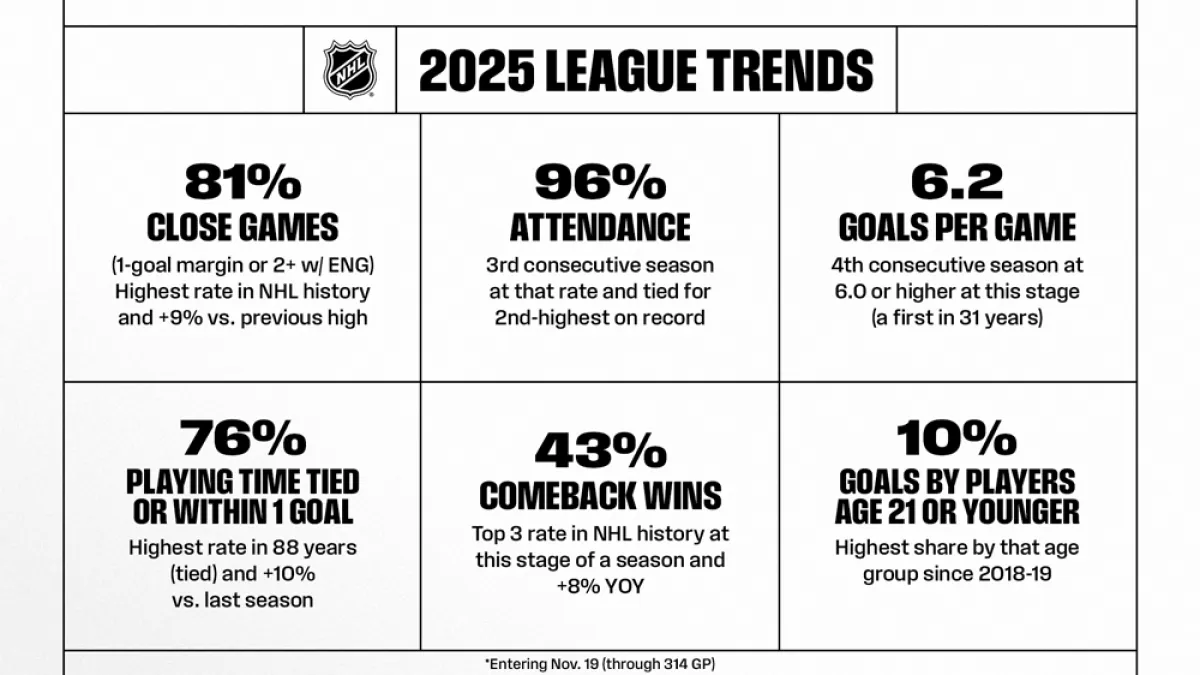
The most striking feature of this season has been the remarkable parity across the league. According to NHL.com statistics, 76 games have been tied after 55 minutes—tied for the second most at this stage of a season in league history. Additionally, 90 games have gone to overtime, the most ever at the quarter mark. This means teams are earning “loser points” at an unprecedented rate, keeping virtually every franchise within striking distance of a playoff spot. Only five teams sit below .500 in points percentage, creating a situation where every game carries playoff-level intensity.
This compressed schedule, designed to accommodate the Olympic Winter Games Milano Cortina in February, has only amplified the stakes. Teams are playing every other day or on back-to-back nights, leaving little practice time and forcing players to remain in constant “game mode.” Seattle Kraken center Chandler Stephenson, a veteran of three Stanley Cup runs, noted that “it almost feels like playoffs” already. This environment rewards teams with depth, strong goaltending, and the ability to adapt quickly to adverse situations.
The surprises have been plentiful. Six teams that missed the playoffs last season currently hold playoff positions, including the Pittsburgh Penguins, Detroit Red Wings, and New York Islanders in the East, plus the Chicago Blackhawks and Anaheim Ducks in the West. Meanwhile, the two-time defending Stanley Cup champion Florida Panthers and the two-time Western Conference champion Edmonton Oilers find themselves outside the playoff picture. As we'll explore in our detailed report cards, injuries, emergent young talent, and coaching changes have all played significant roles in these early-season narratives.
Top of the class: A-grade teams setting the standard
The Colorado Avalanche have established themselves as the NHL’s benchmark through the first quarter, posting numbers that could challenge league records. Currently on pace for 137.9 points, the Avalanche lead the league in goals per game (4.00) while simultaneously allowing the fewest. Their dominance extends to underlying metrics: they generate the most scoring chances per 60 minutes, shots per 60, and scoring chances at 5-on-5. Nathan MacKinnon appears poised for his second Hart Trophy, while Cale Makar could win his third Norris and potentially challenge for the Hart as well. Their only blemish is a bottom-10 power play converting at just 15.7%, but when you’re dominating at even strength this thoroughly, special teams become a secondary concern.
The Anaheim Ducks represent perhaps the most delightful surprise of the young season. Following a preseason over/under of just 83.5 points, they’re on pace for 108.1 and fighting for the Pacific Division crown. Their young core has exploded, with Leo Carlsson projected to finish with 108 points—potentially surpassing Teemu Selanne’s franchise record of 109. Chris Kreider’s offseason addition has paid immediate dividends with 14 points in his first 15 games. However, the Ducks’ reliance on goaltender Lukas Dostal (17 starts in 22 games) raises durability questions, and their underlying defensive metrics show they’re allowing among the most scoring chances and high-danger opportunities in the league. This suggests their goaltending might be masking systemic issues that could surface later.
Pittsburgh has been arguably the Eastern Conference’s biggest revelation. Tabbed by many as rebuilding under new coach Dan Muse, the Penguins instead sit firmly in the playoff mix. They’ve achieved this through a complete defensive transformation—allowing the second-fewest goals in the NHL while ranking top 10 in offense and operating the league’s best power play. Arturs Silovs and Tristan Jarry have formed a reliable goaltending tandem, while the team’s commitment to defensive structure has been remarkable. Their lone weakness has been overtime performance (0-4), leaving valuable points on the table in a season where every point is precious.
B-grade teams: solid but with room for improvement
The Dallas Stars have weathered coaching changes and offseason personnel losses to remain competitive under Glen Gulutzan’s second stint. Their efficiency has been key—despite ranking in the bottom 10 in scoring chances and shots per 60, they sit 10th in goals per game and operate the league’s second-best power play. The Stars rank among the top 10 in fewest goals allowed and high-danger chances surrendered, showing a commitment to structure. Their penalty kill, however, sits in the bottom third at 75.7%, an area they’ll need to clean up to maintain their position in the tight Central Division.
Detroit’s decade-long rebuild is finally bearing fruit, with the Red Wings posting their best start in ten years. The recipe has been collective effort: Steve Yzerman’s vision of a high-skilled, defensively responsible team has materialized under Todd McLellan’s guidance. Dylan Larkin leads in goals and points while providing invaluable leadership to rookies Emmitt Finnie and Nate Danielson. Defensively, rookie Axel Sandin-Pellikka has provided crucial depth. The Red Wings average among the fewest shots against per game, but their goaltending tandem of Cam Talbot and John Gibson hasn’t been dominant, and their reliance on power-play scoring suggests even-strength improvement is needed.
New Jersey’s star-studded roster has produced solid results, though a freak injury to Jack Hughes (surgery on his finger after a restaurant accident) has tempered enthusiasm. Hughes was averaging more than a point per game before the injury, joined by Jesper Bratt and Nico Hischier in driving offense. Jake Allen has been excellent in handling an increased workload while defenseman Simon Nemec has blossomed into a reliable two-way presence. The Devils’ depth will be tested during Hughes’ absence, and Jacob Markstrom’s subpar performance has placed extra pressure on Allen to maintain his strong play.
Middle of the pack: C-grade teams searching for consistency
The Edmonton Oilers find themselves in familiar territory—digging out of an early hole after a disappointing start. Leon Draisaitl and Connor McDavid continue producing at elite levels, and the team recently showed resilience with a strong performance against Washington. However, they’ve allowed more than four goals in 13 of their first 22 games, ranking dead last in team save percentage and goals allowed. This defensive collapse echoes past slow starts, but with the Western Conference tighter than ever, they have less margin for error. The question isn’t whether they can score, but whether they can stop anyone consistently.
The Toronto Maple Leafs’ post-Mitch Marner era has begun with a thud. Despite John Tavares’ resurgence (12 goals in 21 games) and William Nylander’s point-per-game pace, the Leafs rank near the bottom of the Eastern Conference. Injuries have decimated the roster—Auston Matthews, Matthew Knies, Chris Tanev, and Brandon Carlo have all missed significant time. More concerning is their defensive regression; they’re top three in goals allowed per game and struggle against the rush. Craig Berube’s defense-first system that worked last season appears to have lost its effectiveness, leaving Toronto without a clear identity and searching for answers after a 1-5-2 stretch.
The New York Rangers’ defensive transformation under Mike Sullivan has been impressive—they rank sixth in goals allowed per game and feature one of the league’s best goaltending tandems in Igor Shesterkin and Jonathan Quick. Vladislav Gavrikov’s addition has solidified the blue line. Unfortunately, their offense has completely vanished, ranking 30th at 2.48 goals per game. J.T. Miller, Mika Zibanejad, and Artemi Panarin all perform below their career norms, and the power play sputters. This defensive identity might keep them in games, but without scoring, they’re destined for the mediocrity their record reflects.
Below expectations: D and F grades
The Vancouver Canucks’ season has unraveled since a promising 4-2 start. Injuries have been brutal—they’ve used 29 skaters and three goaltenders in just 23 games. Thatcher Demko looked like his Vezina-finalist self early but couldn’t sustain it behind a depleted lineup. The Canucks rank near the bottom in every offensive category and are either worst or second-worst in allowing shots, scoring chances, and high-danger opportunities. Their projected 71.3-point pace represents a shocking collapse for a team many expected to contend.
St. Louis has experienced one of the most disappointing starts among teams with playoff aspirations. After adding Pius Suter to a group featuring seven returning 20-goal scorers, they’ve scored the fifth-fewest goals per game while allowing the third-most. Their goaltending has betrayed their solid defensive structure, posting the fourth-lowest save percentage in all situations. Five points out of a wild-card spot, the Blues face a crossroads where their next stretch could determine whether they buy or sell at the deadline.
Nashville earns the season’s only failing grade, sitting on pace for just 59.6 points while scoring a league-low 2.29 goals per game—on track for one of the most offensively challenged seasons in NHL history. Filip Forsberg continues building his franchise legacy, and Matthew Wood has shown Calder Trophy potential, but these bright spots can’t overcome the team’s inability to score. They’ve also surrendered the sixth-most goals per game, lack their best defenseman Roman Josi for most of the season, and watched Steven Stamkos’ production plummet. Peter Laviolette faces a monumental task to salvage anything from this campaign.
What this means for the playoff race
As we approach the season’s midpoint, the unprecedented parity suggests the playoff race will remain fluid until the final days. The compressed schedule means teams have limited practice time to address weaknesses, making in-game adjustments and player health paramount. Teams like Colorado and Anaheim have built cushions, but in a season where nine points separate 16 teams, those advantages can evaporate quickly.
The true tests are coming for early surprises. Can Anaheim’s young core maintain this pace while managing Dostal’s heavy workload? Will Pittsburgh’s goaltending hold up through Jarry’s injury absence? Can Detroit’s rookies continue producing when the intensity ramps up? For struggling teams like Edmonton and Toronto, the question is whether they can fix systemic issues before the standings gap becomes insurmountable.
This season’s defining characteristic may be that no team can afford an extended slump. The Blues’ three-game losing streak dropped them from wild-card contention to the lottery conversation. Conversely, Detroit’s 2-0-1 run vaulted them to the Atlantic Division summit. With the Olympic break creating further schedule compression, teams that build positive momentum before February will have significant advantages. For a more detailed analysis of how each team arrived at their current position, our complete first-quarter report cards provide deeper insights into the trends shaping this remarkable season.
The quarter mark has revealed a league where traditional powers face unprecedented challenges, rebuilding teams arrive ahead of schedule, and every game truly matters. With 75% of the season remaining, the teams that can maintain health, find consistent goaltending, and adapt to this playoff-like atmosphere will separate themselves from the pack. Until then, fans should buckle up—this tight race shows no signs of loosening anytime soon.
Frequently Asked Questions

Par Mike Jonderson
Mike Jonderson is a passionate hockey analyst and expert in advanced NHL statistics. A former college player and mathematics graduate, he combines his understanding of the game with technical expertise to develop innovative predictive models and contribute to the evolution of modern hockey analytics.