














2025-26 NHL first-quarter report cards for all 32 teams: Complete analysis at the quarter mark
The 2025-26 NHL season has officially crossed its first major milestone, with every team having played more than 20 games and establishing clear patterns of success, struggle, and surprise. As the league pauses for reflection at this quarter-mark juncture, report cards provide an essential snapshot of which franchises are exceeding expectations and which are falling short of their potential.
These evaluations consider everything from points pace and underlying metrics to injury management and special teams performance. Some organizations have built upon last season’s momentum, while others find themselves searching for answers earlier than anticipated. What follows is a comprehensive breakdown of all 32 teams, categorized by their first-quarter performance grades.
A grades: elite performers setting the standard
Colorado Avalanche: A+
Colorado has established itself as potentially the best team in hockey through the first quarter. The Avalanche lead the NHL in goals per game while simultaneously giving up the fewest, a dominant two-way profile rarely seen in modern hockey. Their underlying numbers match the eye test—they generate the most scoring chances, shots, and high-danger opportunities per 60 minutes in 5-on-5 play, while ranking top-10 in fewest shots and high-danger chances allowed.
Nathan MacKinnon has positioned himself for a second Hart Trophy, while Cale Makar could win his third Norris and possibly challenge his teammate for league MVP. The supporting cast has provided consistent depth scoring that previous Colorado teams lacked. At their current 137.9-point pace, they threaten to surpass Boston’s record 135-point regular season from 2022-23. The only blemish is a power play converting at just 15.7%, bottom-10 in the league—a concerning number that hasn’t derailed them yet but requires attention.
Anaheim Ducks: A
No team has been more pleasantly surprising than Anaheim. Projected as a rebuilding squad with an over/under of 83.5 points, the Ducks are pacing for 108 points and fighting for the Pacific Division crown. Their young talent has blossomed dramatically, led by Leo Carlsson’s 108-point projected season that would rank among the franchise’s best ever, challenging Teemu Selanne’s record of 109 points. Chris Kreider’s offseason addition has paid immediate dividends with 14 points in his first 15 games.
The concern lies in over-reliance on goaltender Lukas Dostal, who has started 17 of 22 games—a 63-game pace reserved for elite workhorses. While Dostal’s 5.42 goals saved above expected ranks sixth among regular starters, the Ducks bleed chances defensively, sitting top-three in scoring chances allowed, shots against, and high-danger chances per 60. The sustainability of this model depends on whether their offensive explosion can continue masking defensive vulnerabilities.
Dallas Stars: A
Glen Gulutzan’s second tenure has Dallas performing efficiently despite concerning underlying numbers. The Stars sit bottom-10 in scoring chances, shots, and high-danger chances per 60, yet rank second in power-play percentage and 10th in goals per game. This efficiency has them on pace for 111.8 points despite offseason losses of Evgenii Dadonov, Mikael Granlund, and Mason Marchment.
The disconnect between their 5-on-5 defensive structure (top-10 in fewest goals and high-danger chances allowed) and penalty kill (75.7% success rate, bottom-10) presents a fixable problem. If Dallas can shore up their shorthanded work, they have the makings of a legitimate contender in the Central Division.
Detroit Red Wings: A
Detroit is experiencing its best start in a decade, validating Steve Yzerman’s vision and Todd McLellan’s coaching. The Red Wings rank among the fewest shots allowed per game, reflecting a defensive buy-in that extends throughout the lineup. Dylan Larkin leads the team in goals and points while providing invaluable leadership to impressive rookies Emmitt Finnie and Nate Danielson. On the back end, Axel Sandin-Pellikka has provided crucial depth.
The even-strength scoring has lagged behind their power-play success, raising questions about sustainability when the man advantage cools. Goaltending remains a question mark—Cam Talbot has improved from last season, but offseason acquisition John Gibson hasn’t provided the stabilizing force Detroit hoped for. Despite these concerns, the Red Wings’ early season analysis reveals a team maximizing its potential through structure and youth development, with their 96.3-point pace representing a massive step forward.
New York Islanders: A
The Islanders’ surprising success begins with Matthew Schaefer, the number-one overall pick who immediately impacts both ends of the ice with over 22 minutes per game. The Calder Trophy favorite headlines a rookie class that includes breakout performer Maxim Shabanov. Bo Horvat is having his best season in years, while a healthy Mathew Barzal and Kyle Palmieri power a top-10 offense.
Ilya Sorokin and David Rittich have delivered solid goaltending, but the power play ranks among the league’s worst, and the offense skews top-heavy. Losing Alexander Romanov to shoulder surgery for five-to-six months tests their depth significantly. Still, their 99.8-point pace far exceeds preseason expectations.
Pittsburgh Penguins: A
First-year coach Dan Muse has engineered one of the season’s most shocking turnarounds. Projected at just 77.5 points, Pittsburgh sits on a 97.6-point pace and firmly in the Eastern Conference playoff mix. Muse’s system gives players freedom while maintaining structure, resulting in the league’s best power play and second-fewest goals allowed. Arturs Silovs’ emergence and Tristan Jarry’s improvement have solidified the crease.
The Penguins remain winless in overtime and shootouts (0-4), leaving valuable points on the table in an increasingly tight standings race. Rickard Rakell’s two-month absence with a broken hand tests depth, but Pittsburgh’s commitment to defensive structure under Muse suggests this renaissance has staying power.
Carolina Hurricanes: A-
Carolina continues thriving on Rod Brind’Amour’s smothering defensive structure while simultaneously ranking second in overall offense. Seth Jarvis leads the team in goals, Sebastian Aho paces them in points, and Jordan Staal provides his usual steady two-way presence. Pyotr Kochetkov has excelled while starter Frederik Andersen struggles with consistency and health.
The Hurricanes have lost consecutive games only once, yet special teams present a baffling contradiction—worst power play in the league and 21st-ranked penalty kill despite elite 5-on-5 numbers (third in even-strength goals). Andersen’s ongoing issues create a goaltending conundrum that could derail their 111.8-point pace if Kochetkov can’t maintain his heavy workload.
New Jersey Devils: A-
The Devils’ star-studded offense has delivered as expected, with Jack Hughes posting 20 points in 17 games before a freak restaurant accident required finger surgery. The multi-week absence of Hughes, Cody Glass, and Brett Pesce tests New Jersey’s depth significantly. Jesper Bratt (21 points in 21 games) and Nico Hischier continue producing at elite levels, while Simon Nemec has blossomed into the top-pairing defenseman they envisioned when drafting him second overall in 2022.
Veteran Jake Allen has handled an increased workload excellently, contrasting sharply with Jacob Markstrom’s struggles. The Hughes injury coincides with Markstrom’s poor form, creating a critical juncture where the Devils must prove their offensive depth can sustain them through adversity while protecting Allen from overexposure.
B grades: solid performers with room to grow
Boston Bruins: B+
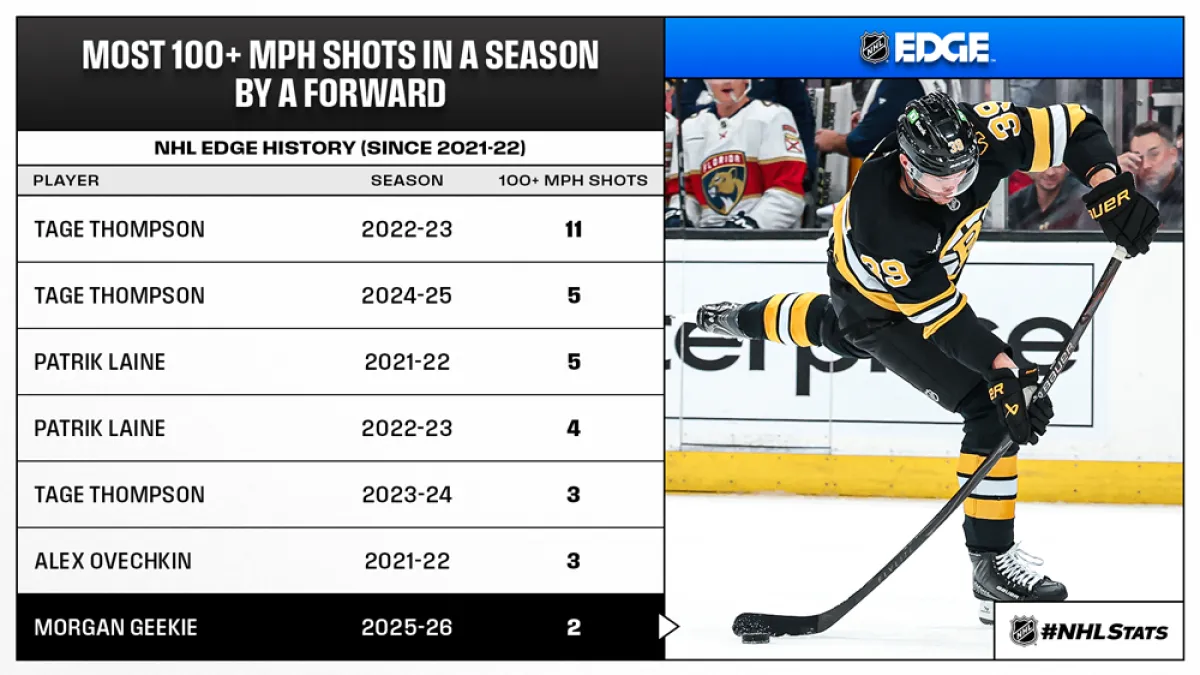
Projected as Atlantic Division cellar dwellers with an 80.5-point over/under, Boston instead contends for top positioning behind Marco Sturm’s defense-first structure. The system has mitigated Elias Lindholm’s extended absence while allowing David Pastrnak to shine and Morgan Geekie to emerge as an offensive threat. Nikita Zadorov brings necessary physicality, and Jeremy Swayman’s return to form anchors a top-10 power play and penalty kill.
Injuries have hit hard—Charlie McAvoy’s indefinite absence after taking a puck to the face compounds losses of Casey Mittelstadt, Viktor Arvidsson, and Jordan Harris. The Bruins remain bottom-10 in goals against, and without McAvoy anchoring the blue line, sustainability concerns persist despite their 88.8-point pace.
Chicago Blackhawks: B+
Connor Bedard has answered every question about his sophomore season, pacing for 116 points that would rank among the highest non-Denis Savard seasons in franchise history. The goaltending transformation has been equally dramatic—the team save percentage jumped from .894 last season to .911 through 22 games, tied for fourth in the NHL. Spencer Knight presents a compelling case for Olympic consideration.
Chicago’s youth movement creates defensive inconsistency. They rank as the third-youngest team, with a top-four defense averaging under 24 years old and including two rookies. This inexperience shows in bottom-four rankings for scoring chances allowed, high-danger chances allowed, and shots against per 60. The 89.5-point pace exceeds expectations, but defensive structure must improve for this surprise start to matter in March.
Montreal Canadiens: B+
Rookie goaltender Jakub Dobes has outperformed starter Sam Montembeault, becoming an unexpected backbone for Montreal’s early success. The Canadiens have committed to stronger defensive structure through the neutral zone with tighter gaps, significantly limiting rush chances. Cole Caufield (13 goals) and Nick Suzuki (22 points in 20 games) lead the offensive charge.
Recent regression raises alarms—a 7-0 loss to Dallas followed by below-average goaltending from both netminders suggests confidence issues. Injuries to Kaiden Guhle, Kirby Dach, Patrik Laine, and Alex Newhook have tested depth severely. After exceeding expectations as a surprise playoff team last season, their 97.6-point pace shows they weren’t a fluke, but maintaining this level requires healthier bodies and consistent defensive execution.
Philadelphia Flyers: B+
Rick Tocchet has Philadelphia firmly in the Eastern Conference wild-card mix through stingy defensive play and elite penalty killing. Dan Vladar has evolved from tandem option to reliable starter, while Travis Sanheim commands the blue line with authority. Trevor Zegras, acquired to bolster center depth, averages over a point per game alongside veteran Travis Konecny.
The offense ranks 26th in goals per game despite solid individual performances, and the power play operates below 20% efficiency. Matvei Michkov’s step backward (nine points in 19 games) contributes to inconsistency throughout the lineup. Backup Samuel Ersson’s reliability remains questionable if Vladar falters or gets injured, potentially sinking their 97.6-point projection.
San Jose Sharks: B+
The Sharks present a fascinating dichotomy—on pace for their first 80-point season since their last playoff appearance in 2018-19, yet still showing significant flaws. Macklin Celebrini’s Calder-caliber performance has him tracking toward 121 points, which would surpass Joe Thornton’s franchise record of 114. Yaroslav Askarov, William Eklund, and Will Smith show clear developmental progress.
Their six-game losing streak to open the season—surrendering over three goals in each defeat—created a hole they’ve only recently escaped. Since October 23, San Jose owns the fourth-most points in the NHL, but they remain bottom-10 in overall goals per game, goals allowed, and penalty kill percentage. The 89.1-point pace represents progress, but consistency remains elusive.
Seattle Kraken: B+
Seattle’s massive investment in goaltending has paid dividends, with Joey Daccord, Philipp Grubauer, and Matt Murray combining for the league’s best team save percentage in 5-on-5 play. Lane Lambert’s first season has reestablished their defensive identity, ranking among the best at limiting high-danger chances. The Kraken sit just one point behind Anaheim for the Pacific Division lead despite ranking 30th in goals per game at 2.55.
The offensive impotence creates impossibly thin margins—Seattle’s goals scored and allowed per game were identical at 2.68 as recently as Friday. Dead last in scoring chances, shots, and high-danger chances per 60, their 104.4-point pace depends entirely on goaltending excellence continuing. Whether this model proves sustainable through a grueling 82-game schedule remains the central question.
Vegas Golden Knights: B+
Without Alex Pietrangelo, Vegas has established one of the NHL’s most consistent defensive structures, ranking top-three in fewest high-danger chances and shots allowed per 60. The offensive talent continues producing as expected, leaving the defensive identity as their defining characteristic through the first quarter.
Despite limiting quality chances, the goaltending has been maddeningly inconsistent. The team sits around league average in 5-on-5 save percentage but bottom-third overall at .893, undermining their structural advantages. The recent signing of Carter Hart, eligible for reinstatement December 1 following his acquittal in the Hockey Canada trial, adds another layer of uncertainty to their 100.6-point pace.
Columbus Blue Jackets: B
Zach Werenski continues delivering as Columbus’s cornerstone, playing nearly 27 minutes per game while reaching 400 career points. The young forward trio of Kirill Marchenko, Dmitri Voronkov, and Adam Fantilli showcases an exciting future, while Jet Greaves provides better-than-expected goaltending. The Blue Jackets own one of the league’s best rush attacks at 5-on-5.
Special teams have been problematic—a middling power play and poor penalty kill have cost them valuable points. The lineup lacks depth behind its stars, and losing captain Boone Jenner to injury exacerbates that weakness. Their 89.1-point pace keeps them in the wild-card conversation, but they need more consistent offensive contributions throughout the lineup to maintain this position.
Los Angeles Kings: B
The Kings’ defensive consistency addresses last season’s fatal flaw—giving up 20 goals over four games to blow a 2-0 series lead against Edmonton. Through 22 games, they allow the fifth-fewest goals per game, relying on goal prevention to win tight contests. This structure provides a foundation for playoff success if they can finally break through their first-round ceiling.
Scoring remains problematic—bottom-six in goals per game and power-play percentage despite strong underlying numbers (sixth in high-danger chances, 12th in shots). The Kings average 2.68 goals for and against, making every game a coin flip. Their 99.8-point pace reflects a team that knows its identity but must find offensive consistency to become a true threat.
Minnesota Wild: B
Minnesota’s greatest success has been simply keeping players on the ice. After injuries devastated their start last season, they’ve had eight players appear in every game and 13 skaters play 20-plus of their first 23 contests. This continuity shows in their defensive structure, with three of four top defensemen playing every game and Jonas Brodin missing just one.
The same old scoring problems persist—bottom-10 in goals per game despite top-half underlying metrics in scoring chances and shots per 60. The 99.8-point pace keeps them jockeying between third in the Central and a wild-card spot, but they’ll need to convert more opportunities to secure their playoff position comfortably.
Ottawa Senators: B
After a shaky start recommitted to Travis Green’s defensive structure, Ottawa has climbed into the Atlantic’s top three. They rank third in fewest shots against per game, with their goals-against average trending downward since late October. Drake Batherson (19 points in 17 games), Tim Stutzle, and Shane Pinto drive the offense, while Jake Sanderson continues his development into a two-way force.
Linus Ullmark has struggled mightily, giving up three-plus goals in 10 of his first 16 starts despite his Vezina pedigree. Leevi Merilainen provides solid backup work, but Ullmark must rediscover his form for Ottawa to maintain their 96.9-point pace. Recent injuries to Thomas Chabot and Ridly Greig test their depth further as they await captain Brady Tkachuk’s return.
Tampa Bay Lightning: B
Tampa Bay remains Tampa Bay—adaptive, dangerous, and resilient despite injuries. Jake Guentzel and Nikita Kucherov form a potent one-two punch, while Anthony Cirelli’s 200-foot game and Victor Hedman’s continued excellence provide stability. The penalty kill ranks among the league’s best, and Jon Cooper maximizes his lineup better than perhaps any coach in hockey.
Only six skaters have appeared in every game, forcing heavy reliance on call-ups that has dampened their usual swagger. Brayden Point’s dramatic regression (three goals, 11 points in 20 games) hurts more than the injuries, as the usually dynamic center looks like a shadow of his former self. Their 104.4-point pace feels slightly disappointing given the talent level, but championship experience keeps them firmly in contention.
Winnipeg Jets: B
The Jets can score in bunches from any line combination, with Kyle Connor, Josh Morrissey, and Mark Scheifele all averaging over a point per game. Their top-10 power play and offensive depth provide insurance for the crushing news that three-time Vezina winner Connor Hellebuyck could miss six weeks.
Their defensive structure hemorrhages chances—top-three in scoring chances allowed per 60 and top-10 in shots and high-danger chances against. Eric Comrie and Hellebuyck’s excellence produced a top-five team save percentage that masked these issues. With Comrie and Thomas Milic now tasked with holding down the fort, their 93.7-point pace faces its sternest test.
Florida Panthers: B-
Injuries have decimated the two-time defending champions, yet they persist. Aleksander Barkov’s season-ending ACL/MCL tear, Eetu Luostarinen’s bizarre barbecuing accident burns, Cole Schwindt’s broken arm, and Matthew Tkachuk’s ongoing recovery from offseason surgery haven’t buried them. Brad Marchand is playing his best hockey in years, leading the team in goals and points while Sam Reinhart and Anton Lundell contribute strong two-way play.
Florida’s “bend-don’t-break” mentality faces unprecedented strain. Their 93.2-point pace reflects championship confidence and quality depth, but the caliber of missing stars makes it impossible to evaluate their true identity. Whether this roster can survive the regular season grind and peak in April seems increasingly unlikely.
Utah Mammoth: B-
The league’s newest franchise opened with an eight-win-in-10-games stretch that included a seven-game winning streak. During that run, they ranked top-five in goals scored, goals against, shots for, and shots against per game—the prototype of a well-balanced team.
Reality has hit hard since late October. Utah has lost nine of 12, with their offense dropping to bottom-four and their defense falling to bottom-10 in goals allowed per game. Their 96.3-point pace still positions them for playoff contention, but the dramatic swing exposes their roster’s limitations. Consistency will determine whether this inaugural season becomes a fairytale or a cautionary tale.
C grades: underperforming with time to recover
Washington Capitals: C+
Alex Ovechkin playing premier hockey into his 40s remains a marvel—20 points and a hat trick in his first 20 games. Tom Wilson, John Carlson, and Jakob Chychrun provide veteran support, while Logan Thompson ranks among the league’s top starters in save percentage and goals-against average.
Washington lacks the consistency that defined last season’s Eastern Conference crown. Coach Spencer Carbery’s attempt to build a faster team hasn’t materialized, and the offense sputters without regular contributions from depth players. Pierre-Luc Dubois and Nic Dowd’s injuries compound these issues, while a bottom-five penalty kill undermines their structure. Their 92.7-point pace keeps them in the hunt, but something feels off about their overall execution.
Buffalo Sabres: C
The Sabres discovered a potential long-term solution in waiver claim Colten Ellis, who posted a .914 save percentage and 3-1-0 record in his first four starts. Josh Doan has fit seamlessly into the lineup with 12 points in 20 games, and Buffalo owns the league’s best penalty kill at 89.8%. A recent 9-3 demolition of Chicago showed their offensive potential.
Despite heating up with four wins in five games after a five-game losing streak, Buffalo sits near the Atlantic Division basement. Defensive leaks, top-heavy scoring, and a sputtering power play have characterized much of their season. Their 82-point pace represents progress but remains far from snapping their historically long playoff drought. Coach Lindy Ruff faces mounting pressure to maintain this modest momentum.
Edmonton Oilers: C-
Sitting a point out of the final wild-card spot represents minor success for a team that has overcome slow starts before to reach consecutive Stanley Cup Finals. Leon Draisaitl and Connor McDavid continue averaging over a point per game, with Evan Bouchard, Ryan Nugent-Hopkins, and Jack Roslovic providing secondary scoring.
The concerning patterns mirror previous seasons. Edmonton has allowed four-plus goals 13 times in 22 games, including seven goals to Washington on November 19. They rank last in team save percentage and have surrendered the most goals in both all situations and 5-on-5 play. Their 85.4-point pace puts them in familiar territory, but the defensive structure and goaltending show no signs of improvement, making their usual second-half surge seem less certain.
New York Rangers: C-
Mike Sullivan’s defensive system has transformed New York into one of the NHL’s stingiest teams, allowing just 2.65 goals per game. Igor Shesterkin and Jonathan Quick form an elite tandem, while Vladislav Gavrikov’s addition solidifies a blue line anchored by Adam Fox. The Rangers rank top-10 in both power play and penalty kill.
The offense ranks 30th at 2.48 goals per game, and their star scorers have been alarmingly unproductive. J.T. Miller’s 12 points in 22 games preceded an upper-body injury, Mika Zibanejad has just 15 points through 23 games, and even Artemi Panarin can’t maintain a point-per-game pace. Sullivan hasn’t found answers for the sputtering attack, leaving a team with elite goaltending and no identity. Their 82-point pace feels unsustainable without significant offensive improvement.
Toronto Maple Leafs: C-
John Tavares’ renaissance (12 goals in 21 games) and William Nylander’s 27 points in 19 games have powered Toronto’s top-five offense and second-ranked 5-on-5 goal production. Nick Robertson’s emergence as a regular top-six forward adds needed depth, while Joseph Woll’s return from personal issues provides stability in net.
The Mitch Marner-less Maple Leafs look lost defensively, ranking top-three in goals against per game and struggling mightily against the rush. Injuries have devastated the roster—Auston Matthews, Matthew Knies, Anthony Stolarz, Nicolas Roy, Scott Laughton, Chris Tanev, and Brandon Carlo have all missed time. Craig Berube’s defense-first system worked last season but has collapsed under the injury barrage. Their recent 1-5-2 stretch leaves them at 78.3-point pace and the bottom of the Eastern Conference, searching for answers and healthy bodies.
D grades: serious concerns mounting
Calgary Flames: D
Calgary’s defensive structure would be the envy of playoff teams—they rank top-four in fewest scoring chances and high-danger chances allowed per 60, plus 13th in shots against. This structure makes their offensive incompetence even more glaring.
Averaging 2.38 goals per game represents the second-lowest mark in the NHL and threatens to become one of the most offense-challenged seasons in league history. Their recent three-game winning streak averaged 4.66 goals, raising their season average from an even more appalling 2.10. At 64.9-point pace, the Flames rank among the worst teams despite excellent underlying defensive metrics—a truly historic imbalance between their two-way performance.
Vancouver Canucks: D
Vancouver’s season divides neatly into two segments: their opening six games showed a healthy team’s potential, with Thatcher Demko looking like his Vezina-finalist self and Filip Chytil answering top-six center questions. Kiefer Sherwood’s nine-goal October suggested secondary scoring depth.
Since October 21, nearly everything has collapsed. The Canucks have endured three three-game losing streaks, used 29 skaters and three goaltenders, and rank dead last or second-to-last in shots, scoring chances, and high-danger chances allowed per 60. Their offensive generation sits bottom-10 across all categories. At 71.3-point pace, Demko’s health and Chytil’s development seem like distant memories as Vancouver searches for any positive momentum.
St. Louis Blues: D-
The Blues entered the season as a playoff team that added 25-goal scorer Pius Suter to a group featuring seven returning double-digit goal scorers. Instead, they sit third-from-bottom in points with the fifth-fewest goals per game and bottom-10 shots per game.
Their defensive structure paradoxically ranks top-10 in limiting scoring chances, yet they give up the third-most goals per game at 3.64. Goaltending has sabotaged their structure with the fourth-lowest team save percentage in all situations. Their 71.3-point pace leaves them five points from the final wild-card spot, making the upcoming weeks crucial to determining whether they’re playoff contenders or lottery participants.
F grade: historically poor performance
Nashville Predators: F
Nashville’s penalty kill ranks above league average, and Filip Forsberg projects to his fourth 30-goal season in five years. Matthew Wood presents a strong Calder Trophy case. Beyond these minor positives, the Predators have been historically brutal.
They were the last team to 50 goals, averaging a league-worst 2.29 per game—a pace ranking in the bottom 125 seasons in NHL history. They’ve given up the sixth-most goals, own a bottom-seven power play, and lost captain Roman Josi for most of the season. Steven Stamkos, with over 580 career goals, is on pace for fewer than 20 in a non-injury season for the first time in his career. Their 59.6-point pace reflects a team struggling in every facet, making even minor improvements feel like significant victories.
Key takeaways as the season progresses
The first quarter reveals a league with remarkable parity and surprising narratives. Colorado’s dominance positions them as early Stanley Cup favorites, while Anaheim, Detroit, and Pittsburgh have authored the season’s most compelling overachievement stories. The two-time champion Panthers face unprecedented adversity, and traditional powers like Toronto and Edmonton scramble to find their footing.
Western Conference standings remain incredibly tight—Seattle leads the Pacific despite the league’s worst offense because of elite goaltending. The Central Division features five teams within a handful of points, while the Eastern Conference’s wild-card race already promises chaos down the stretch.
Injury management has separated contenders from pretenders more than any other factor. Teams like Florida and Toronto that can’t stay healthy struggle to establish identity, while squads like Minnesota and Dallas that maintain roster continuity build momentum through consistency. Goaltending variance continues driving outcomes more than any other position, with surprises like Dobes in Montreal, Dostal in Anaheim, and Ellis in Buffalo altering franchise trajectories.
As teams approach the season’s midpoint, the focus shifts from establishing patterns to adjusting them. Can Colorado fix their power play? Will Anaheim’s goaltending hold up? Can Edmonton solve their defensive disaster? The answers will determine which teams receive high marks when final report cards come due in April.
For deeper analysis on specific team progressions, examine Detroit’s player grades and development trajectory as a model for how franchises maximize early-season potential. Statistical tracking throughout the season reveals which teams maintain their first-quarter performance and which regress toward their underlying numbers.
Frequently Asked Questions

Par Mike Jonderson
Mike Jonderson is a passionate hockey analyst and expert in advanced NHL statistics. A former college player and mathematics graduate, he combines his understanding of the game with technical expertise to develop innovative predictive models and contribute to the evolution of modern hockey analytics.