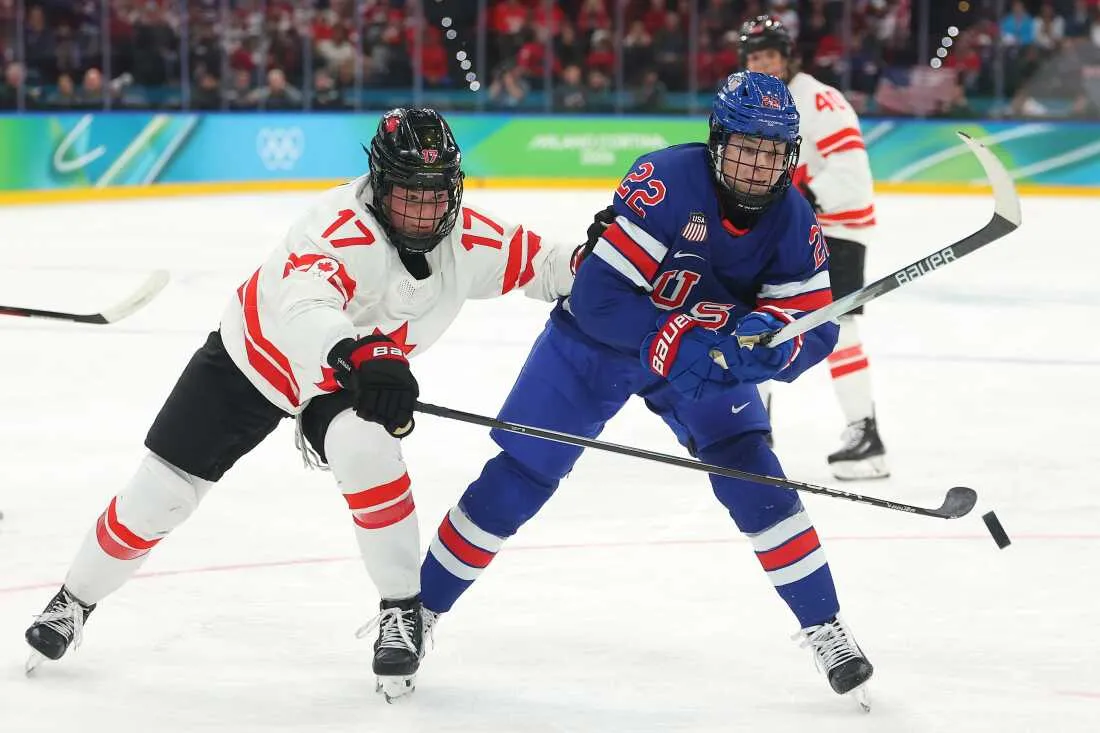
The 2026 Milan Cortina Winter Olympics men’s hockey tournament wrapped up with a dramatic 2-1 overtime victory for Team USA over Canada, securing America’s first gold medal in the discipline since 1980.[1] NHL players dominated the rosters of nearly every competing nation, bringing their club form to the international stage. As the regular season resumes this week, it’s worth examining how representatives from all 32 teams fared in Italy.[2]
From breakout performances by young stars to veterans who underdelivered, the tournament highlighted individual impacts amid team successes like Slovakia’s semifinal run and Finland’s bronze. Our pre-Olympics roster predictions set the stage, but the results tell a fuller story. Here’s a division-by-division breakdown of one standout or disappointment per NHL club.
Atlantic division
Boston Bruins defenseman Charlie McAvoy emerged as a cornerstone for Team USA, pairing seamlessly with Quinn Hughes to anchor the top defense. His physical play along the boards and neutral-zone disruptions were vital, especially after a challenging NHL season marred by a broken jaw.[1] McAvoy’s resilience helped the Americans navigate tough matchups.
Buffalo Sabres forward Tage Thompson proved his worth after being overlooked for the 4 Nations Face-Off. The towering center scored twice in the first four games, blending elite hands and speed on a third line with Dylan Larkin.[1] His power-play contributions against Sweden fueled U.S. momentum.
Detroit Red Wings captain Dylan Larkin ignited Team USA’s quarterfinal win over Sweden with the opener, showcasing veteran leadership and two-way reliability. His clutch scoring echoed his 4 Nations heroics, making him indispensable in key moments.[1]
Florida Panthers sniper Sam Reinhart disappointed for Canada despite his point-per-game NHL pace. Limited to lower-line minutes in a stacked forward group, he rarely flashed his signature scoring touch or speed, even as injuries forced adjustments.[1]
Montreal Canadiens winger Juraj Slafkovsky authored Slovakia’s Cinderella story, tallying four goals and seven points in four games en route to the semifinals. The 21-year-old’s presence drew defenders, signaling his rising leadership potential.[1]
Ottawa Senators goaltender Mads Sogaard showed promise for Denmark before a lower-body injury sidelined him mid-game against the U.S. His 32 saves in that 6-3 loss exceeded expectations, but the untimely exit hurt Denmark’s chances.[1]
Tampa Bay Lightning blueliner Erik Cernak provided steady reliability for Slovakia, scoring the opener against Germany and excelling in all situations. His understated style amplified the team’s family-like unity.[1]
Metropolitan division
Carolina Hurricanes center Sebastian Aho linked up beautifully with Mikko Rantanen for Finland, notching three goals and five points in five games. His pressure on Jordan Binnington in the semifinal nearly forced overtime.[1]
Columbus Blue Jackets defenseman Zach Werenski outshone even Quinn Hughes as Team USA’s top overall blueliner, blending poise, skill, and physicality across all situations.[1]
New Jersey Devils star Jack Hughes silenced doubters with four goals and seven points, including the golden overtime winner against Canada. His bottom-six role belied his game-changing impact.[1]
New York Islanders veteran Ondrej Palat offered limited depth scoring for Czechia, with just one key goal in the quarters overshadowed by an overtime loss to Canada.[1]
New York Rangers center Mika Zibanejad led Sweden in goals with three and points with six, including a clutch tie against the U.S. that forced overtime.[1]
Philadelphia Flyers defenseman Travis Sanheim silenced critics with a pivotal semifinal assist for Canada, sparking a comeback against Finland.[1]
Pittsburgh Penguins winger Rickard Rakell failed to elevate Sweden’s depth, managing one assist in limited minutes despite his NHL scoring prowess.[1]
Washington Capitals enforcer Tom Wilson embodied vintage grit for Canada, producing offensively while protecting teammates and creating chaos.[1]
Central division
Chicago Blackhawks forward Teuvo Teravainen struggled offensively for bronze-winning Finland, posting just one point in six games despite second-line deployment.[1]
Colorado Avalanche forward Martin Necas led Czechia in scoring, powering a quarterfinal push against Canada after an early loss.[1]
Dallas Stars defenseman Miro Heiskanen logged heavy minutes for Finland’s bronze squad, quarterbacking the top power play and penalty kill.[1]
Minnesota Wild defenseman Quinn Hughes justified his hype with seven points and the OT winner versus Sweden, logging massive ice time for gold.[1]
Nashville Predators winger Filip Forsberg underproduced for injury-hit Sweden, with one goal despite expectations as a top scorer.[1]
St. Louis Blues prospect Dalibor Dvorsky averaged a point per game for medal-bound Slovakia, anchoring lines and the top power play.[1]
Utah Mammoth forward Clayton Keller earned gold with minimal minutes, his skill justifying selection amid depth.[1]
Winnipeg Jets goaltender Connor Hellebuyck capped a legendary resume with 40 saves in the gold-medal clincher.[1]
Pacific division
Anaheim Ducks goaltender Lukas Dostal faltered for Czechia with a high goals-against average and middling save percentage.[1]
Calgary Flames forward Martin Pospisil triumphed post-concussion, contributing steadily for Slovakia’s medal chase.[1]
Edmonton Oilers superstar Connor McDavid set a points record, earned MVP honors, and powered Canada’s line with Celebrini and MacKinnon.[1]
Los Angeles Kings winger Joel Armia led Finland with eight points, thriving across all situations en route to bronze.[1]
San Jose Sharks rookie Macklin Celebrini starred on Canada’s top line, leading in goals before the final.[1]
Seattle Kraken forward Eeli Tolvanen rebounded with two points in the bronze game for Finland.[1]
Vancouver Canucks center Elias Pettersson disappointed for Sweden, scoring twice early but nothing else.[1]
Vegas Golden Knights center Jack Eichel delivered three goals and six points for U.S. gold, excelling everywhere.[1]
As detailed in ESPN’s full breakdown, these performances will influence narratives when NHL action restarts Wednesday. Standouts like McDavid and Hughes return with momentum, potentially boosting playoff pushes, while disappointments face added scrutiny. Medal hauls—gold for USA, silver Canada, bronze Finland, fourth Slovakia—underscore the global talent pool. Expect Olympic chemistry to linger in key matchups ahead.[2]
Frequently Asked Questions

Par Mike Jonderson
Mike Jonderson is a passionate hockey analyst and expert in advanced NHL statistics. A former college player and mathematics graduate, he combines his understanding of the game with technical expertise to develop innovative predictive models and contribute to the evolution of modern hockey analytics.