





The Montreal Canadiens sent shockwaves through the NHL landscape on June 27, 2025, acquiring right-shot defenseman Noah Dobson from the New York Islanders in a blockbuster trade that signals their unequivocal shift from rebuild to contention. By surrendering forward Emil Heineman and two first-round picks (16th and 17th overall) in the 2025 NHL Draft, general manager Kent Hughes made his most aggressive move yet, immediately signing Dobson to an eight-year contract extension that locks in the 25-year-old as a cornerstone of the franchise’s blue line for the better part of the next decade. This acquisition addresses Montreal’s most glaring organizational need—a legitimate top-pairing right-shot defenseman capable of driving offense while playing heavy minutes against opposing top lines.
The timing couldn’t be more critical for a Canadiens team coming off a surprising 40-31-11 campaign that saw them return to the postseason after a difficult rebuild. While their young core of Nick Suzuki, Cole Caufield, and 2024 Calder Trophy winner Lane Hutson provided hope for the future, the departure of veteran David Savard to retirement created a massive void on the right side of the defense. Dobson’s arrival doesn’t just fill that gap—it represents a significant upgrade and potentially the final piece in Montreal’s transformation from lottery team to legitimate Stanley Cup contender.
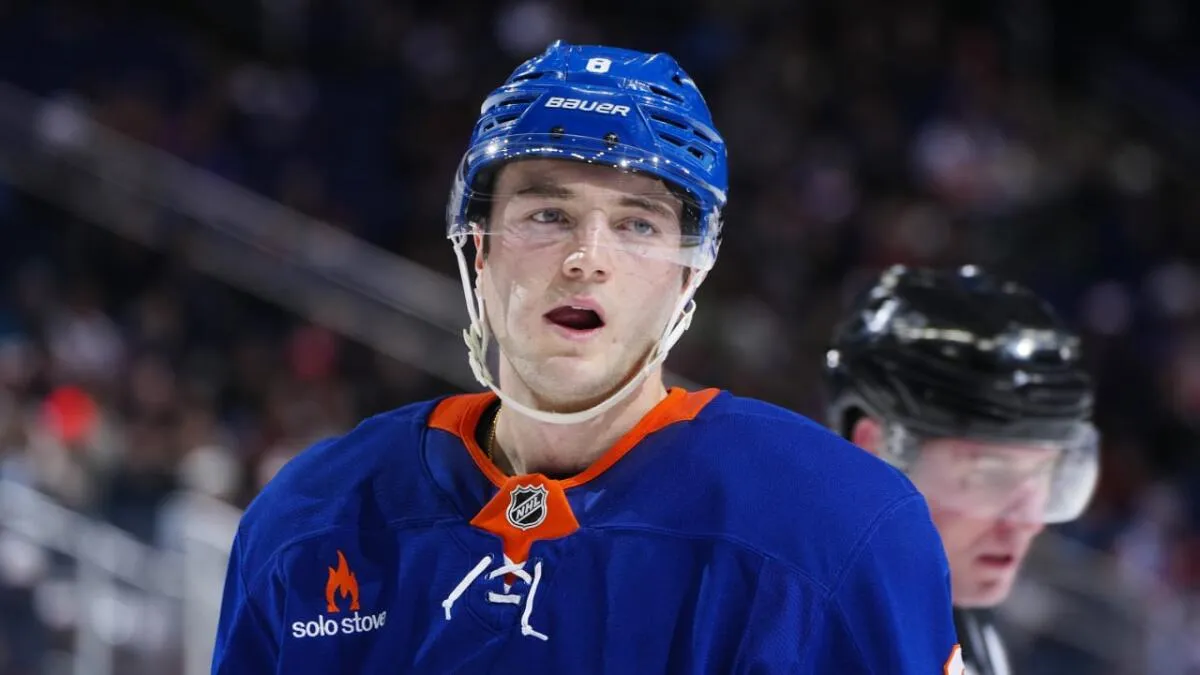
Noah Dobson trade details and contract extension with Montreal Canadiens
The framework of the deal reflects the premium value of elite defensemen in today’s NHL. Montreal shipped out Heineman, a promising 23-year-old winger who notched 18 points in 62 games during his rookie season, plus the immediate futures represented by two mid-first-round selections. While the cost was substantial, it pales in comparison to the certainty Dobson provides. The eight-year extension, reportedly carrying an average annual value of $8.5 million, now positions Dobson as the highest-paid defenseman on the roster and the strategic partner for Hutson on what projects as one of the league’s most dynamic pairings.
From the Islanders’ perspective, the move represented a painful but necessary pivot. Facing cap constraints and a roster that had plateaued, general manager Lou Lamoriello opted for a futures package that could accelerate their own retooling process. Heineman’s tenacity and scoring touch offered immediate NHL readiness, while the two first-rounders provided valuable ammunition for either prospect acquisition or additional moves. Yet the consensus around the league immediately favored Montreal, with most analysts viewing Dobson as exactly the type of player you mortgage future assets to acquire—a proven top-pairing defenseman entering his prime with a track record of durability and offensive production.
The contract structure itself reveals Montreal’s confidence in their competitive window. By committing to Dobson through his age-33 season, Hughes has essentially declared the next eight years as the Canadiens’ championship era. The deal includes a full no-movement clause for the first five seasons, underscoring the mutual commitment between player and organization. For Dobson, the appeal extended beyond financial security—he joins a youthful, ascending roster with championship pedigree in one of hockey’s most passionate markets.
Noah Dobson top-pairing defense role transforms Montreal Canadiens blue line
Dobson’s arrival fundamentally alters the deployment strategy for coach Martin St. Louis, who suddenly possesses one of the NHL’s most enviable defense corps. The projected top pairing of Dobson with Hutson creates a devastating combination of offensive creativity and two-way stability. Hutson’s Calder Trophy season showcased his elite puck-moving ability and power-play quarterback skills, but the Canadiens’ coaching staff often had to shelter him defensively. Dobson’s presence changes that equation entirely—his 6-foot-4 frame, smooth skating, and mature defensive reads allow Hutson to take more offensive risks while trusting his partner to handle the backend responsibilities.
What makes this partnership particularly intriguing is the complementary nature of their skill sets. Hutson excels at transitional play and creating offense through the neutral zone, while Dobson brings a heavy shot from the point and exceptional vision for finding teammates in scoring positions. During his 70-point season in 2023-24, Dobson demonstrated his playmaking prowess with 60 assists, joining Islanders legend Denis Potvin as just the second defenseman in franchise history to reach that milestone. That season also featured 10 goals, with five coming on the power play, highlighting his utility in special teams situations that desperately needed reinforcement in Montreal.
The ripple effects extend throughout the lineup. Mike Matheson, who previously carried the heaviest load as Montreal’s number-one defenseman, can now slide into a more appropriate second-pairing role where his offensive instincts won’t be overtaxed by constant matchups against elite competition. Kaiden Guhle and Arber Xhekaj form a punishing physical third pair, giving Montreal the rare luxury of three distinct defense pairings, each bringing different strengths. This depth becomes crucial during the postseason when coaching adjustments and injury management often determine series outcomes.
Offensive production elevates Noah Dobson to elite status for 2025-26 season
The numbers tell a compelling story of a defenseman arriving at superstardom. Dobson’s four-year totals of 209 points (46 goals, 163 assists) in 308 games rank 10th among all NHL defensemen over that span, placing him in elite company alongside Cale Makar, Quinn Hughes, and Adam Fox. His 2023-24 season represented a true breakthrough, but even his “down” year in 2024-25—39 points in 71 games—came while playing through a nagging lower-body injury that cost him time in December and January. When healthy, Dobson consistently produced at a 50-plus point pace, remarkable production for a defenseman who also averaged over 22 minutes per game and drew the toughest defensive assignments.
Advanced metrics further support his value proposition. According to data from MoneyPuck, Dobson led all Islanders defensemen with 5.9 expected goals during the 2024-25 season, while his on-ice expected goal differential of +11.3 ranked first among New York’s blue line. These underlying numbers suggest his offensive contributions weren’t merely a product of opportunistic play but rather reflected genuine driving offense and territorial dominance. His ability to exit the defensive zone cleanly, either through crisp passing or controlled skating, relieved pressure on Islanders goaltenders and jumpstarted transition opportunities.
The power-play dynamic he brings cannot be overstated. Montreal’s man-advantage units struggled with predictability last season, often forcing attempts through Hutson at the point while opponents collapsed around the slot. Dobson’s right-handed shot from the left circle creates a completely new look, forcing penalty killers to respect the one-timer threat and opening passing lanes for cross-ice feeds to Caufield and Suzuki. This dual-threat capability from the point should immediately elevate Montreal’s power-play efficiency from its 19.2 percent conversion rate in 2024-25 into the top-10 territory.
Key attributes Dobson brings to Montreal:
- Elite offensive production from the back end
- Right-shot balance to complement left-handed Hutson
- Proven top-pairing minutes against elite competition
- Power-play versatility with heavy shot and playmaking
- Durability and age (25) fitting Montreal’s competitive window
Noah Dobson top-pairing defense impact on Montreal Canadiens playoff aspirations
The acquisition fundamentally changes the calculus for Montreal’s 2025-26 season and beyond. Where the Canadiens entered last year as a fringe playoff hopeful, they now begin the campaign with legitimate designs on the Atlantic Division title and a deep postseason run. The addition of Dobson slots another proven impact player into a roster already featuring six others aged 25 or younger in NHL.com’s top 100 keeper and dynasty rankings—tied for the most among all NHL teams. This youth movement, combined with veteran stability from players like Brendan Gallagher and Joel Edmundson, creates an optimal blend of energy and experience.
General manager Kent Hughes hasn’t been shy about raising expectations. Following the trade, Hughes acknowledged that while the roster looked improved on paper, management still had work to do to reach their ultimate championship aspirations. This sentiment reflects both the excitement around Dobson’s arrival and the reality that complementary pieces remain necessary. The penalty kill, in particular, requires attention after losing Savard, Christian Dvorak, and Joel Armia—their three most relied-upon shorthanded performers. Dobson contributes here as well, having averaged 1:43 of shorthanded ice time per game with the Islanders, though his primary value remains at even-strength and on the power play.
What makes the timeline so compelling is the synchronization of Montreal’s core entering their collective prime. Suzuki (26), Caufield (24), Slafkovsky (21), Hutson (21), and now Dobson (25) form a nucleus that should improve organically over the next three to five years while competing at the highest level. Unlike teams that mortgage their future for a brief championship window, Montreal has positioned themselves for sustained excellence. The Dobson trade accelerated the timeline without sacrificing long-term flexibility, a rare feat in modern NHL roster construction that speaks to both Hughes’ patience and his opportunistic aggression when the right target became available.
Montreal’s early 7-3-0 start to the 2025-26 season validates the organization’s bold approach. The top line of Caufield, Suzuki, and Slafkovsky has been dominant, rookie goaltender Jakub Dobes has exceeded expectations, and the special teams have shown dramatic improvement. Perhaps most importantly, the Dobson-Hutson pairing has clicked immediately, combining for 14 points in those first 10 games while posting a 56 percent expected goals share at five-on-five. This instant chemistry suggests the trade will pay dividends far sooner than even the most optimistic projections indicated.
The Canadiens’ ascent represents a masterclass in rebuilding through the draft while remaining flexible enough to capitalize when transformational talents become available. Noah Dobson didn’t just join a hockey team—he became the final ingredient in a recipe that should sustain Montreal’s competitive relevance for the better part of a decade. As the season progresses and the playoff race intensifies, the true value of this franchise-altering acquisition will become even more apparent, but the early returns suggest the Canadiens have found their bridge from potential to fulfillment.
Frequently Asked Questions

Par Mike Jonderson
Mike Jonderson is a passionate hockey analyst and expert in advanced NHL statistics. A former college player and mathematics graduate, he combines his understanding of the game with technical expertise to develop innovative predictive models and contribute to the evolution of modern hockey analytics.