












The Washington Capitals captain continues to rewrite the record books at age 40. In a dominant 8-4 victory over the Montreal Canadiens at Bell Centre, Alex Ovechkin notched his 33rd career hat trick and added an assist to surpass Colorado Avalanche legend Joe Sakic on the NHL’s all-time points list, cementing his place among the game’s immortals with a performance that reminded everyone why they call him “The Great Eight.”
Just two minutes remained in regulation when Ovechkin received a pristine feed from linemate Dylan Strome and buried his second goal of the evening, his 906th career tally. The moment registered his 1,642nd point, moving him past Sakic’s 1,641 and into sole possession of 10th place in NHL history. He would add an empty-netter minutes later to finish the night with 1,643 points, leaving no doubt about his ascent up hockey’s most sacred leaderboard.
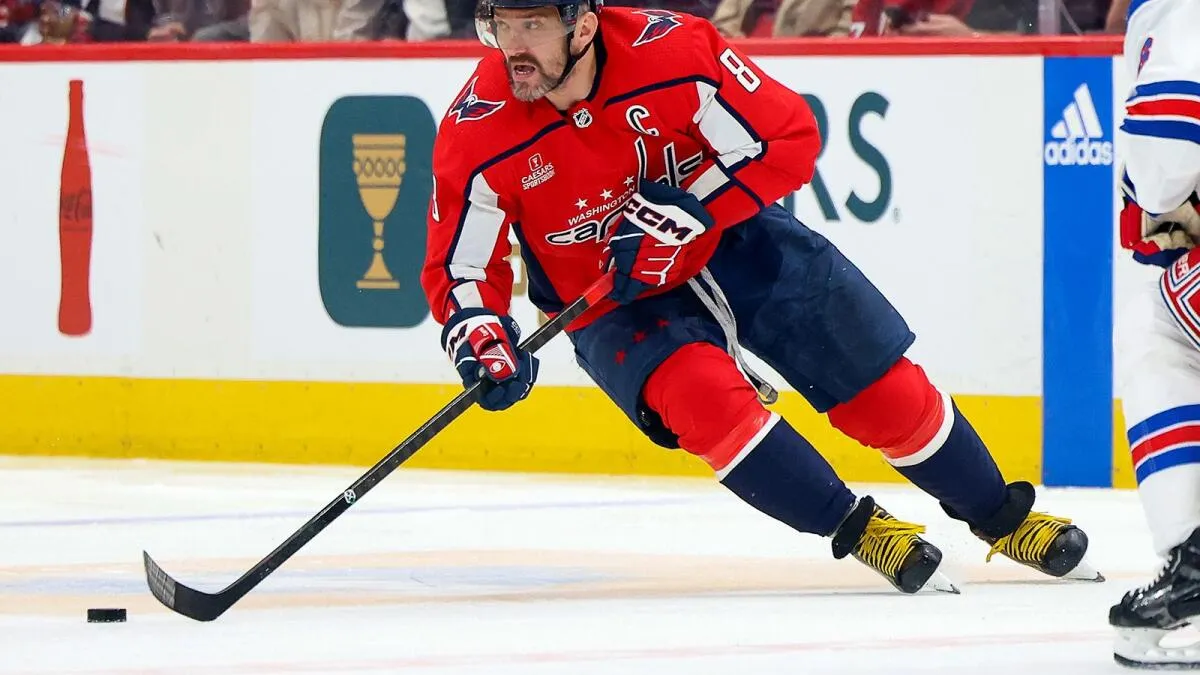
The historic night in Montreal
The milestone moment
The electricity in Bell Centre was palpable even before Ovechkin’s milestone moment arrived. At 16:03 of the third period, with the Capitals clinging to a 6-4 lead, Strome threaded a perfect pass through traffic to find Ovechkin in his office. The Russian winger made no mistake, snapping the puck past Canadiens goaltender Jakub Dobes to secure his place in hockey history. The goal extended Washington’s lead and triggered a celebration among Capitals players who understand the weight of what their captain continues to accomplish two decades into his remarkable career.
“I just try to do my job and try to enjoy the moment,” Ovechkin told reporters after the game, his typical humility undercutting the magnitude of the achievement. The empty-netter that completed his hat trick was almost anticlimactic—just another entry in a box score that grows more impressive with each passing season. Yet every goal now carries historical significance as Ovechkin continues his assault on records once thought unbreakable.
A captain’s performance
This wasn’t merely a nostalgic victory lap for an aging superstar. Ovechkin’s four-point night showcased the same lethal shot and offensive instincts that have defined his 19-year career. He opened the scoring just 60 seconds into the contest, blasting a wrist shot past Sam Montembeault on the power play after Strome won the faceoff clean in the right circle. The goal extended his current goal streak to four games, a feat that makes him only the third player in NHL history to accomplish such a run at age 40 or older.
The accomplishment places Ovechkin alongside Dean Prentice of the 1972-73 Minnesota North Stars and Jaromir Jagr of the 2012-13 Dallas Stars. When he added the hat trick, Ovechkin became just the sixth player to score three goals in a game at age 40, joining an exclusive club that includes Gordie Howe, Johnny Bucyk, Jagr, Nicklas Lidstrom, and Teemu Selanne. The hat trick also tied him with Brett Hull for fourth-most in NHL history, trailing only Wayne Gretzky (50), Mario Lemieux (40), and Mike Bossy (39).
Team effort on special night
While Ovechkin rightfully claimed the spotlight, the victory represented a complete team effort during a particularly emotional evening. Strome finished with three assists despite learning before warmups that his wife had gone into labor with their third child. The center played through the distraction, his mind divided between the ice and the delivery room, yet he still managed to set up Ovechkin’s historic marker.
“I kind of thought I was going to make it home in time, maybe,” Strome said. “Obviously that didn’t happen but I just tried to focus on hockey and the guys were right there with me.” His performance exemplified the tight-knit nature of a Capitals team that has rallied around its aging captain’s pursuit of immortality.
Ethen Frank, playing in just his second full season with Washington, matched Ovechkin’s four-point output with two goals and two assists. After the game, Frank captured the feeling inside the Capitals’ room: “After everything he’s done we’re still amazed at what he can do, and I’m sure he’s not close to slowing down.” The 27-year-old forward’s breakout performance highlighted Washington’s depth, crucial for a team hoping to remain competitive while its franchise player chases history.
Climbing the all-time list
The company he keeps
Ovechkin now sits at 1,643 career points, composed of 907 goals and 736 assists in 1,512 games. The player he passed, Joe Sakic, accumulated 1,641 points over 1,378 games with the Quebec Nordiques and Colorado Avalanche, winning two Stanley Cups and earning hockey’s ultimate respect as both a player and later as an executive. Sakic’s career average of 1.19 points per game slightly edges Ovechkin’s 1.09, but longevity and goal-scoring prowess have become the Capitals’ captain’s distinguishing traits.
The top 10 now reads as a who’s who of hockey royalty: Wayne Gretzky (2,857), Jaromir Jagr (1,921), Mark Messier (1,887), Gordie Howe (1,850), Ron Francis (1,798), Marcel Dionne (1,771), Steve Yzerman (1,755), Mario Lemieux (1,723), Sidney Crosby (1,708), and now Ovechkin. Among active players, only Crosby ranks ahead of Ovechkin, and the Pittsburgh Penguins captain’s 1,708 points represent the next mountain to climb.
What’s next for the great eight
At his current pace—20 points in 21 games this season—Ovechkin projects to add approximately 78 points over a full 82-game schedule. This would place him around 1,700 points by season’s end, potentially leapfrogging Crosby for ninth place and putting Lemieux’s 1,723 points within striking distance for the 2026-27 campaign.
The real intrigue lies in Ovechkin’s pursuit of Gretzky’s all-time goals record of 894. With 907 goals already banked, Ovechkin has surpassed The Great One and now targets the seemingly impossible milestone of 1,000 career goals. Every game brings him closer to that magical number, and his performance at age 40 suggests he may have several productive seasons remaining.
Comparing eras and careers
Context matters when comparing players across different eras. Sakic played the majority of his career in the high-scoring 1990s and early 2000s, when power plays were more frequent and goaltending equipment was less refined. Ovechkin has dominated during the dead puck era’s evolution into today’s speed-focused, salary cap-constrained game. His ability to score from his “office” in the left circle has remained constant despite defensive systems designed specifically to stop him.
The physical toll tells another story. Ovechkin has remained remarkably durable, playing fewer than 72 games only three times in his career. Sakic, conversely, battled injuries throughout his final seasons, missing 38 games in 2007-08 due to hernia surgery and a snow-blower accident that broke three fingers. Ovechkin’s conditioning and training regimen have become legendary, allowing him to maintain elite production while peers have faded.
The significance of passing Sakic
Sakic’s enduring legacy
Joe Sakic represents more than just a number on a leaderboard. The Burnaby, British Columbia native spent his entire 21-year career with the Nordiques/Avalanche franchise, captaining two Stanley Cup champions and earning the Conn Smythe Trophy in 1996. His wrist shot was considered among the deadliest in hockey history, and his quiet leadership style set a standard for captaincy across professional sports.
Sakic’s most memorable moment came after the 2001 Stanley Cup victory when, defying tradition, he passed the trophy directly to Ray Bourque rather than hoisting it first himself. Bourque had waited 22 seasons to win hockey’s ultimate prize, and Sakic’s gesture encapsulated his selfless approach to the game. He retired in 2009 and was inducted into the Hockey Hall of Fame in 2012, his first year of eligibility.
Ovechkin’s unique trajectory
While Sakic built his legend on consistency and leadership, Ovechkin has revolutionized what it means to be a goal-scorer in the modern era. His 907 goals represent the most by any player in NHL history, and he shows no signs of slowing down. Unlike Sakic, who balanced his offense between goals and assists, Ovechkin has always been primarily a shooter first, a mindset that has redefined positional expectations for wingers.
The Washington captain has scored 200 or more goals across three different decades—a feat no other player has accomplished. His 245 goals in the 2000s, 437 in the 2010s, and 213 in the 2020s demonstrate an unprecedented ability to adapt his game while maintaining elite production. Sakic, by contrast, never scored more than 54 goals in a single season, though his 1,016 career assists prove he was as much a playmaker as a finisher.
The goal-scorer’s evolution
What makes Ovechkin’s pursuit of history so compelling is its singularity. While Sakic and most top-10 scorers compiled their points through balanced production, Ovechkin has become perhaps the most specialized elite scorer in hockey history. More than 55% of his points have come from goals, an almost unheard-of ratio among the league’s all-time leaders.
This specialization speaks to both his talent and adaptability. As the NHL has become faster and more skilled, Ovechkin has maintained his physical, power-forward style while incorporating subtle refinements to his game. His one-timer remains virtually unstoppable, his positioning impeccable, and his hockey sense underrated. The result is a player who has outlasted entire generations of stars while remaining the focal point of every opponent’s defensive game plan.
The milestone also highlights the changing nature of career longevity. Sakic retired at 39, his body breaking down after years of punishment. Ovechkin at 40 looks capable of playing several more seasons at a high level, his training methods and dedication to conditioning allowing him to defy the typical aging curve. Whether he can maintain this pace into his mid-40s remains uncertain, but recent history suggests writing him off is foolish.
Alex Ovechkin passes Joe Sakic for 10th on NHL all-time points list represents more than just a number changing on a scoreboard. It symbolizes the torch passing from one generation’s finest leader to perhaps the greatest pure scorer the game has ever known. For Capitals fans, it’s another milestone in a journey that has redefined what greatness looks like in the modern NHL. For hockey historians, it’s a reminder that some records aren’t meant to stand forever, especially when a 40-year-old legend still carries his team and the sport on his shoulders. As Ovechkin continues his impossible climb toward 1,000 goals and beyond, the only remaining question isn’t if he’ll amaze us again, but when—and how high he’ll ultimately soar before his remarkable story reaches its final chapter.
Frequently Asked Questions

Par Mike Jonderson
Mike Jonderson is a passionate hockey analyst and expert in advanced NHL statistics. A former college player and mathematics graduate, he combines his understanding of the game with technical expertise to develop innovative predictive models and contribute to the evolution of modern hockey analytics.