The Pittsburgh Penguins’ 2026 playoff run ended abruptly with a Game 6 loss to the Philadelphia Flyers, halting a potential reverse sweep and exposing key vulnerabilities. Despite a strong regular season where Sidney Crosby, Evgeni Malkin, and Erik Karlsson kept the team competitive, the Penguins struggled to score against a stifling Flyers defense anchored by breakout goalie Dan Vladar.[1][2] This early exit puts general manager Kyle Dubas in a delicate position, balancing the desires of aging stars with the need for a sustainable future.
With significant cap space and draft capital at their disposal, the Penguins must address offensive woes, goaltending uncertainty, and roster youth infusion. Dubas has shown creativity in recent moves, but the clock is ticking on the Crosby-Malkin-Letang era.
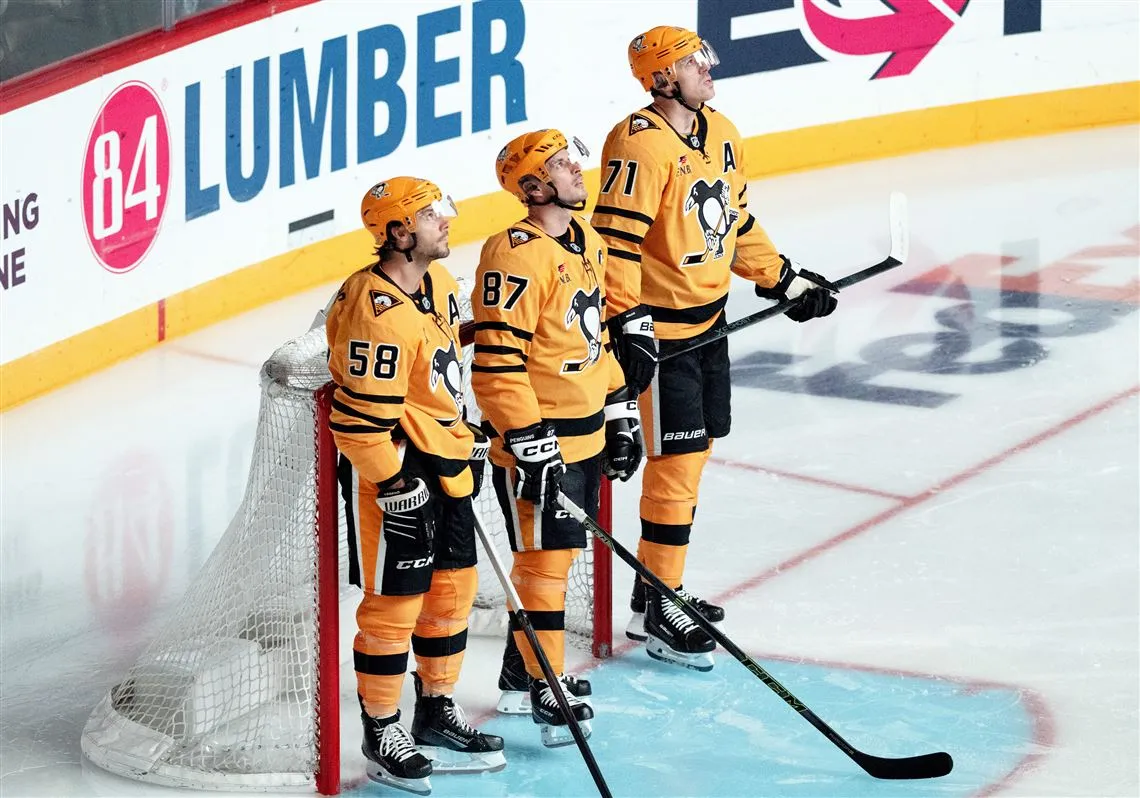
Playoff failures highlight scoring drought
The Penguins’ most glaring issue in the playoffs was their anemic offense. They averaged just 1.83 goals per game, third-fewest among the 16 playoff teams, managing only 11 goals against the Flyers—including one empty-netter.[3]
This was a stark contrast to their regular season, where they ranked third in NHL scoring and seventh on the power play. Against Philadelphia, however, they converted just 3 of 19 power-play chances, including a disastrous 0-for-5 performance in Game 2 that yielded a shorthanded goal.
Vladar’s stellar play exacerbated the problem, posting a .937 save percentage and 1.61 goals-against average. The Penguins’ top scorers—Crosby (38 years old), Karlsson (35), Bryan Rust (33), and Malkin (39)—carried the load, but younger contributions were scarce.
Father Time has caught up. Kris Letang, at 39, managed 34 points in 74 games, up slightly from 30 the prior year but well below his 51-point 2023-24 season. Trading Jake Guentzel two years ago left a void that trades like Anthony Mantha haven’t fully filled.
The offense’s disappearance underscores a deeper issue: overreliance on veterans. Without consistent secondary scoring, playoff success remains elusive.
Goaltending carousel demands resolution
Goaltending compounded Pittsburgh’s woes. Stuart Skinner started the first three games with a dismal .873 save percentage and 3.08 goals-against average, prompting a switch to Arturs Silovs for Game 4.
Silovs delivered, winning two games with a .939 save percentage and 1.52 GAA, but it was too late to overcome the deficit. Skinner’s regular-season stats (.885 SV%, 2.99 GAA in 27 games) offered little reassurance, especially after his playoff flop.
As a pending UFA, Skinner’s future hangs in the balance. Recent analysis questions if he’s played his last game as a Penguin, favoring Silovs as the starter despite his regular-season .888 SV% and 3.07 GAA.
Dubas faces choices: let Skinner walk and pair Silovs with a veteran via trade, or promote AHL prospects like Joel Blomqvist or Sergei Murashov. Goaltending stability is crucial, but not the top priority.
The late pivot worked temporarily, but early struggles dug an insurmountable hole. Pittsburgh can’t afford another tandem experiment.
Reliable netminding will free resources for other upgrades, allowing the offense to breathe.
Evgeni Malkin’s uncertain path forward
Malkin’s future looms largest. The 39-year-old pending UFA posted 61 points (42 assists) in 56 games, a throwback season warranting an extension if he wishes to stay—and retire as a Penguin.
Sidney Crosby has publicly advocated for re-signing his longtime linemate, emphasizing the trio’s chemistry.[4] Yet Dubas must weigh sentiment against rebuild realities.
Letang’s contract runs two more years, but his declining production signals trouble. Losing Malkin would accelerate transition, but his leadership and skill are irreplaceable short-term.
Free agency offers slim pickings; Buffalo’s Alex Tuch (29) headlines UFAs but plays on a stronger Sabres squad. Overpaying risks cap inefficiency.
Dubas’ past acumen—acquiring Mantha (career-high 64 points), Egor Chinakhov (36 points in 43 games), and Thomas Novak (42 points)—suggests he can replace Malkin creatively.
The decision defines the offseason: extend for one last run or pivot to youth?
Rejuvenating the attack with fresh talent
Pittsburgh’s top five regular-season scorers were all 30-plus: Crosby, Karlsson, Rust, Mantha (31), and Malkin. This aging core needs bolstering from within or without.
Strategies to reignite the offense include better power-play execution and depth scoring, lessons from the Flyers series.
Dubas holds three first-round picks and seven seconds over the next three drafts—assets to protect or flip judiciously. Trading veterans for young wingers aligns with recent successes like Chinakhov.
Potential targets: under-25 trade pieces to pair with Crosby, easing the load on elders. Free agency tempts, but Tuch may command top dollar elsewhere.
Mantha, Novak, and Chinakhov proved Dubas’ eye for value. Replicating that via trades preserves picks for a full rebuild.
Youth infusion prevents 2026-27 scoring from worsening, buying time for prospects.
Maximizing cap flexibility and assets
The Penguins boast $45.8 million in cap space, per recent projections—a war chest for maneuvers.[5]
This affords aggression without mortgaging the future, unlike past win-now splurges. Acquiring first-rounders via savvy deals accelerates contention.
However, nostalgia pressures Dubas for “one more run” with Crosby, Malkin, and Letang. Balancing playoffs and prospects is GM artistry.
Ownership changes, like the recent Fenway-to-Hoffmann sale, add layers but signal investment.[6]
Dubas must stay crafty, avoiding rental chases that deplete drafts.
Pittsburgh’s transition demands precision; cap smarts position them for relevance.
The Penguins stand at a crossroads, where honoring legends meets building anew. Dubas’ offseason blueprint—resolving Malkin, stabilizing the crease, and injecting speed—could spark contention or hasten rebuild. Fans crave playoffs, but sustainability ensures the black and gold endure beyond the Crosby era.[7]
Frequently Asked Questions

Par Mike Jonderson
Mike Jonderson is a passionate hockey analyst and expert in advanced NHL statistics. A former college player and mathematics graduate, he combines his understanding of the game with technical expertise to develop innovative predictive models and contribute to the evolution of modern hockey analytics.