




Buffalo enters free agency with $12.9 million in projected 2026-27 cap space and must decide how to fit Alex Tuch at $10.5 million to $11 million AAV.
The Sabres reached the second round for the first time since 2011 before falling to Montreal in Game 7. General manager Jarmo Kekäläinen now confronts the task of keeping the core intact.
Tuch, the top unrestricted free agent in a shallow class, told media this week that talks with his family and the club will begin in the next two to three weeks. His agent and the Sabres maintained open communication all season.
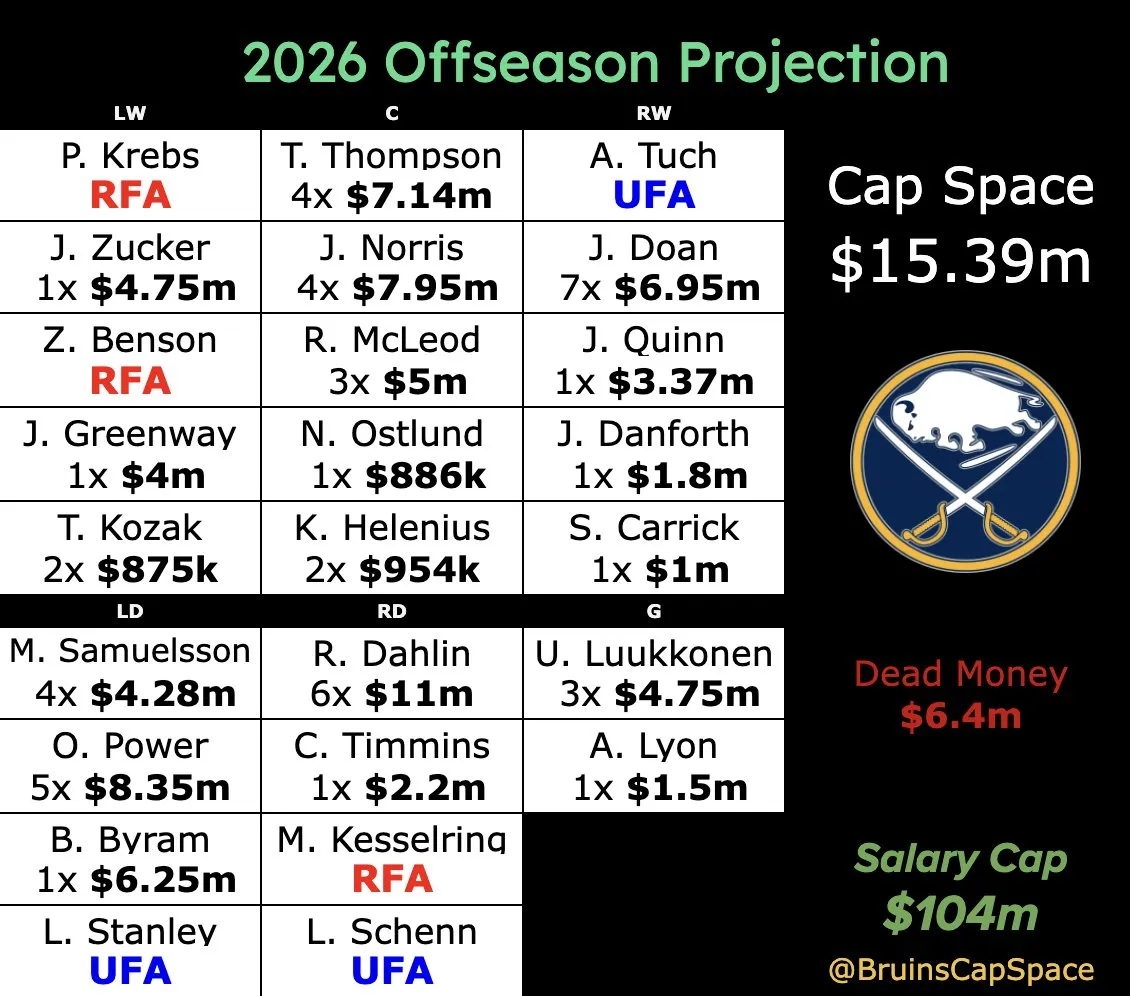
Limited room forces roster creativity
Zach Benson and Michael Kesselring represent the main restricted free agents. Benson posted a breakout regular season and strong playoff showing while Kesselring saw limited postseason ice time.
Kekäläinen must stretch the $12.9 million across multiple contracts. Re-signing Tuch at the expected range would consume most of the space and leave minimal flexibility for the two RFAs.
Lindy Ruff received a two-year contract extension through the 2027-28 season on May 20, locking in the coaching staff. That stability does not solve the salary-cap arithmetic.
Possible trades or short-term deals
Kekäläinen has already signaled willingness to explore moves that create breathing room. One or more departures from the defense corps or bottom-six forwards could open the necessary dollars.
If the Sabres hold firm below Tuch’s market number he will attract offers elsewhere given the thin free-agent pool. Benson and Kesselring could also draw interest from teams seeking cost-controlled talent.
The club’s recent playoff success gives Tuch incentive to stay, yet the numbers require precise execution before July 1.
Frequently Asked Questions
Sources

Par Mike Jonderson
Mike Jonderson is a passionate hockey analyst and expert in advanced NHL statistics. A former college player and mathematics graduate, he combines his understanding of the game with technical expertise to develop innovative predictive models and contribute to the evolution of modern hockey analytics.