











When the Nashville Predators signed Steven Stamkos to a four-year, $32 million deal in the summer of 2024, expectations soared across Smashville. The two-time Stanley Cup champion and future Hall of Famer was supposed to bring elite goal-scoring prowess to a franchise hungry for offensive production. Instead, the 2024-25 campaign delivered disappointment, and the 2025-26 season has only amplified concerns. Through the opening weeks of this season, Stamkos has struggled to find his rhythm, leaving fans and analysts questioning what’s gone wrong for one of hockey’s most decorated snipers.
The numbers tell a sobering story. After potting 40 goals and 81 points in his final season with the Tampa Bay Lightning, Stamkos saw his production plummet to 27 goals and 53 points during his debut year in Nashville. Now, in the 2025-26 campaign, he’s managed just one goal and one assist through 11 games—a pace that would result in career-worst totals. The power play specialist who once terrorized goaltenders with his lethal one-timer has been largely invisible, with zero power-play goals and a meager 25 shots on goal. For a player averaging 2.27 shots per game, compared to 174 total shots last season, the offensive output simply isn’t there.
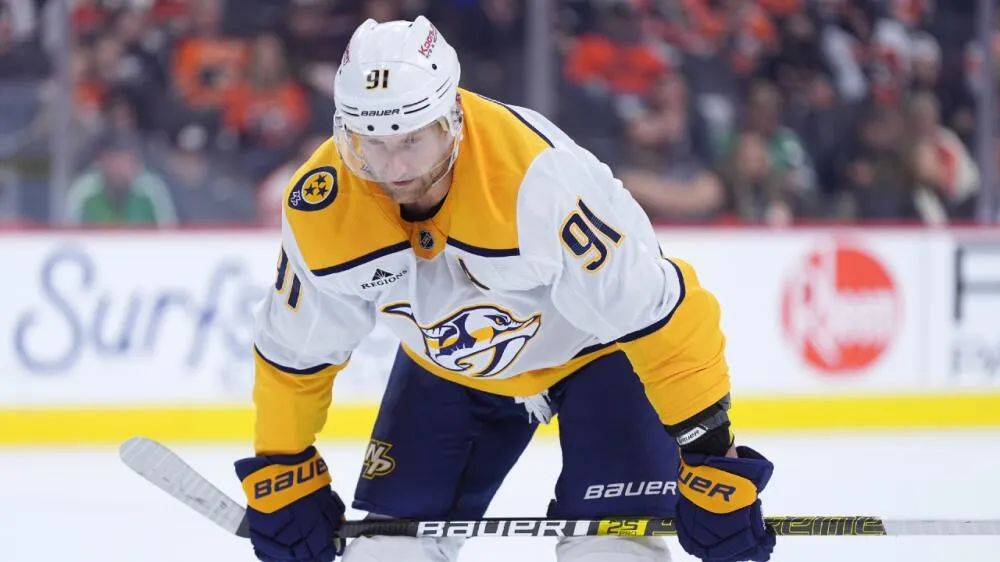
Understanding the Steven Stamkos Nashville Predators slump in 2025-26 season
Multiple factors have contributed to Stamkos’s ongoing struggles in Tennessee. Chief among them is the chemistry issue that has plagued him since arriving in Nashville. Head coach Andrew Brunette addressed this concern candidly, stating, “He’s having trouble finding some chemistry. That’s kind of been for the whole time he’s here. We’re hoping we find somebody for him.” Unlike his time in Tampa Bay, where he enjoyed years of familiarity with linemates like Nikita Kucherov and Brayden Point, Stamkos has been shuffled through various line combinations without establishing a consistent rhythm.
The Predators’ center depth has been particularly problematic. Brady Martin, Nashville’s fifth overall pick in the 2025 NHL Draft, made the team out of training camp but managed only one assist in three appearances before being sent back to the OHL. Fedor Svechkov has also struggled in the pivot role, remaining goalless and becoming a healthy scratch for multiple games. This instability has forced Brunette to experiment with Stamkos at center, despite the veteran’s greater success on the wing throughout his career.
The positional uncertainty hasn’t helped matters. Stamkos excels when positioned on the left wing, where he can unleash his trademark one-timer from the faceoff circle. Shot data reveals he’s scored the most goals from that spot throughout his career, utilizing a shot that clocks in at 63 MPH—placing him in the 89th percentile for average shot speed. When forced to play center, Stamkos becomes more concerned with defensive responsibilities and faceoff duties, limiting his ability to find those prime scoring positions.
His defensive struggles have compounded the offensive woes. Following trade rumors that emerged earlier this season, Stamkos posted a career-worst minus-36 rating in 2024-25, marking his second consecutive season with a negative plus/minus. Despite starting only 5.4% of his shifts in the defensive zone last season, he still found himself on the wrong side of scoring chances far too often. For a team already struggling defensively, adding a liability in their own end only magnified the problems.
The positional experiment and its limited success
In late October 2025, Brunette made the decision to move Stamkos back to center, hoping the position change would spark both the player and the team’s moribund offense. “He still skates great,” Brunette said. “We just want him to have the puck more. As a center, it gives him a little more freedom.” The coach had tried this approach during the previous season when Tommy Novak struggled, eventually trading Novak and Luke Schenn to the Pittsburgh Penguins for Michael Bunting.
Stamkos expressed willingness to play wherever needed. Prior to a game against his former Lightning team, he noted, “(Brunette) and I have talked. I’m obviously comfortable playing there. I thought, when we made the switch last year, that it kind of helped out… I thought (the Dallas game) felt good. I feel like you’re involved a little more, touch the puck a little more. Hopefully, that continues to translate.” However, even facing Tampa Bay didn’t provide the emotional spark many anticipated. In a 5-2 loss to the Lightning, Stamkos managed just three shots on goal with no points in 16:23 of ice time.
The sample size remains small, but the results have been underwhelming. Nashville’s offense ranks 27th in the NHL in goals scored, managing two or fewer goals in eight of their first 11 games. While Stamkos isn’t solely responsible for the team’s offensive drought, his lack of production from a player earning $8 million annually has been glaring. The Predators desperately need their marquee signing to deliver, particularly with other offensive pieces like Filip Forsberg requiring support.
Logic suggests that keeping Stamkos on the wing makes the most sense for everyone involved. Ryan O’Reilly, a former Selke Trophy winner, possesses elite faceoff abilities and defensive acumen that make him far better suited for top-line center duties. Allowing Svechkov development time in a second-line center role while sliding Stamkos to his natural left wing position would optimize the lineup. Yet injuries, inconsistency, and desperation have kept Brunette mixing and matching in search of any offensive spark.
Historical context and the weight of expectations
To understand the magnitude of Stamkos’s decline, one must consider his Tampa Bay pedigree. Over 16 seasons with the Lightning, he accumulated 555 goals and 1,137 points in 1,082 games. He won two Maurice “Rocket” Richard Trophies as the league’s leading goal scorer and hoisted back-to-back Stanley Cups in 2020 and 2021. The No. 1 overall pick in the 2008 NHL Draft became synonymous with Lightning hockey, delivering clutch performances and establishing himself as a future first-ballot Hall of Famer.
His final three years in Tampa Bay saw Stamkos average 90 points per season, culminating in that 40-goal, 81-point campaign in 2023-24. Expected goals metrics showed he consistently outperformed projections, scoring 27 goals against an expected total of 22.7 during his first Nashville season. While the volume remained decent, the dramatic drop-off in overall production signaled deeper issues than simple puck luck or finishing ability.
The transition from Tampa Bay to Nashville represented more than just a change in uniform. Stamkos left behind an organization he helped build into a dynasty, familiar systems he’d mastered, and teammates who understood his tendencies instinctively. In Nashville, he joined a team with championship aspirations but significant question marks. General Manager Barry Trotz had assembled an expensive roster through free agency signings, but chemistry takes time to develop. The “crazy introduction of multiple core pieces basically screwed up Nashville’s prior rhythm,” as one analysis noted, creating discord rather than immediate success.
Age remains an elephant in the room. At 35 years old, Stamkos is no longer the dynamic scorer who could take over games single-handedly. While Brunette insists “he still skates great,” the reality is that elite athletes inevitably decline. The question becomes whether Stamkos has enough left in the tank to return to even 70% of his former production, or if the Nashville chapter represents an unfortunate coda to a brilliant career.
What needs to change for a turnaround
Increased shot volume stands as the most obvious requirement for Stamkos to rediscover his scoring touch. Averaging barely two shots per game simply won’t generate enough opportunities for a player whose game relies on volume shooting and capitalizing on rebounds. Last season’s 174 shots represented a decline from his prime years, but it was still workable. This season’s pace would produce fewer than 170 shots over a full 82-game schedule, well below the threshold for a productive offensive player.
Finding stable linemates represents another critical need. Whether that means reuniting with players who complement his style or giving a combination enough games to develop chemistry, the constant shuffling must end. The speculation surrounding potential trades highlights how the situation has deteriorated, but moving Stamkos mid-season would likely hurt both parties. Nashville would eat salary for a player they desperately need, while Stamkos would face the challenge of adapting to yet another new system.
Deployment strategy requires reassessment. Stamkos should be positioned exclusively on the left wing, particularly on the power play, where he can utilize his one-timer without the added responsibilities of center. He needs offensive zone starts in situations where he can focus on shooting and finishing rather than covering defensive assignments or winning crucial faceoffs. Simplifying his role might limit his overall ice time, but it would maximize his impact in the minutes he does play.
Nashville’s roster construction also plays a role. The additions of defensemen like Nicolas Hague and Nick Perbix should theoretically improve the team’s overall defensive structure, reducing the pressure on forwards to compensate. If the Predators can tighten up their own end and generate more transition opportunities, players like Stamkos will benefit from more offensive zone time and cleaner scoring chances. The team’s success and individual performances remain interconnected.
Mental and physical health cannot be discounted. Professional athletes rarely admit when injuries or fatigue are affecting their play, but the cumulative toll of 17 NHL seasons is substantial. Whether Stamkos is dealing with lingering issues that haven’t been disclosed publicly or simply needs time to adjust to Nashville’s systems, patience may be required. However, the luxury of patience diminishes when a team is struggling to make the playoffs and a player is earning premium money.
The Steven Stamkos Nashville Predators slump in the 2025-26 season has become one of the most troubling storylines of the early campaign. For a franchise that invested heavily in championship-caliber veterans, Stamkos’s inability to produce has created a ripple effect throughout the lineup. While Brunette continues searching for solutions—positional changes, line shuffles, increased ice time—none have generated the desired results. The coach’s description of Stamkos as a “first-ballot Hall of Famer” is accurate, but Hall of Fame credentials don’t guarantee current production.
Time remains for Stamkos to turn things around, but the window is closing rapidly. Nashville sits well outside playoff position, and every game without offensive contributions from their highest-profile signing increases the pressure. Whether the answer lies in positional stability, better linemates, or simply time to adapt, the Predators need their veteran sniper to rediscover his finishing touch. The hockey world will be watching to see if one of the game’s great scorers can author a redemption arc, or if the Nashville experiment will be remembered as a disappointing final chapter to an otherwise illustrious career.

Par Mike Jonderson
Mike Jonderson is a passionate hockey analyst and expert in advanced NHL statistics. A former college player and mathematics graduate, he combines his understanding of the game with technical expertise to develop innovative predictive models and contribute to the evolution of modern hockey analytics.