





Sweden 2026 World Junior Championship roster projection: A new generation of talent emerges
Sweden enters the 2026 World Junior Championship with a chip on their shoulder and a roster brimming with elite prospects. After securing silver in 2024, the tre kronor stumbled in 2025, falling to Czechia in a heart-wrenching bronze medal game. The 7-0 loss to Canada in the 2025 U18 World Championship final still stings for many returning players, who now seek redemption on the bigger stage in Minneapolis and St. Paul. With the tournament returning to American soil for the first time since 2018, Sweden brings an intriguing mix of SHL veterans, college standouts, and potential 2026 NHL first-round picks eager to prove they belong among hockey’s international elite.
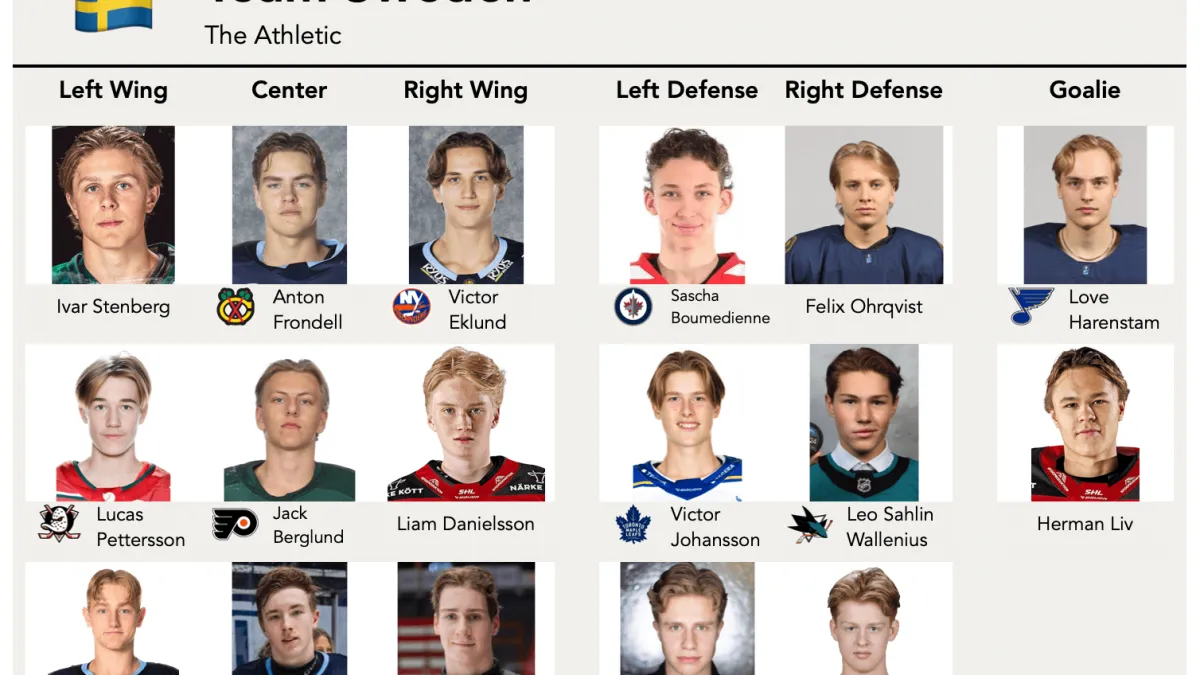
Sweden’s 2026 World Junior Championship roster projection: Forward group packs star power
The forward corps represents Sweden’s greatest strength heading into the 2026 tournament, featuring multiple game-breakers capable of stealing the spotlight on any given night. This projected lineup blends proven production at professional levels with explosive junior dominance, creating a three-line attack that should concern any opposing goaltender.
Anton Frondell and Victor Eklund lead the top line chemistry
The foundation of Sweden’s offensive attack begins with two teammates who’ve developed remarkable chemistry at Djurgårdens IF. Anton Frondell and Victor Eklund, both highly touted prospects from the 2025 NHL Draft, have shared ice time in Sweden’s top professional league, creating an intuitive understanding that translates seamlessly to international competition. Frondell, though typically a winger, has impressed coaches with his domineering play style down the middle in previous tournaments.
Joining this duo on the left wing would be Lucas Pettersson, who has proven ready for top-line responsibilities through his 13 points across 22 SHL games. Pettersson’s mature two-way game complements the creative brilliance of his linemates perfectly. His ability to win puck battles along the boards and create space would allow Frondell and Eklund to operate in prime scoring areas. This trio has the potential to become one of the tournament’s most dangerous combinations, capable of controlling possession and generating high-quality chances against any defensive structure.
Ivar Stenberg anchors the second line with draft-eligible firepower
If there’s one player who could define Sweden’s tournament, it’s Ivar Stenberg. The 18-year-old winger has been so dominant in the SHL that scouts debate whether he should be ranked ahead of Canadian superstar Gavin McKenna for the 2026 NHL Draft’s top spot. Stenberg currently sits tied for 12th in SHL scoring with 20 points in just 21 games, putting him on track for one of the best draft-eligible seasons in league history. Only Daniel and Henrik Sedin posted better numbers as teenagers in Sweden’s top circuit.
Stenberg’s linemate Viggo Björck brings his own impressive resume, having torched the Swedish junior scene to historic levels with 74 points in 42 games for Djurgårdens last season. At just 17 years old, Björck has already registered seven points in 19 SHL games, showcasing playmaking vision that surgically dismantles defensive coverage. His older brother Wilson, a Vancouver Canucks prospect, could join this line, creating a family connection that might unlock even greater production. The chemistry between these players, honed through years of development in Swedish hockey programs, gives Sweden unprecedented depth at center.
Depth options provide versatility and two-way reliability
Sweden’s bottom six forward projection demonstrates remarkable depth and flexibility. College center Eric Nilson, a 2025 second-round pick, brings a polished two-way game developed in the NCAA. Jack Berglund, a 2024 second-round selection who missed last year’s tournament due to injury, adds physical presence and penalty-killing ability. Liam Danielsson, despite lacking NHL affiliation, earns consideration through extensive international experience and familiarity with Sweden’s systems.
The fourth line consists entirely of NHL-affiliated prospects ready for larger roles. Eddie Genborg’s physicality and 13 SHL points make him an ideal energy player. Linus Eriksson, a 2024 second-round pick seeking to translate his potential into production, and Melvin Fernström, a 2024 third-rounder, round out a group that can match up against any opponent’s depth. As extras, Filip Ekberg scorched the U18 World Championship and could force his way into the lineup, while Valter Lindberg’s international experience provides insurance.
Sweden’s 2026 World Junior Championship roster projection: Rebuilding the blue line
Sweden’s defensive corps enters 2026 without the veteran presence that guided previous medal runs, but this predominantly left-shot group possesses enough offensive skill and defensive awareness to compete with hockey’s traditional powers. Eight defenders will battle for playing time in a system that emphasizes puck movement and intelligent positioning.
Left-shot heavy top pairing leads the way
Sascha Boumedienne anchors the defense as the unit’s top player and only established NHL first-round pick. Selected 28th overall by Winnipeg in 2025, Boumedienne offers serious offensive upside despite spending most of his development in the United States. His international experience with Sweden through multiple junior tournaments makes him the logical choice to quarterback the top power-play unit.
Victor Johansson, his projected partner, shone at the World Junior Summer Showcase and could parlay that strong impression into significant minutes. Johansson’s mobility and ability to join the rush provide a perfect complement to Boumedienne’s vision and passing. This pairing would be trusted in all situations, from protecting late leads to generating offense when trailing. Their success in transitioning the puck to Sweden’s elite forwards will largely determine the team’s overall performance.
Second pair offers puck-moving proficiency
The second pairing of Alfons Freij and Leo Sahlin Wallenius represents Sweden’s commitment to skill development over physical intimidation. Both were second-round picks in 2024 who excel at advancing the puck efficiently through the neutral zone. Their ability to execute crisp first passes and support the attack makes them invaluable in tournament play, where transition game often separates medalists from also-rans.
Freij, in particular, has shown the capability to handle increased responsibility in the SHL, while Sahlin Wallenius brings a steadier, more defensive-minded approach that balances the pairing. Together, they can log substantial minutes against opposing middle-six forwards while still contributing offensively. Their development trajectory suggests they’ll be ready for elevated roles come December.
Bottom pair and extras provide specialized roles
Viggo Gustafsson locks down a roster spot based on his strong performance at the 2025 tournament, where he posted three points and a plus-3 rating. His comfort level in international competition gives coaches confidence when deploying him in crucial defensive situations. Felix Öhrqvist, though not a returnee, has represented Sweden at every junior level from U16 to U20, making his integration seamless.
As extras, Gabriel Eliasson brings a physical edge forged during his time with the OHL’s Barrie Colts, though he must balance aggression with disciplined play. Karl Annborn, the roster’s only right-shot defender, offers a different look despite being a seventh-round pick in 2025. His inclusion acknowledges the value of defensive balance, especially when facing teams loaded with skilled right-wingers.
Sweden’s 2026 World Junior Championship roster projection: New era in net
Sweden’s goaltending situation underwent a complete overhaul from 2025, as each netminder aged out of eligibility. This fresh-faced trio enters without World Junior experience but brings impressive credentials from professional and junior leagues. The competition for the starter’s crease will be one of training camp’s most compelling storylines.
Love Härenstam earns the starting nod
Love Härenstam receives the projected starting assignment based on his NHL affiliation and strong showing at the World Junior Summer Showcase. While details of his specific club situation remain fluid, his status as the only NHL-drafted goalie on the roster gives him an edge in experience and pedigree. Härenstam’s ability to handle the mental pressures of international competition will be tested early, particularly in medal-round games where Swedish goaltenders have historically struggled.
Herman Liv and Carl Axelsson push for playing time
Herman Liv and Carl Axelsson each impressed at the Summer Showcase, creating a genuine three-way battle for playing time. Liv’s performance at the professional level suggests he’s comfortable facing elite shooters, while Axelsson’s dominance at the junior ranks indicates untapped potential. This healthy competition benefits the entire team, pushing each goaltender to maintain peak performance throughout the tournament.
The coaching staff faces difficult decisions regarding rotation and rest. With a compressed schedule featuring potential back-to-back games, having three capable netminders provides valuable insurance against injury or cold streaks. Sweden’s success may ultimately depend on which goaltender gets hot at the right moment, as recent champions like Canada and the United States have shown the importance of exceptional goaltending in single-elimination medal games.
Key storylines shaping Sweden’s 2026 medal hopes
Beyond the roster construction, several compelling narratives will define Sweden’s journey through the 2026 World Junior Championship. From sibling connections to draft-position implications, these stories add layers of intrigue to the on-ice product.
The Stenberg-Björck connection drives offensive identity
The relationship between Ivar Stenberg and Viggo Björck transcends simple linemate chemistry. Having played together in Djurgårdens’ junior program, their intuitive understanding creates offensive opportunities that seem telepathic. As Stenberg noted during the Summer Showcase, “Sometimes you watch the moves he does and you’re like, ‘Whoa, how did he manage to get hold of that puck?’ He’s very smart. I like playing with him because you know you’re going to get the puck in good positions.”
Their shared disappointment from the U18 final against Canada provides additional motivation. Both players spoke about wanting “revenge” and the opportunity to rewrite their international narratives. With Stenberg potentially challenging for the second overall pick in the 2026 NHL Draft and Björck establishing himself as a first-round talent, their performances will be scrutinized by general managers and scouts filling the Minneapolis arena. The brothers Björck, Wilson and Viggo, add another dimension—playing for one’s country alongside family creates memories that transcend draft rankings or individual statistics.
2026 NHL Draft implications for Swedish hockey
The 2026 World Junior Championship serves as the ultimate showcase for Sweden’s most promising NHL prospects. With as many as five potential first-round picks on the roster, including Stenberg, Björck, and Boumedienne, the tournament offers a rare opportunity to evaluate these players against the world’s best junior competition. Scouts will be watching closely to see how the Swedish development model produces talent capable of competing with the Canadian Hockey League’s physicality and the NCAA’s structured systems.
Sweden’s success in developing first-round caliber players directly impacts the national program’s long-term health. Recent history shows that countries producing multiple high draft picks typically enjoy sustained international success. The performance of these prospects in Minneapolis could influence NHL teams’ drafting strategies and potentially shift more resources toward Swedish scouting. Top Swedish NHL players of the 2024-25 season demonstrates the pipeline’s current strength at the professional level.
Conclusion: Sweden’s 2026 World Junior Championship roster projection indicates medal contention
Sweden’s projected roster for the 2026 World Junior Championship blends elite offensive talent, mobile defense, and motivated goaltending into a legitimate medal threat. The forward group’s depth, led by Stenberg and Frondell, matches up with any nation, while the defensive corps possesses enough skill and experience to navigate tournament pressure. The goaltending question remains the biggest variable, as unproven netminders must quickly establish trust.
Redemption narratives run deep through this roster, from the Stenberg-Björck duo seeking to avenge U18 disappointment to the entire program aiming to reclaim the silver medal form of 2024. Playing in the United States adds another layer of motivation for Swedish players familiar with North American hockey culture. If the goaltending holds steady and the power play clicks at expected rates, Sweden has the talent to push Canada and the United States for gold. Anything less than a medal would be considered a disappointment for a nation that views the World Juniors as a critical measure of developmental success. The 2026 tournament represents Sweden’s best opportunity in years to capture their first gold medal since 2012.
Frequently Asked Questions

Par Mike Jonderson
Mike Jonderson is a passionate hockey analyst and expert in advanced NHL statistics. A former college player and mathematics graduate, he combines his understanding of the game with technical expertise to develop innovative predictive models and contribute to the evolution of modern hockey analytics.