





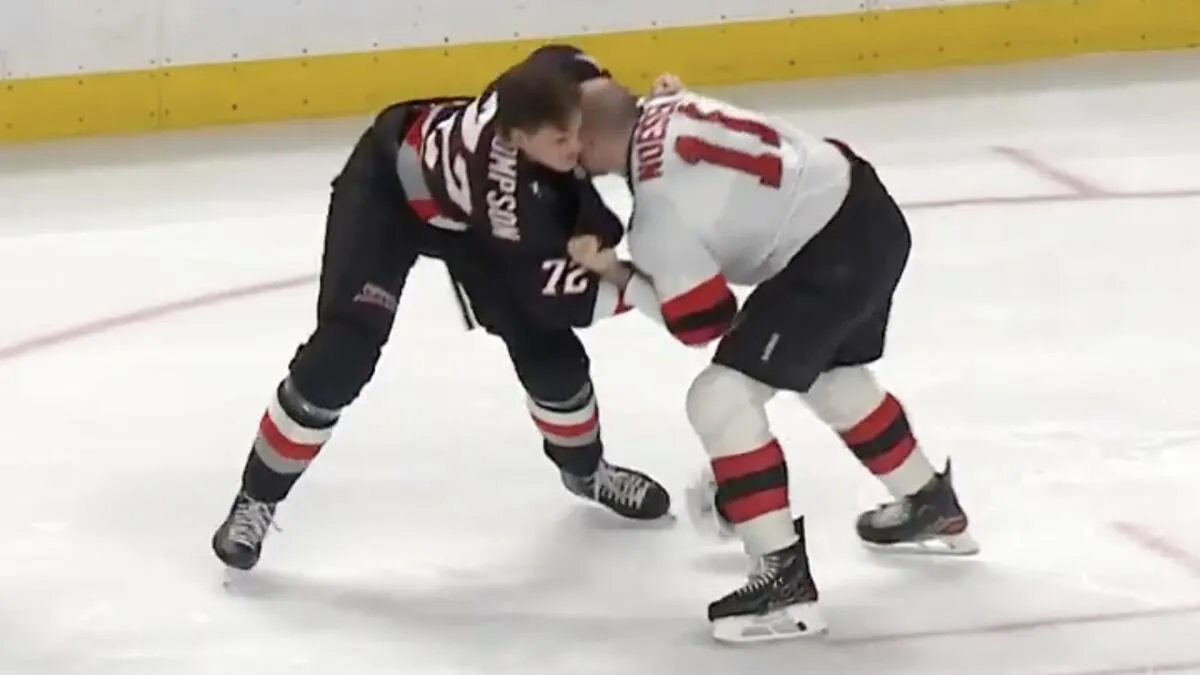
Sabres star Tage Thompson took matters into his own hands on Friday afternoon, dropping the gloves with New Jersey Devils forward Stefan Noesen just 2:24 into the first period. The bout, which had been anticipated for months following a controversial hit last season, sent a jolt through KeyBank Center and provided the defining moment in an otherwise disappointing 5-0 loss for Buffalo. The fight marked a personal and team statement that echoed far beyond the final score.
The confrontation stemmed from unfinished business dating back to February 2, 2025, when Noesen delivered a dangerous elbow to Thompson’s head during a game in New Jersey. The hit concussed the Sabres’ leading scorer and forced him to miss a game, but perhaps more damaging was the team’s lack of immediate response. No Buffalo players challenged Noesen in the moment, a failure that prompted internal meetings and candid discussions about protecting star players. That embarrassment became a turning point for the Sabres, who vowed never to repeat such a passive display.
The backstory that sparked the confrontation
The February incident lingered in the Sabres’ locker room for nearly ten months. After Noesen’s hit went unanswered, the team canceled practice the following day and held a pointed meeting about accountability and standing up for teammates. Captain Rasmus Dahlin later called the inaction “embarrassing” and promised it would never happen again. That promise was put to the test when the Devils returned to Buffalo for the first time since the controversial play.
Multiple Sabres players had that memory fresh in their minds. In the lead-up to Friday’s game, several teammates approached Thompson and offered to fight Noesen on his behalf. The gesture showed how far the team’s culture had shifted since February’s passive response. The organization had clearly learned from its mistake, with players proactively volunteering to deliver the retribution that had been missing months earlier. This internal growth within the Sabres’ room demonstrated a renewed commitment to protecting each other, a core value in hockey’s unwritten code.
The hit itself had been a textbook example of what the league tries to eliminate. Noesen’s elbow caught Thompson in open ice, targeting the head of one of Buffalo’s most valuable players. Beyond the immediate injury, it raised questions about player safety and team cohesion. The Sabres’ management and coaching staff used the incident as a teaching moment, emphasizing that star players cannot be left vulnerable. That lesson clearly resonated throughout the roster, creating the environment where teammates were eager to make things right nearly a year later.
Thompson’s decision to handle the matter personally added another layer of significance to the story. While he appreciated his teammates’ offers, he felt this was his battle to fight. The 6-foot-6 center has never been shy about physical play, but this represented something deeper than a typical hockey fight. It was about personal accountability, leadership, and sending a message that Buffalo’s best players wouldn’t be intimidated. The pre-game conversations between Thompson and Noesen set the stage for a rare example of two players agreeing to settle their differences honorably.
The fight unfolds at KeyBank Center
The moment arrived early in the first period during the game’s first faceoff involving both players. As the puck dropped in the New Jersey zone, Thompson and Noesen squared off, immediately grabbing each other’s jerseys. The capacity crowd of 19,070 roared as Buffalo’s star center threw several heavy punches, clearly getting the better of the 6-foot-1 Devils forward. The bout lasted less than a minute but ignited the arena and energized both benches.
Sabres captain Rasmus Dahlin watched the fight from the bench and later expressed admiration for his teammate’s courage. “That was unbelievable,” Dahlin told WGR Sports Radio 550 during the first intermission. “He’s a nail-gun. He’s not fun to fight against that’s for sure. We talked about it before the game, he didn’t want anyone to do it. He wanted to do it himself. Hell of respect for that. That’s big.” The comment highlighted how Thompson’s actions resonated within the locker room, reinforcing his status as a leader willing to stand up for himself.
The fight marked only Thompson’s sixth regular-season bout in his career, making it a rare occurrence for the skilled forward. While he has dropped gloves occasionally with players like Morgan Rielly, Jalen Chatfield, and Max Pacioretty, fighting has never been his primary role. This one carried extra weight because of the history and the premeditated nature of the encounter. Unlike spontaneous heat-of-the-moment fights, this was a calculated response to a specific incident, making it stand out in an era where staged fights have become increasingly rare.
For Noesen, agreeing to the fight demonstrated a level of respect for hockey’s code. He could have easily declined, forcing the Sabres to either accept inaction or have another player fight him instead. Instead, he acknowledged his responsibility for the earlier hit and accepted the consequences. Thompson later expressed appreciation for that professionalism, saying, “I respect that” when discussing Noesen’s willingness to answer for his actions. The honorable handling of the situation from both sides provided a glimpse into the unwritten rules that still govern the sport.
Thompson’s message of accountability
The pregame agreement between Thompson and Noesen added a fascinating subplot to the confrontation. During warmups, Thompson approached Noesen and said he didn’t appreciate the February hit. According to Thompson, Noesen responded by agreeing to a fight, setting the stage for the first-period showdown. This negotiation, while common in hockey’s past, is increasingly rare in today’s NHL and showed both players’ commitment to resolving their conflict without escalating into further cheap shots or dangerous plays.
Thompson’s decision to handle the fight himself spoke volumes about his character and leadership. “There were a lot of guys in the room asking, but I said I wanted to do it,” Thompson explained after the game. “I figured I’d take care my own business.” The statement resonated throughout the organization, with coach Lindy Ruff expressing “a ton of respect” for Thompson’s approach. The veteran coach noted, “That’s the guy that hit him, the fact he wanted to go after him I thought was great.”
This approach to accountability reflects a broader shift in how star players view their responsibilities. In the past, enforcers handled retribution while skill players focused on offense. Modern hockey has blurred those lines, with elite players increasingly willing to engage physically when necessary. Thompson’s willingness to risk injury and take himself off the ice for five minutes demonstrated that he values team principles and personal pride as much as his point contributions. The Sabres have built their franchise around him, and his actions reinforced why he’s considered the heart of the team.
The fight also highlighted the maturity within Buffalo’s locker room. Rather than forcing a younger player to fight their battle or demanding unofficial enforcers handle retribution, Thompson’s teammates offered support while respecting his choice. Dahlin’s comments about the pre-game discussion showed a unified approach to addressing the issue. The Sabres’ response to the February incident had clearly evolved from disorganized to cohesive, with players communicating openly about how to handle difficult situations. This growth could prove valuable as the team pushes for playoff contention.
Game overshadowed by the bout
Despite the electric start from Thompson’s fight, the Sabres couldn’t translate that energy into offensive production. New Jersey goaltender Jake Allen delivered a stellar performance, stopping all 42 Buffalo shots for his first shutout of the season. The Sabres controlled possession for much of the game, outshooting the Devils 42-23 and creating numerous quality chances, particularly in the first two periods. As Thompson noted, “I thought we controlled the first two periods pretty handily.”
The Devils proved opportunistic, capitalizing on Buffalo’s mistakes to build a commanding lead. Nico Hischier opened the scoring late in the first period after a turnover behind the Sabres’ net, and Arseny Gritsyuk’s spectacular individual effort made it 2-0 midway through the second. The game got away from Buffalo in the third period when aggressive forechecking created odd-man rushes that the Devils converted into three more goals. Brenden Dillon, Paul Cotter, and Gritsyuk’s second tally completed the 5-0 rout.
The frustration mounted when defenseman Mattias Samuelsson left the game bleeding heavily after taking an elbow to the face from Timo Meier with 12:02 remaining in the third period. No penalty was called on the play, and Samuelsson entered concussion protocol. Coach Ruff said postgame he had no update on the status of the defenseman, who has been arguably Buffalo’s best player this season. The incident was particularly concerning given the game’s context and the team’s history with head injuries.
In goal, Alex Lyon made 18 saves on 23 shots in his first start since November 13. The veteran goaltender had spent recent weeks working on his game as the odd man out in Buffalo’s three-goalie rotation. Despite the final score, Lyon felt he played better than the statistics suggested. “I didn’t feel too bad,” he said. “Game probably felt better than the score, but that being said, it’s been a while since I won a game and for me that’s really the most important thing.”
What this means for Buffalo moving forward
The fight’s significance extends beyond the loss and could shape the Sabres’ identity for the remainder of the season. Buffalo has struggled to find consistency, sitting at 9-11-4 with the fewest points in the Eastern Conference (22). The team has been shut out three times in 15 home games and has dropped two straight since climbing back to .500 with a win over Carolina. In this context, Thompson’s willingness to stand up for himself provides a spark that could galvanize a roster searching for an identity.
The cultural evolution within the franchise is perhaps the most important takeaway. Since the February incident, the Sabres have demonstrated a willingness to respond immediately to physical challenges, creating an environment where players feel protected. This sense of security allows skill players to play with confidence, knowing teammates have their backs. The fact that multiple players offered to fight Noesen before Thompson chose to handle it himself shows a locker room that has internalized the lessons from earlier failures. That unity could prove crucial during the grind of an 82-game season.
Thompson’s role as a leader has been solidified through this sequence of events. While his offensive production makes him indispensable on the ice, his actions against Noesen demonstrated a different type of leadership that resonates with teammates and fans alike. The decision to take care of his own business rather than delegating to a role player speaks to his character and commitment to the team. Young players watching Thompson handle both scoring and accountability learn valuable lessons about what it means to be a franchise cornerstone.
The Sabres now face a quick turnaround with a game against the Minnesota Wild on Saturday, putting their ability to bounce back to the test. The Wild have won seven straight games, presenting a formidable challenge for a Buffalo team still processing Friday’s frustrations. How they respond emotionally and physically could determine whether the fight becomes a defining moment that sparks a turnaround or simply a footnote in another difficult season. One thing is certain: the days of Buffalo failing to respond to dangerous hits on their star players are firmly in the past.
Thompson’s decision to handle his own battle with Noesen represents more than just a hockey fight; it symbolizes a franchise finding its backbone. The Sabres may have lost the game, but they demonstrated a cultural shift that could pay dividends as the season progresses. For a team desperate for positive momentum, having a captain in spirit if not letter who leads by example in all facets of the game provides a foundation upon which to build. As the team navigates the challenges ahead, the memory of Thompson standing up for himself will remain a touchstone for what it means to wear the Buffalo sweater.
Frequently Asked Questions

Par Mike Jonderson
Mike Jonderson is a passionate hockey analyst and expert in advanced NHL statistics. A former college player and mathematics graduate, he combines his understanding of the game with technical expertise to develop innovative predictive models and contribute to the evolution of modern hockey analytics.