



Buffalo Sabres forward Tage Thompson took matters into his own hands on Friday night, squaring off against New Jersey Devils forward Stefan Noesen just 2 1/2 minutes into their highly anticipated matchup. The fight, which lasted approximately 30 seconds, put an end to nine months of built-up tension stemming from a controversial elbow to the head that Noesen delivered back in February 2025. As both players dropped their gloves at the faceoff circle in the Buffalo zone, the crowd at KeyBank Center erupted, sensing that a long-awaited moment of reckoning had finally arrived.
The November 28, 2025 contest marked the first meeting between these two teams since that fateful game on February 2, when Noesen’s hit sent Thompson crashing face-first to the ice. While the Sabres won that earlier matchup 4-3, the victory came at a cost, and the lack of immediate response from Thompson’s teammates became a sore spot that festered within the Buffalo locker room for the remainder of the season. Friday night’s fight wasn’t just about two players settling a score—it was about a team demonstrating its unity and a franchise player standing up for himself.
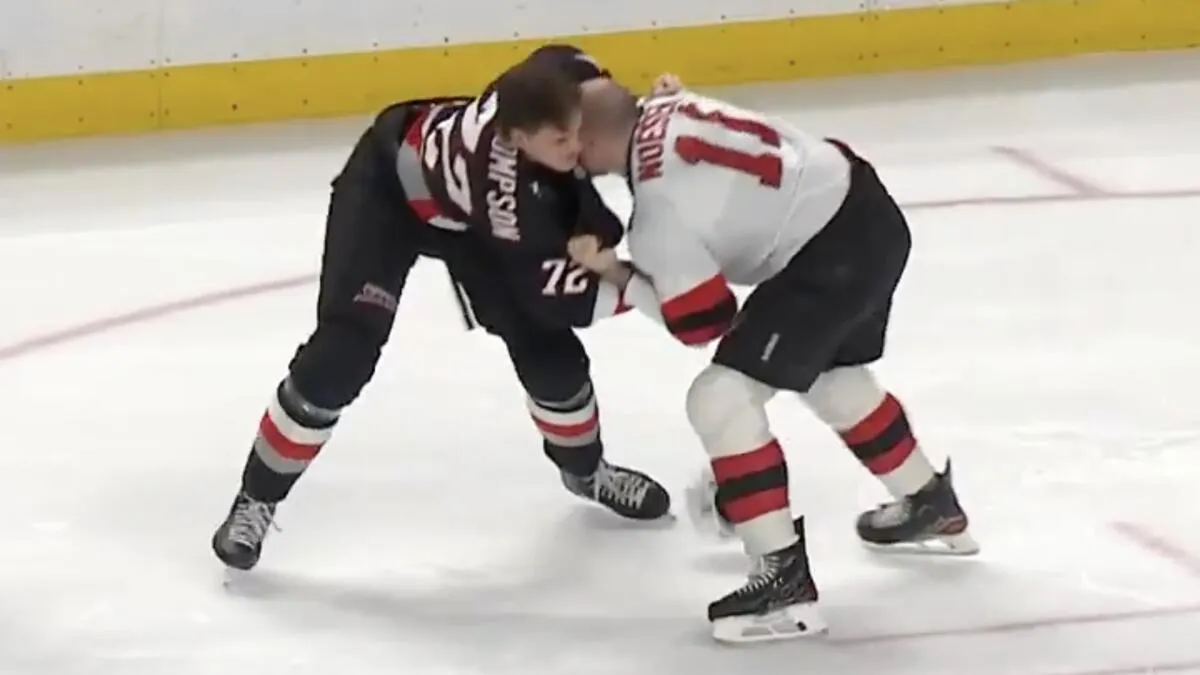
The build-up to Tage Thompson vs Stefan Noesen fight in November 2025
The February 2025 elbow that started it all
The roots of this confrontation trace back to a seemingly innocent play in the second period of a game on February 2, 2025. Thompson was lunging for a loose puck at the Devils’ blue line when Noesen knocked it away and continued his momentum forward. Rather than pulling up, Noesen extended his elbow and caught Thompson directly in the head, a blow that spun the Sabres center around violently, knocked his helmet off, and sent him crashing to the ice face-first.
The immediate aftermath saw Noesen ejected from the game with a match penalty, but the NHL’s Department of Player Safety surprisingly opted not to issue any supplemental discipline. This decision baffled many around the league, given the direct contact to the head and the dangerous nature of the hit. Thompson, fortunately, escaped serious injury and only missed one game, but the incident left a lasting impression on both the player and the organization.
What made the hit particularly galling for the Sabres was the context. Thompson had emerged as Buffalo’s franchise cornerstone, a 6-foot-7 center coming off back-to-back 40-goal seasons. Having your star player targeted with what many viewed as a predatory hit, only to see the perpetrator escape further punishment, created a sense of injustice that would simmer for months.
Sabres’ response and team meeting
In the immediate aftermath of the February incident, the Sabres faced intense criticism for their failure to come to Thompson’s defense. Not a single player confronted Noesen after the hit, allowing him to skate off the ice following his ejection without so much as a cross word. The image of Thompson lying on the ice while his teammates stood by became a talking point across the league and a source of embarrassment within the Buffalo room.
The team responded by holding a closed-door meeting the following day, addressing their lack of response and establishing a new standard for how they would protect each other moving forward. While the specifics of that meeting remained private, the message was clear: never again would a Sabres player be left to fend for himself after a dangerous hit.
Throughout the remaining months of the 2024-25 season and into the current campaign, Buffalo’s response to physical play has been noticeably different. The team has shown a willingness to push back, to stand up for teammates, and to send messages when necessary. The lesson learned from the Noesen incident has become part of the Sabres’ organizational DNA, a turning point in the team’s development from a young group learning to compete to a unified squad ready to battle for each other.
Nine months of tension
As the calendar turned toward the 2025-26 season, both Thompson and the Sabres organization knew that the first rematch with New Jersey would carry extra significance. The NHL schedule makers, perhaps sensing the potential for fireworks, had the teams meeting just before Thanksgiving weekend, adding a national audience to the already charged atmosphere.
Thompson, known for his calm demeanor and focus on skill over fisticuffs, had never been in an NHL fight before Friday night. standing 6-foot-7, the 27-year-old has always relied on his reach, shot, and playmaking ability to impact games, not his willingness to drop the gloves. The fact that he initiated the fight speaks volumes about how much the February incident had affected him personally.
Leading up to the game, both teams downplayed the potential for a confrontation. Coach Lindy Ruff, when asked about the February incident, stated, “We spent time last year on this topic. That topic is really for me it’s behind me. I think the way our team has handled every situation really from that point forward, we learned a hard lesson.” But actions speak louder than words, and the opening minutes of Friday’s game revealed that some scores can’t be settled in team meetings or press conferences—they require a more direct form of resolution.
Fight night - How the November 2025 Devils vs Sabres brawl unfolded
The opening faceoff confrontation
The tension was palpable as the teams lined up for a defensive zone faceoff just 2:30 into the first period. Thompson and Noesen, positioned across from each other in the circle, exchanged words that were clearly picked up by the television microphones. While the exact dialogue remains unknown to the public, the body language told the story: Thompson was issuing a challenge, and Noesen was accepting.
As the linesman prepared to drop the puck, both players simultaneously dropped their gloves and removed their helmets, a sign of respect and a clear signal that this was going to be a fair fight. The crowd, sensing what was about to happen, rose to its feet with a collective roar. When the puck hit the ice, both players ignored it completely, instead grabbing each other’s jerseys and beginning to exchange punches.
The officials, recognizing that this was a premeditated confrontation, wisely backed off and let the players settle their differences. The faceoff was essentially nullified as teammates from both sides formed a circle around the combatants, creating a makeshift ring for the heavyweight bout.
Blow-by-blow of the 30-second scrap
What followed was a surprisingly technical fight for two players not known as enforcers. Thompson, leveraging his 6-foot-7 frame and significant reach advantage, established early control with a strong left hand grip on Noesen’s jersey. The New Jersey forward, standing 6-foot-2, immediately recognized he needed to get inside Thompson’s long reach to be effective.
The exchange began with Noesen throwing the first punch, a right hook that caught Thompson high on the shoulder but failed to do much damage. Thompson responded with a series of straight lefts, using his reach to keep Noesen at bay while landing several clean shots to the Devils forward’s face. After about 15 seconds, it became clear that Thompson’s size advantage was telling.
Noesen, to his credit, continued to press forward, landing a couple of body shots that may have slowed Thompson’s offense. But with about 10 seconds left in the bout, Thompson caught Noesen with a solid right cross that staggered the Devils forward. Sensing his opportunity, Thompson followed up with another right that sent Noesen tumbling to the ice, ending the fight as the linesmen stepped in to separate the players.
The entire sequence lasted roughly 30 seconds, though it felt longer to those watching. Both players received five-minute major penalties for fighting, and the game resumed with a new faceoff at center ice.
Crowd reaction and immediate aftermath
The KeyBank Center crowd erupted when Noesen hit the ice, showering Thompson with cheers and chants of “Tage! Tage!” as he skated to the penalty box. The Sabres bench was visibly energized, with players tapping their sticks on the boards in approval. It was the kind of moment that can galvanize a team and define a season.
Social media immediately lit up with clips of the fight, with fans from around the league weighing in on the confrontation. The video quickly amassed millions of views across platforms, with many praising Thompson for standing up for himself and sending a message that targeting Buffalo’s star players would have consequences.
For Noesen, the immediate aftermath was more subdued. He picked himself up off the ice and skated directly to the Devils’ room, his face showing the effects of Thompson’s reach advantage. While he had answered the bell and accepted the challenge, the result was clear: Thompson had won the fight decisively, both in the moment and in the larger narrative of settling their score.
Aftermath and implications of the Devils Sabres fight
Coach Lindy Ruff’s perspective
Following the game, which Buffalo won 4-2, Sabres coach Lindy Ruff addressed the fight with a mix of resignation and understanding. While he had publicly stated that the February incident was “behind me,” he acknowledged the importance of what Thompson had done for the team’s identity.
“Sometimes in this game, things have a way of working themselves out,” Ruff said in his postgame press conference. “Tage is a competitor, and he felt he needed to handle that situation. The way our guys responded after what happened in February, we’ve grown as a group. Tonight was just another step in that process.”
Ruff’s measured response reflected the dual nature of fighting in modern hockey. While the league has actively worked to reduce fighting, there’s still an understanding that players sometimes need to police themselves, particularly when it comes to protecting star players and responding to dangerous hits that the league’s disciplinary system may have missed.
The coach also emphasized that the fight didn’t detract from Thompson’s primary responsibilities. “Tage is here to score goals and be our number one center. But he’s also a leader on this team, and leaders sometimes have to do difficult things. I’m proud of him for handling it the way he did.”
League discipline and penalties
Given the premeditated nature of the fight, some wondered whether the NHL would issue additional discipline beyond the five-minute major penalties both players served during the game. However, league sources indicated that no supplemental discipline is expected, as the confrontation fell within the acceptable bounds of the NHL’s fighting rules.
Both players received automatic five-minute majors for fighting, and the officials made the correct call in allowing the confrontation to happen rather than trying to intervene and potentially escalate the situation. The fight occurred at a stoppage in play, and both players removed their helmets voluntarily, which likely worked in their favor when the league reviewed the incident.
For Thompson, the lack of additional discipline means he can continue focusing on his on-ice performance without missing any games. Given that he’s once again on pace for a 40-goal season, that’s crucial for a Sabres team hoping to secure its first playoff berth since 2011. Noesen, likewise, will avoid any suspension, though he’ll certainly think twice before targeting Thompson in future matchups.
The NHL’s Department of Player Safety has maintained a consistent stance on these types of retributional fights: while they don’t encourage them, they understand that they’re part of the game’s fabric, especially when there’s a history between the players involved. The fact that both players squared off voluntarily and that the fight was relatively clean by hockey standards likely factored into the decision not to pursue further punishment.
What this means for both teams
For the Buffalo Sabres, Thompson’s willingness to drop the gloves represents a significant moment in the evolution of their franchise player. Since being drafted 26th overall in 2016, Thompson has always been known for his skill, his hockey IQ, and his devastating shot. Adding a layer of physical accountability to his game shows a maturity and a willingness to do whatever it takes for his team.
The fight also cements the Sabres’ identity as a team that won’t be pushed around. After the criticism they faced in February for their lack of response, they’ve consistently shown that they’re willing to stand up for each other. This moment with Thompson reinforces that culture and sends a message to the rest of the league that Buffalo is not a team to be taken lightly.
For the New Jersey Devils, the fight and the loss serve as a reminder that actions have consequences. While Noesen’s elbow in February didn’t result in supplemental discipline, it clearly left a mark on the Sabres organization. The Devils will need to be prepared for elevated physical play in future matchups with Buffalo, as this rivalry has now taken on a decidedly personal edge.
The incident also highlights the changing dynamics of the Atlantic and Metropolitan divisions. As both teams vie for playoff positioning, games between these clubs will carry extra weight. The Sabres have now established a psychological edge, with their best player demonstrating he’s willing to do the dirty work when necessary.
Friday night’s game will be remembered not just for the fight, but for how it encapsulated the growth of a young Sabres team learning what it takes to compete at the highest level. They’ve gone from a squad that failed to defend its star player to one where that star player leads by example, both with his goal-scoring and his willingness to settle scores when needed. For a franchise seeking its first playoff appearance in over a decade, that kind of character development might be just as important as the two points they earned in the standings.
Frequently Asked Questions

Par Mike Jonderson
Mike Jonderson is a passionate hockey analyst and expert in advanced NHL statistics. A former college player and mathematics graduate, he combines his understanding of the game with technical expertise to develop innovative predictive models and contribute to the evolution of modern hockey analytics.