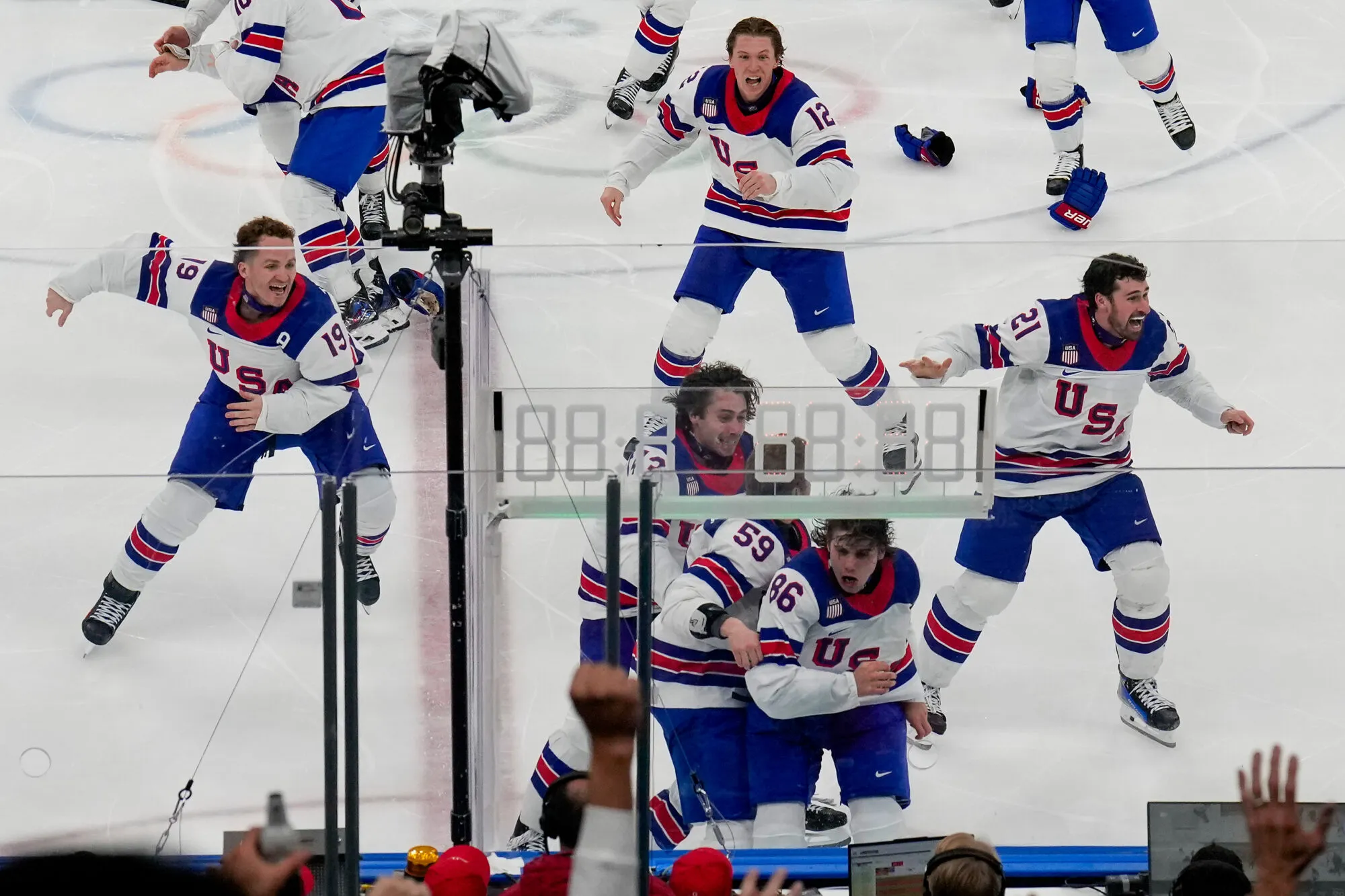
Team USA captured its first men’s Olympic hockey gold medal since the 1980 Miracle on Ice, edging Canada 2-1 in a thrilling overtime showdown at the 2026 Milan Olympics. Matt Boldy scored first for the Americans, but Cale Makar equalized late in regulation to force extra time.[1][2] Jack Hughes then delivered the golden goal at 1:41 of 3-on-3 overtime, assisted by Zach Werenski, past Jordan Binnington.[1]
Connor Hellebuyck’s heroic performance backed the victory, stopping 41 of 42 shots, including clutch denies on Devon Toews and Macklin Celebrini. The game highlighted perfect penalty kills by both sides amid high-stakes power plays. This win marks a pivotal shift in the storied USA-Canada rivalry.
Why Team USA won
Connor Hellebuyck stood tallest, stopping 41 of 42 shots, with 27 from the slot and 17 from the inner slot. His paddle save on Toews and breakaway stop on Celebrini ranked among the tournament’s best. As the reigning NHL MVP and Vezina winner, he outshone legends like Jim Craig and Ryan Miller.[2]
Despite Canada dominating shots 33-18 in the final two periods, USA’s penalty kill shone. They survived a 1:42 5-on-3 disadvantage and another power play after Hughes’ high stick. This resilience prevented a repeat of past collapses, like Sochi.
The 3-on-3 overtime format favored USA’s speed. Jack Hughes, with nine NHL overtime winners, converted Werenski’s forecheck feed after stripping Nathan MacKinnon. Hughes rose from fourth line to star, silencing 4 Nations critics.
During celebrations, players displayed Johnny Gaudreau’s jersey, honoring the late star and Werenski’s friend. As detailed in our coverage of the tribute to the Gaudreau brothers, this emotional moment underscored team bonds.
USA’s defense depth bent but didn’t break, disrupting Canada’s attacks. Though not offensively active, they neutralized stars like MacKinnon. Hellebuyck mopped up the rest, proving goaltending disparity key.
Why Canada lost
Canada generated chances but faltered against Hellebuyck. MacKinnon missed a net-front opportunity, and Celebrini, with six shots including a breakaway, couldn’t replicate earlier magic. Coach Jon Cooper shuffled lines without sparking a winner.
Sidney Crosby’s lower-body injury absence loomed large. Questionable after missing the semifinal, he skipped the final despite promotions featuring him. Nick Suzuki struggled in his spot, losing six of seven faceoffs; Crosby’s power-play prowess (607 points) might have converted opportunities.
USA’s defensive depth outmatched Canada’s offense. First-period disruptions limited quality chances, then bent without breaking. Canada’s power plays, potent on paper, yielded nothing.
Fans debated officiating—a missed slash on Connor McDavid, a tight “too many men” call—but Canada had ample shots. Building from their semifinal push, USA entered confident.
In overtime, Canada possessed the puck but lost it to Werenski’s strip. Binnington faced pressure but couldn’t stop Hughes’ wriggle.
Gold medal game MVP: Connor Hellebuyck
Hellebuyck earned MVP honors with a .956 tournament save percentage and 5.92 goals saved above average, topping all goalies. He entered at .947 and elevated in the final.[1]
Jack Hughes praised him postgame: “He was our best player today by a mile. That was a ballsy, gutsy win. That’s American hockey right there.”
Despite playoff critiques, USA stuck with him over Jeremy Swayman’s group-stage audition. His 41 saves, especially third-period stops, carried the team.
Key moments:
- Paddle save on Toews point-blank.
- Breakaway denial of Celebrini.
- 27 slot shots stopped.
Canada suspected Binnington as a weakness, but Hellebuyck proved the edge. Full recap at NHL.com.[1]
State of the USA-Canada rivalry
Once lopsided—Canada’s golds in 2002, 2010 OT goal, Sochi bronze push for USA, 2016 World Cup, 2025 4 Nations—now balanced. USA believed equality via talent pipeline: Hughes brothers, Tkachuks, Eichel, Matthews.
Youth success fueled it: six IIHF junior golds since 2010 vs Canada’s five. Elite NHL skill ended “annoying little brother” status.
Women’s rivalry as model—equals battling fiercely. Men’s now mirrors: USA forces OT in 4 Nations despite injuries.
Crosby’s absence draws asterisks, like USA’s 4 Nations misses. Canadian arrogance persists; USA holds gold.
Quotes capture shift: Hughes said, “We wanted to go through Canada and beat them.”
This victory cements USA as a hockey power
Team USA’s gold ends a 46-year drought, blending Hellebuyck’s wall and Hughes’ flair. It validates their deepest talent pool ever. Official Olympics report.[3]
Expect fiercer clashes ahead—World Cup, next Olympics. Rivalry thrives on close margins and excuses. American hockey enters a golden era.
Frequently Asked Questions

Par Mike Jonderson
Mike Jonderson is a passionate hockey analyst and expert in advanced NHL statistics. A former college player and mathematics graduate, he combines his understanding of the game with technical expertise to develop innovative predictive models and contribute to the evolution of modern hockey analytics.