






The Toronto Maple Leafs had no business winning this game. Through 40 minutes of uninspired hockey, they trailed the Pittsburgh Penguins 3-0, were outshot 25-8, and faced a chorus of “LET’S GO BLUE JAYS” chants from their own fans at Scotiabank Arena. The performance was shaping up to be the worst loss of the season, a complete capitulation on home ice against a struggling Penguins team.
Then the third period happened. Led by Auston Matthews and William Nylander, Toronto scored four unanswered goals to secure a stunning 4-3 comeback victory that showcased both the best and worst of this franchise. While the two points are crucial, the first 40 minutes exposed several concerning trends that head coach Craig Berube and his staff must address immediately. This wasn’t just a game Toronto won—it was a lesson in how not to play hockey before finding redemption through sheer talent.
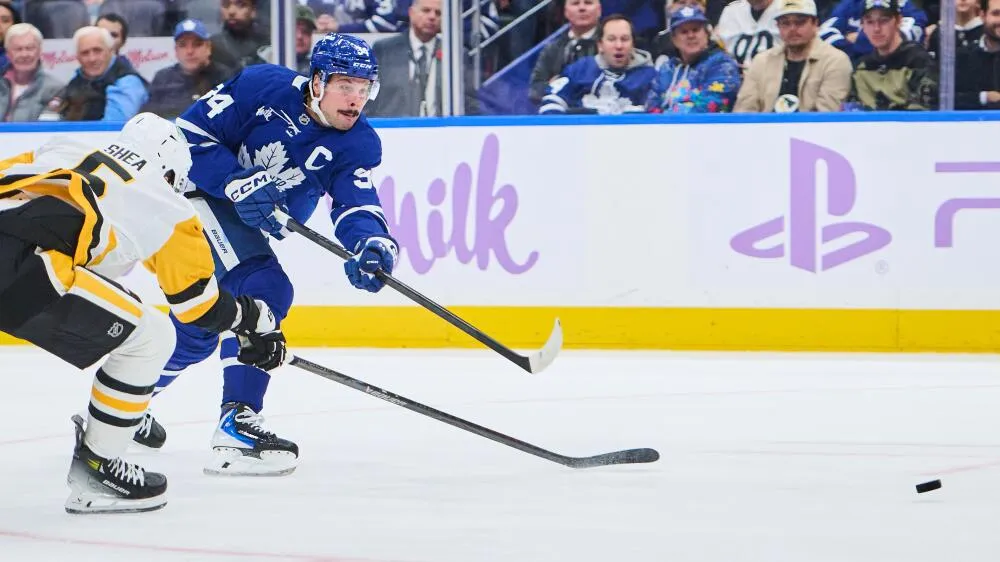
The loaded top line delivers when it matters most in Maple Leafs 4-3 win over Penguins takeaways
When faced with a crisis, Berube went to his nuclear option: loading up Matthews, Nylander, and Matthew Knies on the same line. The decision proved pivotal as this trio dominated the final 20 minutes, accounting for three of Toronto’s four goals and overwhelming Pittsburgh with their skill and speed.
Matthews ignited the rally just 3:31 into the third period after Jake McCabe sprung him on a breakaway. The captain made no mistake, using his signature five-hole move to beat Tristan Jarry and cut the deficit to 3-1. The goal injected life into both the team and the building, transforming the atmosphere from resignation to hope in an instant.
Nylander took over from there, scoring twice in a three-minute, 24-second span that stunned the Penguins. His first goal came when he swooped into the crease area and calmly backhanded a rebound past Jarry at 7:42 of the third. Less than four minutes later, he hammered home a one-timer from the point after Oliver Ekman-Larsson set him up perfectly, tying the game at three.
The firepower on display during those few minutes demonstrated why Toronto’s core remains one of the most dangerous in the NHL. When Matthews and Nylander are engaged and on the same line, they can overwhelm opponents with skill that few teams can match. Matthews finished with a goal and showed his complete game with several crucial blocked shots on the penalty kill late in the period.
“Obviously, Willy and Matthews and Knies’ line did what they’re capable of doing, and our goalie was good,” Berube said after the game, offering a succinct summary of how Toronto survived its own mediocrity. The coach’s tone suggested he understood this wasn’t a sustainable formula—relying on 20 minutes of brilliance to erase 40 minutes of inadequacy.
Matthews himself was refreshingly honest in his post-game assessment. “I think the focus should be on the first two periods and why we lacked all those different things that got us down in the game in the first place,” he stated, acknowledging that while the comeback was thrilling, it shouldn’t overshadow the underlying issues.
At 5-on-5, the Matthews-Knies-Nylander line posted dominant numbers: a 7-3 shot differential and a 75.2 percent share of expected goals in just seven minutes together. These statistics highlight their potential impact when deployed together, but also raise questions about whether this combination should be used more regularly or reserved strictly for emergency situations.
Robertson’s relentless effort stands out in Maple Leafs 4-3 win over Penguins takeaways
While Matthews and Nylander will rightfully receive the headlines, Nick Robertson deserves immense credit for being Toronto’s most consistent player across all 60 minutes. Through the dismal first two periods when his teammates appeared disinterested, Robertson played with constant energy, delivering hits, extending plays, and displaying a tenacity that was sorely lacking elsewhere in the lineup.
Robertson’s work ethic was finally rewarded when he created the game-winning goal with under nine minutes remaining. He battled hard along the boards to retrieve the puck, drove toward the net with determination, and created a rebound that Bobby McMann jammed home to give Toronto its first lead of the night. It was exactly the type of play that defines Robertson’s game—relentless, fearless, and effective.
“He works, he works, he can shoot the puck like few people can,” Matthews said of Robertson post-game. “He’s a smaller guy but he’s not afraid to go to the dirty areas, and battle and compete. He’s been playing great for us the last couple of weeks and he played great tonight.” The captain’s words carried weight, as Robertson has consistently shown he belongs in a top-six role through his recent performances.
Robertson finished the game with an assist, three shots on goal, and over 16 minutes of ice time—his second-highest total of the season. More impressively, he posted a 66 percent share of expected goals at 5-on-5, demonstrating his effectiveness even when the scoresheet didn’t initially reflect it. While he was briefly moved off the top line when Berube loaded up in the third period, the decision was tactical rather than performance-Based.
The 23-year-old’s game extends beyond statistics. In the first period, he generated a dangerous chance after Philippe Myers’ shot created a rebound, though he couldn’t control the bouncing puck. Throughout the second period, when Toronto was being thoroughly dismantled, Robertson remained one of the few players creating any offensive pressure. His willingness to engage physically despite his smaller stature also helps the Leafs establish a forecheck presence they often lack.
For McMann, the goal was equally crucial. He had been held pointless for eight consecutive games, and whispers about him becoming a healthy scratch had begun circulating. His timely goal not only won the game but potentially saved his roster spot. As a streaky player throughout his career, McMann needed this moment to build confidence and momentum moving forward.
The Robertson-McMann connection on the game-winner exemplified what Toronto needs from its depth players: consistent effort, timely execution, and the ability to capitalize when opportunities arise. If the Maple Leafs want to be more than a team that relies solely on star power, they need more players to follow Robertson’s blueprint of maximum effort on every shift.
Defensive breakdowns plague Maple Leafs 4-3 win over Penguins takeaways despite result
The comeback victory cannot mask the alarming defensive deficiencies that plagued Toronto throughout the game. The Maple Leafs’ rush defense continues to be a glaring weakness, and with Chris Tanev sidelined, these issues have become even more pronounced. Pittsburgh exploited Toronto’s inability to defend the transition game, generating high-quality chances off the counterattack repeatedly.
Erik Karlsson’s opening goal perfectly illustrated the problem. Simon Benoit fumbled the puck in the offensive zone while attempting an unnecessary aggressive play well beyond his skill set. The Penguins immediately transitioned up ice, and Sidney Crosby delivered a perfect cross-seam saucer pass to Karlsson, who ripped a shot into the top corner that Anthony Stolarz had no chance to stop. While Crosby’s elite playmaking deserves credit, the sequence began with a self-inflicted wound—a turnover that could have been avoided.
The second goal featured similar themes. Toronto failed to clear the defensive zone despite having possession, and after a deflected shot popped into the air, Morgan Rielly inadvertently touched the puck with his stick raised high. In the ensuing scramble, with Penguins crashing the crease, the puck found its way past Stolarz. The goal was somewhat unlucky, but the entire sequence stemmed from Brandon Carlo and Sammy Blais failing to exit the zone cleanly.
Ben Kindel, Pittsburgh’s 18-year-old rookie and 11th overall pick in the 2025 NHL Draft, repeatedly found time and space in dangerous areas. He scored twice and generated multiple other scoring chances by wading through Toronto’s defensive zone with concerning ease. For a team with playoff aspirations, allowing a teenage rookie to dominate is simply unacceptable, regardless of his talent level.
Berube’s frustration was evident in his post-game comments. “We come out in the second period down 2-0, you think we’re going to make a push and we didn’t,” the coach said bluntly. “The second period, they got the puck and did whatever they wanted with it, and we didn’t check anybody. We didn’t knock anybody off the puck. And when we did get it, we gave it back to them. It’s not good enough.”
The underlying numbers support Berube’s assessment. Natural Stat Trick recorded Pittsburgh out-attempting Toronto 16-0 in the first seven minutes of the second period. The Amazon broadcast had it at 15-1. Either way, the Maple Leafs were thoroughly dominated and fortunate to enter the third period down just three goals.
With Tanev’s absence potentially extending, Toronto cannot continue relying on both Benoit and Myers in significant roles. Both defensemen struggled mightily, playing just 15 minutes each as Berube shortened his bench. McCabe led all Leafs with 23:15 of ice time, while Carlo played over 21 minutes and was particularly effective protecting the net with the goalie pulled late in the game.
The defensive-pair juggling throughout the game reflected Berube’s dissatisfaction with what he was seeing. The Leafs started with Rielly-Carlo, Benoit-McCabe, and Ekman-Larsson-Myers, but those combinations didn’t survive contact with Pittsburgh’s attack. By the end of the game, McCabe was paired with Carlo, while Rielly and Ekman-Larsson featured prominently on both Nylander goals. The constant shuffling suggests Toronto hasn’t found its optimal defensive structure, particularly without Tanev anchoring a pairing.
Power play woes continue in Maple Leafs 4-3 win over Penguins takeaways
Toronto’s power play problems showed no signs of improvement despite Craig Berube’s decision to promote rookie Easton Cowan to the top unit. The move was intended to inject fresh energy and creativity into a man-advantage that has become stagnant, but the lone power play opportunity in the first period yielded just one shot and zero sustained pressure.
The Maple Leafs entered the game converting at a 12.1 percent clip, the second-worst mark in the NHL. Against Pittsburgh, they couldn’t even gain the zone cleanly, with entry attempts repeatedly getting swatted away at the blue line. The execution from Rielly, Matthews, and Nylander on entries was particularly poor, leaving Cowan with little opportunity to showcase the short-area passing ability that earned him the promotion.
Rielly’s struggles as the power play quarterback have become impossible to ignore. On Toronto’s lone opportunity, he passed up an opportunity to simply skate the puck back into the zone after a neutral-zone clear. Later in the game on a different power play, he missed setting up Nylander for a one-timer by approximately half a foot, forcing Nylander to shoot awkwardly off his front foot and generating little danger.
While it would be unfair to place all the blame on Rielly—power play struggles are typically systemic rather than individual—his decision-making and execution on the man advantage have been consistently negative this season. When the player tasked with quarterbacking the unit isn’t making crisp passes or sound reads, the entire system suffers regardless of the talent around him.
For Cowan, the promotion didn’t yield immediate results, but the 19-year-old deserves another opportunity. Following perhaps his best game of the season against Philadelphia, Cowan couldn’t generate much on a line with John Tavares and Nylander at even strength either, finishing with just 10:42 of ice time. Such fluctuations are typical for rookies learning at the NHL level, and one quiet game shouldn’t derail his development or diminish his recent strong play.
The power play’s ineffectiveness becomes even more costly when considering how effective Pittsburgh’s unit has been. The Penguins currently rank second in the league on the man advantage, and they capitalized when Philippe Myers took a penalty during the second period. Kindel scored on a shot that Stolarz couldn’t see through traffic, extending Pittsburgh’s lead to 3-0 and seemingly putting the game out of reach.
According to reports from recent coverage, Toronto needs to find answers quickly on special teams. They can’t continue to waste opportunities with the man advantage while struggling to defend when down a player. The margin between winning and losing in the NHL is razor-thin, and special teams often determine outcomes in tight games.
Potential solutions include giving Cowan more power play time to execute those short-area plays that make him dangerous, adjusting the formation to get more shooting threats from the flanks, or even reconsidering personnel. William Nylander’s one-timer from the point on Ekman-Larsson’s setup at even strength in the third period demonstrated his shooting ability from that position—perhaps he should receive more looks there on the power play as well.
Stolarz keeps Toronto alive through two dismal periods
Lost in the comeback narrative is the exceptional performance by Anthony Stolarz, who was the only Maple Leafs player who showed up for the first 40 minutes. While he allowed three goals, two came from circumstances beyond his control—Karlsson’s perfectly-placed shot off Crosby’s elite playmaking, and Kindel’s power play goal that he couldn’t see through traffic.
During the second period, when Toronto generated virtually no offense and was thoroughly dominated in their own zone, Stolarz made several crucial saves to prevent the game from becoming a complete blowout. Had Pittsburgh scored even one or two more goals during their sustained pressure, the third-period comeback would have been impossible regardless of how well Matthews and Nylander played.
The veteran goaltender’s composure under siege allowed his teammates the opportunity to mount their rally. His performance exemplifies what Toronto needs from the position—steadiness when the team in front of him struggles, and the ability to keep games within reach until the offense finds its rhythm. Without Stolarz’s contributions, particularly in the middle frame, this game would have been decided long before the third period began.
This victory marks the sixth consecutive game where Toronto has surrendered the first goal. That trend is unsustainable over an 82-game season, as constantly playing from behind drains energy and eventually catches up with even the most talented teams. The Maple Leafs must find a way to start games with more urgency and purpose, rather than relying on dramatic comebacks fueled by individual brilliance.
The win moves Toronto’s record to another game above .500 as they continue searching for consistency. Wednesday’s matchup against Utah provides an immediate opportunity to demonstrate they’ve learned from this experience and can string together quality performances. If they replicate the first two periods of this game, they may not be fortunate enough to stage another miraculous rally.
For now, the Maple Leafs will gladly accept two points regardless of how they were earned. Comebacks build character and can galvanize teams when executed at critical moments. However, as Matthews acknowledged, the focus must shift to why they were down 3-0 in the first place. Talent alone won’t carry Toronto through the playoffs—they need defensive structure, consistent effort, and contributions from throughout the lineup to achieve their ultimate goals. This game provided both a warning and a reminder of what’s possible when this team engages fully.

Par Mike Jonderson
Mike Jonderson is a passionate hockey analyst and expert in advanced NHL statistics. A former college player and mathematics graduate, he combines his understanding of the game with technical expertise to develop innovative predictive models and contribute to the evolution of modern hockey analytics.