











Tyler Seguin torn ACL season-ending injury Dallas Stars: A devastating blow to championship hopes
The Dallas Stars received devastating news that veteran forward Tyler Seguin will likely miss the remainder of the 2025-26 NHL season after suffering a torn ACL in his right knee. The injury occurred during Tuesday night’s game against the New York Rangers at Madison Square Garden, leaving the 33-year-old star crumpled on the ice and requiring assistance from multiple teammates and trainers to reach the locker room. Coach Glen Gulutzan delivered the grim update Wednesday, confirming what many feared: Seguin’s season is almost certainly over.
This marks the second consecutive year that Seguin faces a season-ending medical situation, having missed the vast majority of last season following hip surgery before mounting a diligent comeback in time for the Stars’ playoff run to the Western Conference Final. The timing couldn’t be worse for a Dallas team positioned as a legitimate Stanley Cup contender, sitting second in the Central Division with an 18-5-5 record and riding a 12-game road point streak.
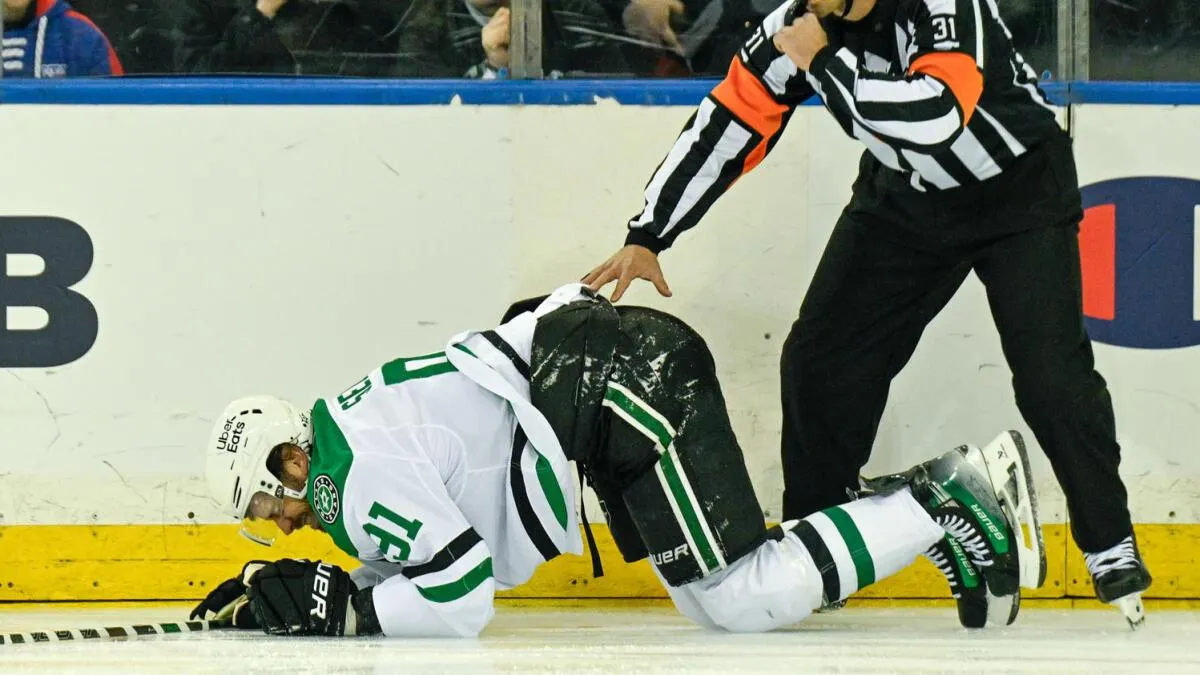
How Tyler Seguin’s torn ACL injury happened against the Rangers
The injury unfolded during the first period of Tuesday’s 3-2 overtime loss in New York. Seguin got tangled up with Rangers defenseman Vladislav Gavrikov while battling for position, causing his leg to twist awkwardly as he fell to the ice. At 1:44 of the opening period, the veteran forward went down in visible pain, unable to put weight on his right leg.
Multiple teammates, including Roope Hintz and Ilya Lyubushkin, rushed to Seguin’s aid, helping him off the ice while the Madison Square Garden crowd fell silent. Athletic trainers provided additional support as Seguin made his way down the tunnel to the visiting locker room area. The scene was reminiscent of his hip injury struggles last season, though this time the diagnosis came back more definitively catastrophic.
The immediate on-ice reaction from teammates
Captain Jamie Benn, who has played alongside Seguin since the forward arrived in Dallas via trade from Boston in 2013, struggled to find words when addressing reporters after the team’s win over New Jersey Wednesday night. “After seeing the grind he went through last year—all the hard work he put in to getting back into the lineup—and then for that to happen again obviously sucks,” Benn said.
Goaltender Jake Oettinger, who recorded a shutout against the Devils, echoed the sentiment: “He’s an irreplaceable player for our team. Just obviously feel horrible for him, and he deserved a lot better than that. It’s kind of hard to put into words when you lose a guy like that.”
The severity of Tyler Seguin’s torn ACL diagnosis
Medical evaluations Wednesday confirmed the torn ACL in Seguin’s right knee, an injury that typically requires 6-9 months of recovery time for professional athletes. Coach Gulutzan didn’t mince words when discussing the timeline: “There’s lots of injuries piling up and lots of games, so we just got to keep moving forward. Haven’t spoken to Tyler yet, but probably just letting everybody know that he’s going to be out for a significant amount of time—probably the rest of the season.”
The specificity of the diagnosis left little room for optimism. While Seguin will consult with doctors to establish a firm recovery timeline, the nature of ACL injuries in hockey—where explosive skating and quick directional changes are fundamental—means even the most optimistic scenarios would struggle to get him back before the playoffs conclude.
Seguin’s recent injury history compounds concern
This represents another brutal setback for a player who has fought through significant health challenges in recent years. Last season’s hip surgery limited him to just 20 regular-season games, though his triumphant return for the final game and subsequent 18 playoff contests demonstrated his commitment to the team’s championship push. He recorded eight points (four goals, four assists) during that postseason run.
The Stars had managed his workload carefully this season, with Seguin appearing in all 27 games while accumulating 17 points (seven goals, 10 assists). He reached the milestone of his 1,000th NHL game on October 30, a testament to his durability earlier in his career. Now he faces another grueling rehabilitation process at age 33.
Tyler Seguin torn ACL season-ending injury Dallas Stars salary cap implications
The NHL’s new collective bargaining agreement introduced significant changes to long-term injured reserve (LTIR) rules for the 2025-26 season, directly impacting how Dallas can manage Seguin’s $9.85 million cap hit. Under the previous system, teams could place players on LTIR and exceed the salary cap by the player’s full cap hit minus available space, a mechanism the Stars used extensively last season.
Understanding the new season-ending LTIR designation
The league now distinguishes between regular LTIR and season-ending long-term injured reserve (SELTIR). If a player is placed on SELTIR—meaning he will miss the entire regular season and playoffs—the team receives full cap relief equal to the player’s entire cap hit. However, if there’s any possibility the player could return during the regular season or playoffs, relief is limited to the previous season’s average league salary of $3,817,293.
Coach Gulutzan’s statement that Seguin will likely miss “the rest of the season” creates some ambiguity. The Stars must await medical guidance on whether “rest of the season” includes potential playoff games or just the regular season schedule. This distinction will determine whether Dallas gets $9.85 million or $3.82 million in relief.
Dallas’s complicated current cap situation
The Stars have already leveraged LTIR this season with Matt Duchene, Adam Erne, and Nils Lundkvist all on the designation, pushing their current cap hit to $97.3 million—well above the $95.5 million league ceiling. The team gave up significant assets at last year’s trade deadline to acquire Mikko Rantanen, Cody Ceci, and Mikael Granlund, taking advantage of LTIR flexibility that no longer exists in the same form.
If Seguin is placed on regular LTIR, the Stars gain immediate access to $3.82 million but must remain cap compliant for the playoffs should he return. If he’s on SELTIR, they can pursue a full replacement but must be certain he won’t be available for postseason play—a risky determination with a competitor like Seguin.
How Dallas Stars will fill the void left by Tyler Seguin torn ACL injury
Coach Gulutzan has already begun reshuffling his lineup, implementing a “next man up” philosophy that championship teams must embrace. In Wednesday’s win over New Jersey, Nathan Bastian stepped into Seguin’s roster spot while Benn moved to right wing alongside Jason Robertson and Hintz on the top line. That line responded immediately, contributing two of the team’s three goals.
Internal options to replace Seguin’s production
The immediate beneficiary appears to be Benn, who slid into his longtime teammate’s position seamlessly. Robertson and Hintz have developed tremendous chemistry, and Benn’s veteran presence could maintain that line’s effectiveness. Roope Hintz emphasized the collective responsibility: “He’s so important for this team on the ice and off the ice. But now we just have to adjust and next man up and be ready to play without him for a while.”
Mavrik Bourque stands to receive significantly increased opportunity as a young center who can play in the middle-six forward group. The team’s forward depth will be tested, but Bourque’s development makes him a candidate for more prominent minutes and power-play opportunities.
Matt Duchene’s impending return provides relief
Perhaps the most significant development beyond the injury itself is the potential return of Matt Duchene, who has missed 23 straight games with an upper-body injury. Gulutzan offered optimism about Duchene’s timeline: “I’d still say it’s day to day for him. But if he can stack a few good days upon each other, then I think it’s going to be sooner than later.”
Duchene’s return would provide a veteran center with offensive capabilities, though he’s a different player than Seguin. The organization must balance rushing Duchene back against ensuring he’s fully healthy, especially given the heightened physical demands of filling a star player’s role.
Championship implications of Tyler Seguin torn ACL season-ending injury
The Stars enter this crisis from a position of strength, sporting a 18-5-5 record and demonstrating the depth that has made them perennial contenders. Their third consecutive trip to the Western Conference Final last season established them as a franchise built for sustained success. However, losing a player of Seguin’s caliber tests even the deepest rosters.
Trade deadline decisions become more urgent
General manager Jim Nill now faces increased pressure to make moves before the March 6 trade deadline. The new LTIR rules complicate his approach, but the Stars’ championship window is firmly open. With limited draft assets remaining after last season’s acquisitions, Nill must get creative to find scoring depth.
The team’s current cap situation means any trade would likely require moving salary out or being absolutely certain about Seguin’s playoff availability. The new playoff salary cap compliance rule prevents the strategy Dallas employed last year—loading up at the deadline and returning healthy stars for the postseason.
Leadership and locker room impact beyond statistics
Statistics only tell part of the story with Seguin. As Gulutzan noted, “He’s a great leader for us, and he’s a great pro. He’s been a guy, quite frankly, that I’ve been maybe the most impressed with, just his leadership ability, when I’ve come in here.” This is the coach’s first season back behind the Stars bench, making Seguin’s veteran guidance particularly valuable during a transition period.
The emotional toll on a team that watched Seguin battle back from hip surgery cannot be understated. Players witnessed his diligent rehabilitation and dedication firsthand. Teammate reactions reflect genuine anguish over seeing a respected veteran face another season lost to injury. This emotional component could either fracture the team’s resolve or galvanize them toward playing for their fallen teammate.
The Dallas Stars must now navigate the complexities of modern NHL salary cap management while maintaining their championship aspirations without one of their most important players. Tyler Seguin’s torn ACL represents more than a medical setback—it challenges the team’s depth, financial flexibility, and emotional fortitude at the most critical point in their season. How they respond will define not only this campaign but potentially the remainder of their competitive window.
The Stars showed immediate resilience with a 3-0 shutout victory over New Jersey, but the long season ahead will test whether that resolve can sustain through the grind of an 82-game schedule and the heightened intensity of postseason hockey. For Seguin, another arduous rehabilitation awaits, adding another chapter to a career marked by both spectacular success and frustrating setbacks. For his teammates, the message is clear: championship teams find ways to overcome adversity, and their true character will be revealed in how they fill the enormous void left by their fallen star.
For more analysis on how injuries are impacting playoff races around the NHL, check out our coverage of the latest injury news and roster movements. The Stars’ situation reflects a broader pattern across the league where teams must balance short-term competitiveness with long-term salary cap health. As Dallas navigates this challenge, their approach could serve as a case study for other franchises facing similar crises, particularly with the new LTIR rules creating additional layers of complexity for general managers to consider.
Frequently Asked Questions

Par Mike Jonderson
Mike Jonderson is a passionate hockey analyst and expert in advanced NHL statistics. A former college player and mathematics graduate, he combines his understanding of the game with technical expertise to develop innovative predictive models and contribute to the evolution of modern hockey analytics.