










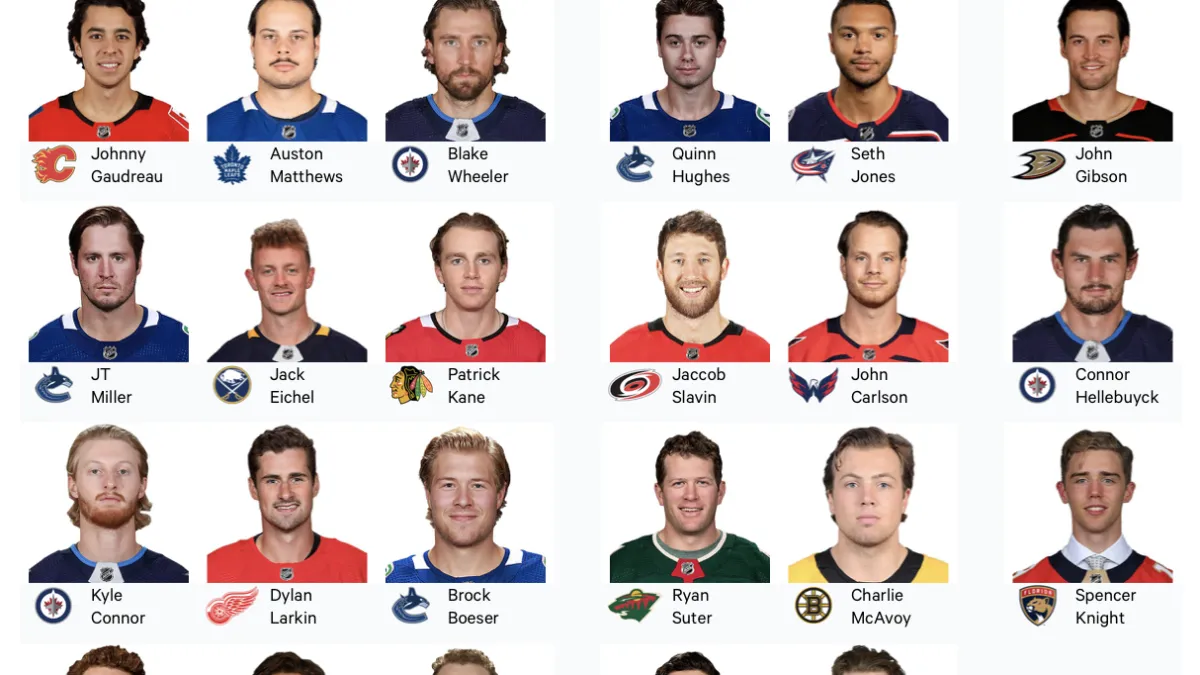
USA Hockey has revealed its roster for the 2026 Milan-Cortina Olympics, leaning heavily on players from last year’s 4 Nations Face-Off. The team, announced on the “Today” show, includes just three new additions: Tage Thompson, Clayton Keller, and Seth Jones. This approach prioritizes familiarity and recent international success after the Americans reached the final in that tournament, only to fall to Canada in overtime.
The roster mirrors Canada’s strategy of building around proven performers from the NHL-run event. General manager Bill Guerin emphasized the depth of talent in U.S. hockey, crediting grassroots development. With the Olympics set to feature 25 players per team, the U.S. aims to contend for gold starting February 12 against Latvia.
Recent standouts earn their spots
Tage Thompson and Clayton Keller played pivotal roles in the U.S. winning the world hockey championship for the first time since 1933. Thompson, a point-per-game producer for the Buffalo Sabres this season, brings scoring punch from the wing. Keller, captain of the Utah Mammoth and tied for his team’s scoring lead, wore the “C” at worlds, showcasing leadership under pressure.
Seth Jones, a key defenseman in the Florida Panthers’ second straight Stanley Cup run, rounds out the trio of additions. His experience bolsters the blue line against top international competition. These selections reward players who delivered in high-stakes scenarios last year.
The rest of the roster draws almost entirely from the 4 Nations participants. This continuity allows coach Mike Sullivan to rely on chemistry built in February’s tournament. As detailed in our pre-announcement projections, such a veteran core was anticipated to form the backbone.
Excitement around these picks has buzzed on social media, with fans highlighting Thompson’s breakout potential. Sources confirmed their inclusions ahead of the official reveal, building anticipation (ESPN report). Jones’ two-way play will be crucial in containing rivals like Canada.
This strategy underscores a preference for battle-tested athletes over flashier options. The additions integrate seamlessly with returning stars, promising a cohesive unit.
Goaltending tandem remains unchanged
The U.S. stuck with the same three netminders from the 4 Nations: Connor Hellebuyck, Jake Oettinger, and Jeremy Swayman. Unlike Canada, which tweaked its backup options behind Jordan Binnington, the Americans prioritized stability. Hellebuyck’s elite positioning and Oettinger’s playoff pedigree anchor the group.
Swayman provides depth with his quick reflexes, ensuring options for the tournament’s rigors. This trio faced elite shooters in the 4 Nations final, gaining invaluable experience. Their retention signals confidence from management in handling Olympic pressure.
Goaltending often decides international tournaments, and this group has proven resilient. Hellebuyck led the NHL in several categories last season, while Oettinger shone in Dallas Stars’ deep runs. Swayman’s emergence with Boston adds youth to the mix.
The decision avoids experimentation, focusing on what worked recently. Teams dress two goalies per game, so rotation flexibility is key. This setup positions the U.S. well for a medal push.
High-profile omissions spark debate
Chris Kreider of the Anaheim Ducks and Adam Fox, formerly of the New York Rangers, are the only 4 Nations holdovers left off. Kreider’s physicality and Fox’s puck-moving ability made them fan favorites, but management opted for others. Jason Robertson, leading U.S. players in points this season with the Dallas Stars, also missed out.
Cole Caufield and Alex DeBrincat, elite goal scorers, were overlooked despite offensive flair. Depth forwards Vincent Trocheck and Brock Nelson earned nods instead, valued for reliability. Guerin noted the tough choices, praising the talent pool.
These snubs highlight a focus on experience over current production. Robertson’s Dallas success and Caufield’s Montreal sniping fueled speculation, but Sullivan’s staff prioritized known quantities. Fans on X expressed surprise, echoing pre-roster chatter.
As explored in our USA-Canada predictions, such debates often arise in selections. The omissions could motivate these players for future chances.
This philosophy favors grit and intangibles, potentially paying dividends in Milan-Cortina.
Guerin’s vision and Olympic format
Bill Guerin, the general manager, called the process “incredibly difficult,” crediting grassroots efforts for U.S. hockey’s strength. “There’s nothing like the Olympics, and I know our players and staff will represent our country well and work hard to achieve our ultimate goal,” he said. His staff, alongside coach Sullivan, built a squad blending skill and tenacity.
The Olympics allow 25 players, up from 23 at 4 Nations, with 20 skaters dressable—typically 13 forwards and seven defensemen—plus two goalies. This extra flexibility aids injury management over the tournament.
- Forwards highlights: Keller’s leadership, Thompson’s scoring, Trocheck/Nelson depth.
- Defense: Jones anchors, with 4 Nations vets.
- Goalies: Hellebuyck, Oettinger, Swayman trio intact.
The U.S. followed Canada’s 4 Nations-heavy model, signaling trust in that event’s lessons (Canada roster details). Guerin’s comments reflect optimism.
This roster positions the Americans as contenders, leveraging NHL stars’ commitment.
The U.S. team enters the 2026 Olympics with momentum from recent triumphs, poised to chase gold in Italy. Facing Latvia first tests early cohesion, but the 4 Nations core promises competitiveness. Expect intense rivalries, especially a potential Canada rematch, to define the tournament. What it means for the medal race: experience could carry Team USA far.
Frequently Asked Questions

Par Mike Jonderson
Mike Jonderson is a passionate hockey analyst and expert in advanced NHL statistics. A former college player and mathematics graduate, he combines his understanding of the game with technical expertise to develop innovative predictive models and contribute to the evolution of modern hockey analytics.