


Team USA advanced to the semifinals of the 2026 Milano Cortina Olympic men’s hockey tournament with a tense 2-1 overtime victory over Sweden in the quarterfinals.[1][2] Quinn Hughes scored the game-winning goal at 3:27 of 3-on-3 overtime, capping a performance that highlighted his status as the Americans’ most vital skater. This marked the first Olympic tournament with active NHL players since 2014 Sochi, and the U.S. entered as the second-favorites behind Canada, with Sweden third. The win sets up a clash with high-scoring Slovakia next.
Dylan Larkin’s second-period goal had given the U.S. the lead, but Mika Zibanejad tied it with 1:31 left in regulation. Connor Hellebuyck’s 27 saves anchored a stout defensive effort, allowing Team USA to overcome a sluggish third period. As noted in NHL Insight’s preview of the Sweden-USA quarterfinal clash, the matchup promised intensity between two powerhouse squads.
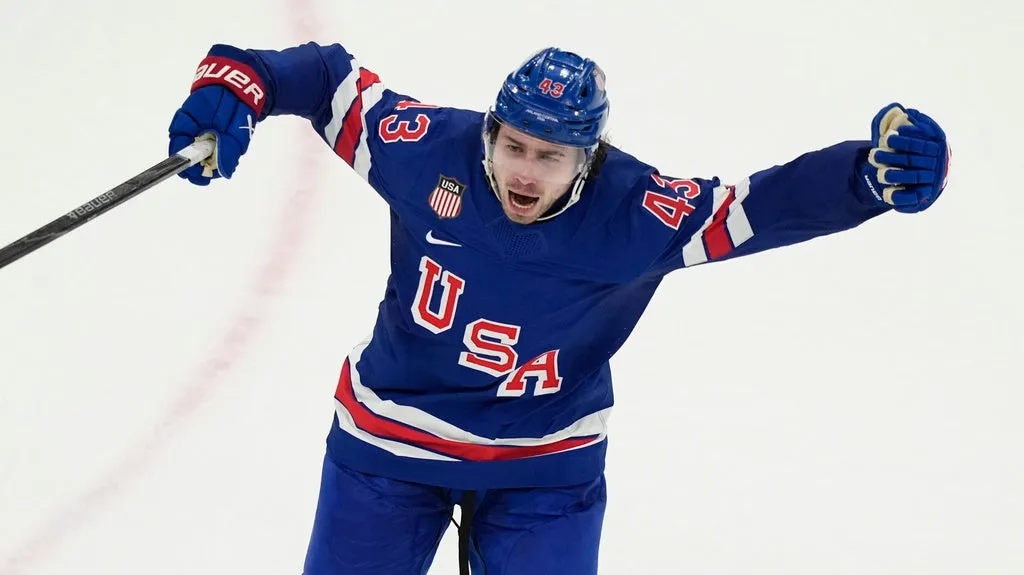
Quinn Hughes proves indispensable for Team USA
Quinn Hughes delivered a masterclass, logging over 27 minutes of ice time—the most among Americans—and averaging 56 seconds per shift. This edged out Sweden’s Erik Karlsson by three seconds per shift. Hughes not only scored the decisive overtime wrister but also assisted on Larkin’s opener, showcasing his ability to control play against top competition.[3]
He was on the ice for the final 1:15 of overtime, deking past Wild teammate Joel Eriksson Ek before roofing a shot off the post. Hughes has topped 20 minutes in every game, dictating tempo and creating offensive chances while exhausting foes. His edgework in 3-on-3 overtime drew praise, with fans noting his unmatched shiftiness.[4]
Beyond the highlight goal, Hughes contributed defensively, helping stifle Sweden’s attacks. As the oldest Hughes brother, he’s embodying the family’s legacy in international play. His dual-threat presence makes him arguably Team USA’s best player, regardless of position.
This performance reaffirms why Hughes is among the NHL’s elite defensemen. In a tournament full of stars, his consistency stands out. For more on Olympic roster impacts, see NHL Insight’s grades for USA and Sweden.
The goal sent arenas into frenzy, with NBC capturing the moment: “QUINN HUGHES! USA WINS! 🦅“
Third-period conservatism raises eyebrows
Team USA dominated the second period with 20 shots and Larkin’s net-front redirect for a 1-0 lead. They entered the game with a plus-8 scoring margin in seconds overall. Yet the third saw just four shots, nearly allowing a shutout before Zibanejad’s late strike.[5]
This shift puzzled observers, as the U.S. had attacked aggressively earlier. Overtime yielded five shots in under 90 seconds, showing urgency when it mattered. Coaches may have prioritized protection, but it invited pressure.
Sweden capitalized on the slowdown, with Zibanejad’s wrister tying it at 91 seconds remaining. The U.S. killed a late penalty but couldn’t extend the lead. This conservatism contrasted their net-rushing style from prior frames.
Analysts question if fatigue or strategy played a role. Still, advancing trumps perfection. Replicating second-period fire will be key moving forward.
The pattern echoes past Olympics where leads slipped in finals. Adjustments could elevate their gold chances.
Defense delivers tournament-best effort
Charlie McAvoy ignited momentum with a hit on Gabriel Landeskog, followed by six shot-free minutes for Sweden. Hellebuyck stonewalled distant tries, finishing with 28 saves on 29 shots.[3]
Brock Faber, Jake Sanderson, Jaccob Slavin, Zach Werenski, and Noah Hanifin formed a wall, with Hanifin as the seventh. J.T. Miller blocked shots relentlessly. The penalty kill stayed perfect at 10-for-10, tops in the tournament.
- Key defensive stats:
- Shots faced: 29
- Power-play goals allowed: 0
- Hits led by McAvoy’s open-ice thump
- Blocks: Multiple from forwards like Miller
This shut down Sweden’s stars amid chaotic quarterfinals elsewhere—Germany conceded six, Switzerland blew a lead. Canada and Finland also needed OT.
Hellebuyck’s poise complemented the group. Such cohesion bodes well for playoffs.
Compared to pool play, this was peak execution. Full marks for resilience.
Looking ahead: Lessons for the Slovakia semifinal
Slovakia looms as an offensive force, scoring six on Germany and averaging high marks. They’re fourth in goals per game, with four vs. Finland and three in a loss to Sweden. Team USA’s blueprint—defense first—must hold against this firepower.[2]
Replicating the shutout stretches and PK prowess is essential. Hughes’ minutes may increase. Offense needs third-period pop.
For full recap, check NHL.com’s game story.[3]
Slovakia’s attack tests the U.S. depth. Success here means gold-medal game.
Early line matchups will matter. USA’s odds remain strong.
Team USA earns a solid B+ despite flaws
The third-period shot drought caps the grade, preventing an A. Yet defense set a standard, and Hughes shone. This gritty win builds momentum.
Advancing amid OT drama shows mettle. Gold path clarified.
Fans celebrate, but focus shifts to Slovakia. Medal hopes burn bright.
Frequently Asked Questions

Par Mike Jonderson
Mike Jonderson is a passionate hockey analyst and expert in advanced NHL statistics. A former college player and mathematics graduate, he combines his understanding of the game with technical expertise to develop innovative predictive models and contribute to the evolution of modern hockey analytics.