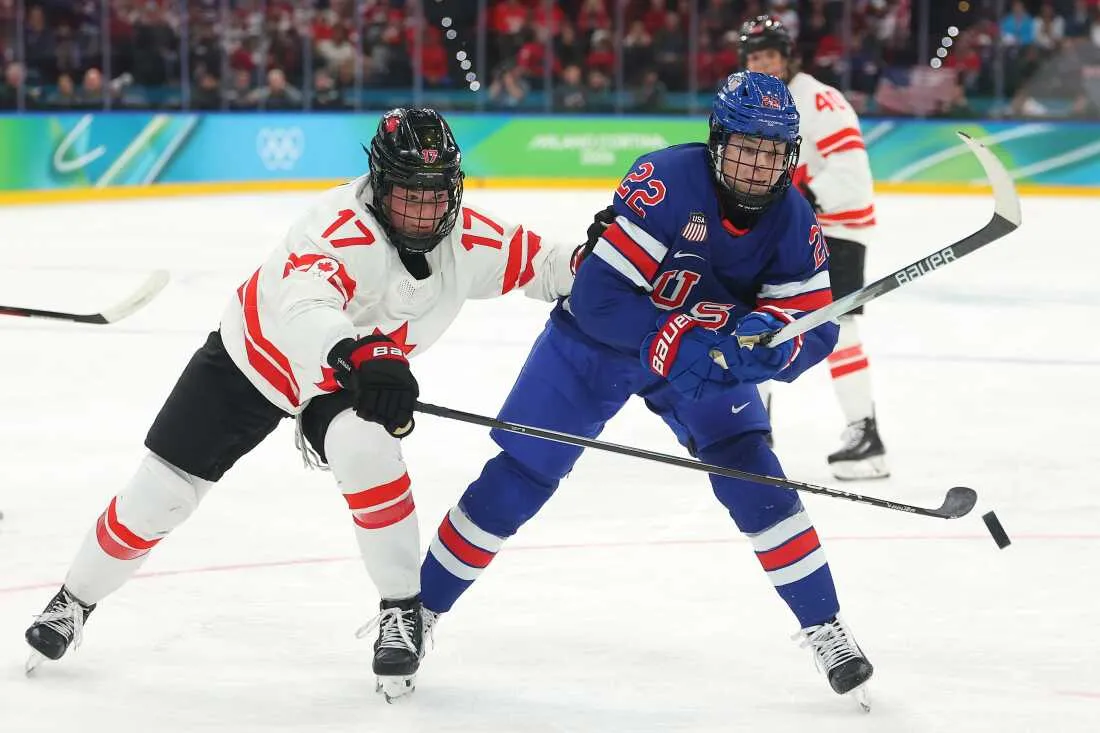
The stage is set for an epic clash in Milano Cortina as top-seeded Canada faces No. 2 United States in the men’s hockey gold medal game on Sunday at 8:10 a.m. ET. [1] [2] Both teams enter undefeated after dominant semifinal performances: Canada edged Finland 3-2 in a thriller, while the U.S. cruised past Slovakia 6-2. [3] This matchup pits NHL superstars against each other in a battle for Olympic immortality and bragging rights that will echo for years.
With rosters stacked from the NHL’s elite, the game promises high-speed action and tight margins. Canada has relied on comebacks, leading for just minutes in elimination rounds, while the U.S. has overwhelmed foes with depth. As detailed in NHL Insight’s coverage of Canada’s late rally to the final, the Canadians’ resilience has been key. Pundits agree: expect a classic rivalry renewed on the biggest stage since 2014. [4]
Most important players for Canada
Jordan Binnington stands out as Canada’s backbone in net, per ESPN’s Ryan S. Clark. The St. Louis Blues goalie has silenced doubters with consistent play, especially after strong showings against the U.S. in the 4 Nations Face-Off. His ability to keep Canada afloat during slow offensive starts could prove decisive.
Emily Kaplan highlights Connor McDavid as the world’s best player in his prime. Wearing the captain’s “C” in Sidney Crosby’s absence during the semis, McDavid penned a manifesto titled “Dear Canada” expressing his gold-medal hunger post-Stanley Cup Final losses. At 29, his unmatched speed could tilt the ice.
Arda Öcal points to 19-year-old Macklin Celebrini, the tournament’s youngest star with 10 points, second to McDavid. His selection over Connor Bedard sparked debate, but Celebrini’s impact has quieted critics. A big final could cement him as Canada’s next leader.
Kristen Shilton echoes the goalie focus on Binnington, who must match Connor Hellebuyck’s dominance. Despite some shaky goals allowed, his big-game reputation shines. Coach Jon Cooper’s trust underscores his potential as a game-changer.
Greg Wyshynski backs Nathan MacKinnon for clutch moments. From Stanley Cup heroics to drawing a key penalty in the semis, MacKinnon’s power skating intimidates. His nose for the net in high-stakes games makes him vital.
These picks reflect Canada’s blend of experience and youth. Binnington or McDavid stepping up could neutralize U.S. offense, but MacKinnon’s playoff pedigree adds edge.
Pivotal players for the United States
Quinn Hughes leads for Clark with heavy minutes and elite two-way play. The Vancouver Canucks captain controls possession against Canada’s prolific attack, vital in all zones.
Kaplan tabs Hellebuyck, last season’s Vezina and Hart winner. Post-knee procedure and playoff woes, he’s posted a .945 save percentage on 90 shots. “Is there a number greater than 100%?” he quipped on his form.
Öcal selects the Tkachuk brothers—Matthew (six assists) and Brady (three goals, five points)—as emotional drivers. Their passion evokes Herb Brooks’ miracle speeches, fueling the push for first gold since 1980.
Shilton calls for captain Auston Matthews to shine after quiet semis. With scoring depth evident, his fingerprints are needed amid playoff critiques. A big game validates his leadership.
Wyshynski agrees on Matthews, urging his line’s activation alongside torrid units like Jack Hughes with Dylan Larkin and Tage Thompson. Critics question his clutch scoring; gold silences them.
U.S. success hinges on Hughes’ steadiness, Hellebuyck’s wall, and Matthews’ eruption. The Tkachuks’ fire could inspire, as explored in our analysis on whether the U.S. can topple Canada.
Major x-factors that could decide the game
Control sequences top Clark’s list. Canada’s unrelenting comebacks meet U.S. draining possession; neither has faced equal control yet.
Kaplan eyes the U.S. penalty kill: perfect 15-for-15 despite 26:57 shorthanded. Facing Canada’s 7-for-16 power play (stars galore), glue guys like Vincent Trocheck must excel. “We’ll watch the film and do what we’ve been doing,” Trocheck said.
Öcal stresses early starts. Canada led minimally in playoffs; U.S. blowouts suggest a quick goal spells doom. First-period tone-setters win.
Shilton questions Canada’s lead protection. “Cardiac Canadians” excel trailing but must hold advantages longer than 35 seconds against U.S. piling-on.
Wyshynski urges U.S. boldness—no timid leads like quarters vs. Sweden. With equal talent, flex depth and own zones. “This is your time. Their time is done,” he quotes from “Miracle.”
These elements—PK, momentum, aggression—could swing it. ESPN’s full breakdown details more. [1]
Expert predictions for the final score
ESPN’s panel splits:
- Ryan S. Clark: Canada 3-2 OT.
- Emily Kaplan: U.S. 3-2 OT (Jack Eichel golden goal).
- Arda Öcal: Canada 4-2 (Brad Marchand empty-net).
- Kristen Shilton: Canada 4-3 OT (Macklin Celebrini winner).
- Greg Wyshynski: U.S. 4-2 (Jack Hughes game-winner, Quinn assist).
Other outlets vary: NHL.com staff picks, Daily Faceoff previews Celebrini’s role. [5] Canada slightly favored at 53-56% odds.
This rivalry’s history—from 1980 Miracle to recent 4 Nations—amps stakes. A U.S. win explodes North American interest; Canada victory extends dominance.
Whoever triumphs claims gold and legacy. Expect overtime drama, stars rising, and hockey at its purest. Tune in—North America’s eyes are locked. [6]
Frequently Asked Questions

Par Mike Jonderson
Mike Jonderson is a passionate hockey analyst and expert in advanced NHL statistics. A former college player and mathematics graduate, he combines his understanding of the game with technical expertise to develop innovative predictive models and contribute to the evolution of modern hockey analytics.