











The Utah Mammoth snapped a four-game winless streak with a hard-fought 3-2 victory over the New York Rangers at Delta Center on Saturday night, delivering a performance that could reshape the trajectory of their season. In front of a raucous home crowd, the Mammoth battled back from a second-period deficit, showcasing the resilience that had been missing during their recent slide. Defenseman Nick DeSimone’s third-period blast proved to be the difference-maker, deflecting off a Rangers stick and sliding between Jonathan Quick’s pads at the 7:32 mark, sending the Utah bench into celebration.
The win elevated Utah back into the second wild card spot with 25 points, positioning them just one point behind Minnesota for third place in the Central Division. More importantly, it provided tangible proof that the team’s young core could deliver in high-pressure moments. For a squad that had been searching for answers during a frustrating 0-1-3 stretch, this victory offered validation that their process could produce results when execution matched effort.
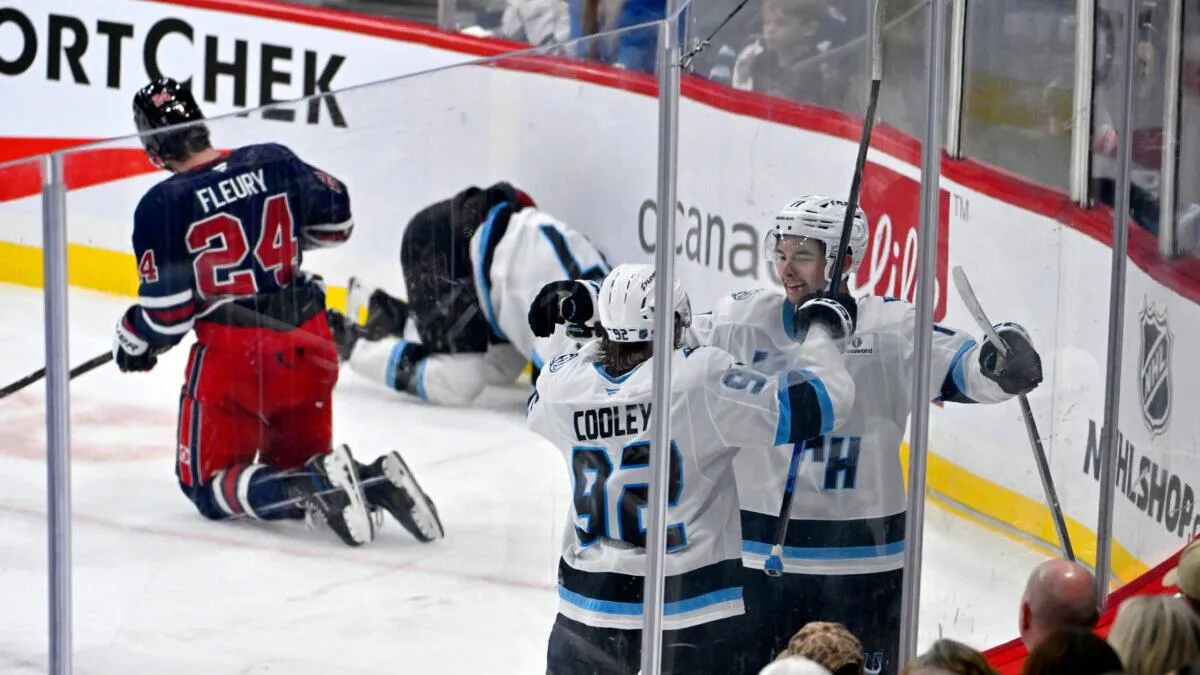
JJ Peterka’s offensive surge continues against New York Rangers
The 23-year-old forward has emerged as Utah’s most reliable offensive weapon during a stretch where goals have been scarce. With five goals and six points in his past six games, Peterka has single-handedly kept the Mammoth competitive in contests where their offense otherwise sputtered. His first-period tally against the Rangers exemplified his current form—a smart, opportunistic play that capitalized on traffic in front of the net.
Peterka opened the scoring at 10:08 of the opening frame, demonstrating the “keep it simple” philosophy that head coach Andre Tourigny had emphasized before puck drop. After Nate Schmidt’s point shot created chaos in the slot, Peterka slipped behind the Rangers defense and tapped the puck home from behind Quick’s skate. The goal marked his fifth in six games and provided an early spark for a team desperate for positive momentum.
What makes Peterka’s recent production so valuable is its timing. During Utah’s four-game skid, the team managed just 2.3 goals per game, often falling behind early and struggling to climb back. Peterka’s ability to consistently find the scoresheet has prevented opponents from completely shutting down the Mammoth attack. His chemistry with linemates Lawson Crouse and Jack McBain has been particularly effective, as the two forechecking specialists create space for Peterka to utilize his creativity and shot-making ability.
Coach Tourigny’s decision to move Peterka away from Dylan Guenther and Logan Cooley has unlocked a different element of his game. On the third line, Peterka faces slightly softer matchups while still receiving significant ice time in offensive situations. This deployment allows him to play with confidence and freedom, taking calculated risks that might not be available when matched against top defensive pairings. His development represents a crucial piece of Utah’s long-term vision, and his current heater suggests the organization was wise to acquire him in the offseason.
The Rangers simply had no answer for Peterka’s versatility. He scored from the doorstep, created chances on the rush, and backchecked effectively against New York’s top line. When a young player can impact the game at both ends of the ice during a must-win contest, it speaks volumes about his maturity and preparation. For Utah to remain in the playoff hunt, they’ll need Peterka’s production to continue at this pace through the upcoming road-heavy schedule.
Karel Vejmelka’s third-period heroics preserve Utah Mammoth victory
While DeSimone’s goal will grab the headlines, the game might have been lost without Vejmelka’s brilliance during a pivotal stretch midway through the final period. With the score knotted at 2-2 and the Rangers pressing for the go-ahead goal, the Utah goaltender made a sequence of saves that defied logic and preserved his team’s chance at victory. Two minutes before DeSimone’s winner, New York had multiple Grade-A chances directly in front of the Mammoth net, but Vejmelka somehow kept the puck out.
The sequence began when Rangers forward Artemi Panarin intercepted a clearing attempt and fed Mika Zibanejad for a one-timer from the slot. Vejmelka’s initial save kicked out a rebound, but he scrambled across his crease to deny a follow-up attempt by Ryan Lindgren. The puck then squirted to the far post, where Alexis Lafrenière had an empty net staring at him. Somehow, Vejmelka reached back with his blocker and deflected the shot wide, prompting a collective gasp from the Delta Center crowd.
“Super consistent game for Vejmelka,” JJ Peterka said postgame. “Huge saves. In the third, with four or five rebounds, it kept us in the game the whole game, and we did our job on the other side.” His teammates clearly recognized the importance of those stops, as the momentum immediately shifted when they cleared the zone and went on the offensive attack.
Vejmelka finished with 20 saves, though that number belies his actual impact. Many of those stops came during high-danger sequences where New York had multiple chances in rapid succession. His ability to control rebounds improved as the game progressed, and his positioning on breakaway situations remained flawless. The Rangers’ lone even-strength goal against him came when Panarin’s breakaway shot squeezed through his pads and barely dribbled across the goal line—a goal that Vejmelka couldn’t have stopped more than twice.
Coach Tourigny specifically highlighted his goaltender’s performance when discussing the turning point. “We had a tough shift in the third where we turned it over, and then Cool’s line went on the inside, and we talked on the bench about momentum and how to get the momentum back. And not just by their decision, but they scored a goal on top of playing the right way on that shift. So that was good, and we need to give credit to Vej, because at that key moment, he made a key save.”
The timing couldn’t have been better for Vejmelka, who has faced increased scrutiny during Utah’s recent struggles. Goaltending consistency remains one of the biggest questions for this young franchise, and performances like Saturday’s provide confidence that the position can be a strength rather than a question mark. With a road-heavy slate approaching, the Mammoth need their netminder to deliver this level of play regularly.
Nick DeSimone’s clutch marker exemplifies Utah Mammoth’s team-first mentality
DeSimone’s game-winning goal at 7:32 of the third period wasn’t just a lucky bounce—it was the culmination of sustained offensive pressure and smart defensive positioning. After the Rangers’ dangerous flurry at one end, the puck transitioned quickly up ice, with Logan Cooley’s line establishing possession deep in New York’s zone. The forecheck created chaos, and when the puck rolled back to DeSimone at the right point, he didn’t hesitate.
The defenseman’s slap shot caught Taylor Raddysh’s stick blade and deflected slightly, changing direction just enough to handcuff Jonathan Quick. The veteran goaltender, who had been spectacular with 31 saves, couldn’t react in time as the puck slid between his pads and across the line. For DeSimone, it represented his second career game-winner and first since December 21, 2023, when he played for the Calgary Flames.
“Everybody bought in tonight,” DeSimone said in the postgame locker room. “Every guy was playing out the game, and we just stuck with it for the whole night, and we got rewarded for it.” His words capture the essence of what made this victory different from recent efforts. Rather than individual players trying to do too much, the Mammoth played a connected, structured game where each line built momentum for the next.
The goal itself was unassisted but hardly a solo effort. The sustained pressure from Utah’s forwards forced the Rangers to collapse, creating space for DeSimone to step into the shot. Coach Tourigny emphasized this point when analyzing the sequence. “We set everybody up for the next shift. Whether it’s setting them up for a forecheck or a good puck, we set each other up all night, which gave us momentum.”
This team-first approach has been missing during Utah’s slide. Too often, players were caught out of position trying to force plays that weren’t there, leading to odd-man rushes against and defensive breakdowns. Against New York, the Mammoth maintained their structure, supported each other in all three zones, and trusted that the process would eventually produce results. DeSimone’s winner was simply the exclamation point on a night where the entire roster contributed.
The Rangers acknowledged Utah’s superior effort afterward. “I thought we got outplayed,” New York coach Mike Sullivan admitted. “I didn’t think for whatever reason we had the juice, the energy. If you don’t bring a certain amount of energy to the game, it’s hard. Today’s game is fast, and that’s a young, fast team.” When opposing coaches recognize your team’s compete level, it validates the message Tourigny has been preaching.
For DeSimone personally, the goal represents a breakthrough moment in his first season with Utah. Acquired to provide defensive depth and stability, he has embraced his role while remaining prepared for opportunities to contribute offensively. “It’s my job to be ready whether I am playing or not playing. Just being in a good mood, being grateful for every day, and showing up. If I’m playing, I just try and do what I can to help.”
The victory over New York provides a template for future success. When Utah plays with pace, supports the puck, and maintains defensive structure, they can compete with any team in the league. The challenge now becomes replicating this effort consistently, starting with Monday’s matchup against Vegas.
The Utah Mammoth’s performance against the Rangers demonstrates why this young franchise remains dangerous despite recent struggles. With JJ Peterka heating up at the right time, Karel Vejmelka finding his form in net, and role players like Nick DeSimone stepping up in crucial moments, the ingredients for a playoff run are present. The team’s ability to execute during high-pressure situations will determine whether this victory becomes a turning point or merely an isolated bright spot.
This level of compete must continue through the upcoming six-game road trip, which will test the team’s mental fortitude and systems play. The Central Division remains tightly packed, and every point matters as the season approaches its midway point. If the Mammoth can build on the positives from Saturday’s win—structured forechecking, responsible defensive play, and clutch goaltending—they’ll position themselves favorably for the second half. The talent is there, the coaching is sound, and now the results are starting to follow. Monday’s rematch against Vegas represents the next opportunity to prove this wasn’t just a one-off performance but rather the beginning of something sustainable.
For more detailed analysis of Utah’s recent performances, check out our comprehensive game recap that breaks down the key moments from Saturday’s victory. And if you’re interested in how the Mammoth handled previous tight contests, our overtime loss analysis against the Islanders provides additional context on the team’s development this season.
Frequently Asked Questions

Par Mike Jonderson
Mike Jonderson is a passionate hockey analyst and expert in advanced NHL statistics. A former college player and mathematics graduate, he combines his understanding of the game with technical expertise to develop innovative predictive models and contribute to the evolution of modern hockey analytics.