






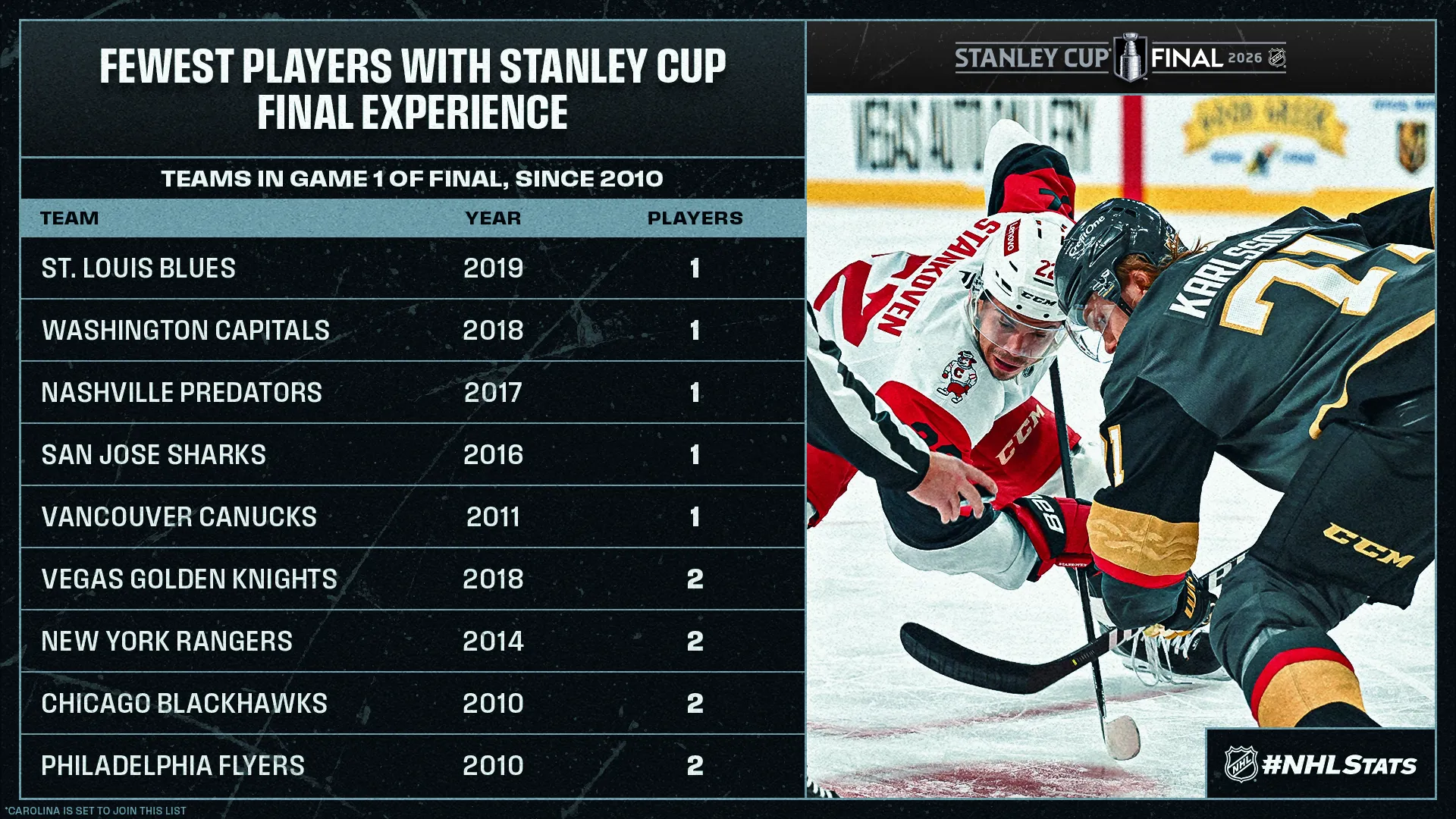
Vegas Golden Knights bring 13 players with prior Stanley Cup final appearances into Game 1 against the Carolina Hurricanes, who count only two such veterans on their roster.
Experience Disparity Sets Series Tone
Jordan Staal and William Carrier represent Carolina’s entire Cup-final history, with Staal arriving via the 2017 Penguins and Carrier via the 2023 Golden Knights. Vegas, by contrast, draws from its own 2018 and 2023 runs, producing the 13-player total confirmed ahead of media day at Lenovo Center. This numerical gap of 11 experienced skaters directly contrasts Carolina’s reliance on first-timers in a best-of-seven format where late-game poise often decides outcomes. The disparity manifests in practice routines, with Vegas players already familiar with the two-day media cycle and final-round travel demands.
Captain Jordan Staal’s leadership role therefore carries added weight as the lone link to Pittsburgh’s 2017 success, yet he faces 13 counterparts who have collectively appeared in 26 prior final games. Carolina’s preparation thus centers on simulation drills absent real final memory, while Vegas refines proven tactics from two championship runs. The causal effect surfaces in overtime scenarios, where the Knights’ veterans hold a documented edge from prior high-stakes minutes.
Scoring Production Highlights Tight Matchup
Mitch Marner leads all playoff scorers with 21 points in 16 games for Vegas, outpacing Jack Eichel’s 18 points across the same 16 contests. Taylor Hall sits third overall with 16 points in just 13 games for Carolina, while teammate Jackson Blake follows closely with 15 points in those same 13 outings. These figures establish a per-game scoring rate of 1.31 for Marner versus 1.23 for Hall, underscoring the offensive balance both sides bring to Raleigh.
The contrast sharpens when comparing games played: Vegas’s top duo accumulated three extra contests yet maintained higher totals, reflecting deeper playoff runs that mirror their final experience advantage. Carolina’s duo achieved comparable output in fewer games, validating their regular-season efficiency of 53-22-7, yet the Knights’ 39-26-17 mark masks the veteran seasoning that has already propelled them past the Avalanche. Mid-series adjustments will therefore hinge on whether Marner and Eichel can sustain their 1.22 combined points-per-game pace against Carolina’s stingier defensive structure.
Game 1 at Lenovo Center Favors Road Underdog
BetMGM lists Carolina at 1.65 moneyline odds for Tuesday’s opener, making the home side 1.65 favorites, while Vegas sits at 2.25. Series-long Stanley Cup odds similarly price Carolina at 1.70 and Vegas at 2.20, reflecting the Hurricanes’ 12-1 playoff record entering the final. Game 1 puck drop at 8 p.m. ET places the Knights on the road for the first of a potential seven games, yet their 13 veterans have already navigated identical environments twice before.
Home-ice advantage at Lenovo Center grants Carolina the last change and crowd support, yet the experience mismatch neutralizes portions of that edge once the series shifts to Vegas for Games 3 and 4. The Knights’ prior final appearances produced a 7-3 record in road games across those two runs, establishing a template that directly counters Carolina’s 53-win regular-season foundation. Early betting markets therefore embed the expectation that Vegas’s seasoning will erode the -155 series price by Game 5 or 6.
Media-day remarks from both GMs and coaches will likely emphasize preparation over pedigree, but the raw count of 13 versus two remains the immovable variable heading into June 2.
Frequently Asked Questions
Sources

Par Mike Jonderson
Mike Jonderson is a passionate hockey analyst and expert in advanced NHL statistics. A former college player and mathematics graduate, he combines his understanding of the game with technical expertise to develop innovative predictive models and contribute to the evolution of modern hockey analytics.