






The Vegas Golden Knights travel to Utah to face the expansion Mammoth in a pivotal late-November matchup that could have significant implications for Pacific Division positioning. With Vegas holding a 9-4-6 record and Utah sitting at 10-7-3, this 9 p.m. ET tilt represents more than just a regular-season game—it’s a meeting between a perennial Stanley Cup contender and a first-year franchise that’s exceeded expectations. Both teams enter with injury concerns that have forced lineup adjustments, making the projected combinations particularly intriguing for hockey analysts and fans alike.
The Golden Knights are expected to roll out the same 18 skaters who secured a gritty 3-2 victory against the New York Rangers on Tuesday, a decision that reflects coach Bruce Cassidy’s trust in his current group. Meanwhile, Utah welcomes back defenseman Dmitri Simashev and forward Liam O’Brien to their lineup, providing a boost to their depth as they face one of the conference’s elite squads. The Mammoth’s ability to compete with veteran-heavy teams like Vegas will be tested against a club featuring Jack Eichel, Tomas Hertl, and Mitch Marner as their new offensive centerpiece.
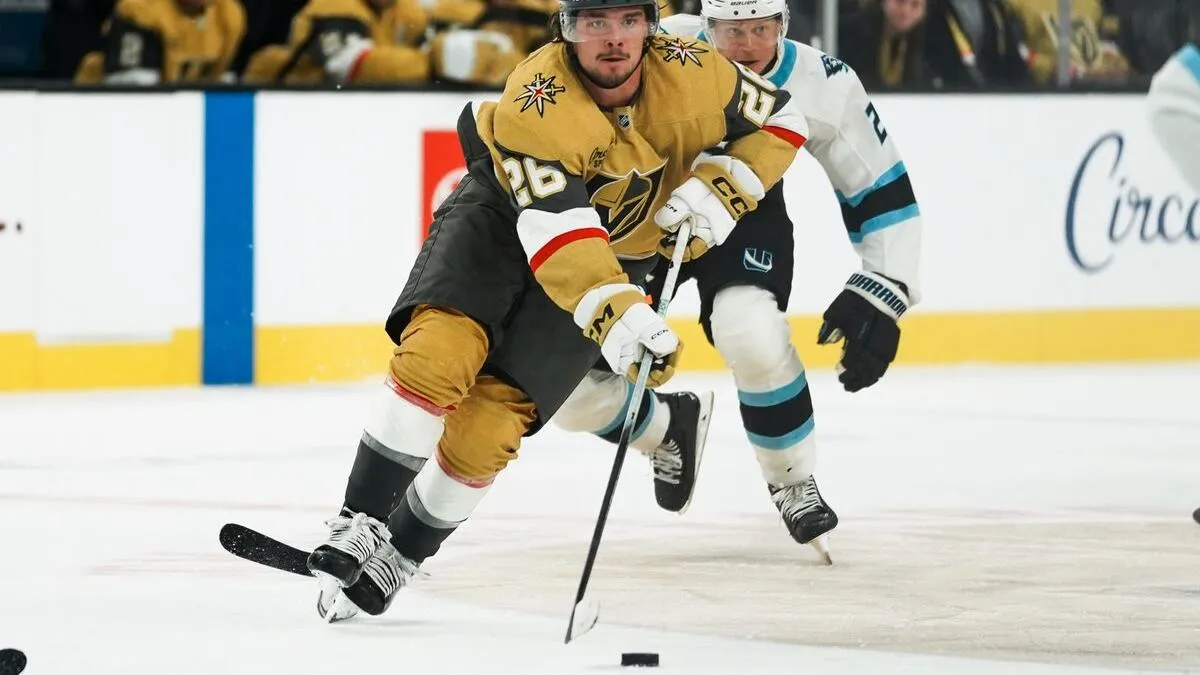
Vegas Golden Knights projected lineup vs Utah mammoth 11/20/2025: offensive structure
Vegas will deploy their newly configured top line featuring Jack Eichel between Ivan Barbashev and Branden Bowman, a unit that’s shown promising chemistry since Marner’s arrival from Toronto. Eichel’s playmaking ability combined with Barbashev’s two-way reliability and Bowman’s emerging scoring touch gives the Golden Knights a legitimate first-line threat. This combination has produced eight goals and 17 points over the past six games, demonstrating its effectiveness against quality competition.
The second line provides the kind of veteran presence that championship teams covet. Tomas Hertl centers Pavel Dorofeyev and Mitch Marner, with Hertl’s net-front presence and defensive zone prowess complementing Marner’s elite passing and Dorofeyev’s quick-release shot. Coach Cassidy has praised this line’s ability to control possession, noting after Tuesday’s win that “when those three are on the ice, we’re not chasing the game.” Their matchup against Utah’s Keller-Hayton-Schmaltz trio could determine which team establishes early momentum.
Brandon Saad, Brett Howden, and Reilly Smith form a defensively responsible third line that can chip in offensively. Saad’s championship experience with Colorado provides invaluable leadership for younger teammates, while Smith’s familiarity with Cassidy’s system from their Boston days makes them a trusted commodity in critical situations. This unit typically sees 14-16 minutes of ice time, with heavy usage on defensive zone starts and penalty kill duties.
The fourth line features Colton Sissons between Cole Reinhardt and Keegan Kolesar, a combination designed to provide energy and physicality while limiting scoring chances against. Sissons’ faceoff proficiency (54.2 percent winning percentage) gives Vegas a reliable option for defensive zone draws, and Kolesar’s willingness to engage physically helps protect star teammates. This line’s performance often flies under the radar, but their ability to tilt ice position through forechecking pressure plays a crucial role in Cassidy’s overall strategy.
Top six forward combinations
The top-six configuration showcases Vegas’ remarkable depth despite injury challenges. Eichel leads the team with 28 points through 19 games, while Marner has quickly acclimated with 11 points in his first nine contests as a Golden Knight. Barbashev’s versatility allows him to play either wing effectively, giving Cassidy flexibility during in-game adjustments. Hertl’s return to form after offseason hip surgery has been a critical development, providing secondary scoring that was missing during Vegas’ early-season struggles.
Bottom six energy lines
The bottom six emphasizes the organization’s developmental pipeline and veteran acquisitions. Howden’s career-high 12 goals last season earned him a two-year contract extension, and his chemistry with Saad and Smith has been evident since training camp. The fourth line’s identity centers on physical play and responsible defense, with Kolesar ranking third on the team in hits (47) despite limited ice time. This group’s ability to wear down opponents through sustained forechecking pressure creates opportunities for the skill lines that follow them.
Utah mammoth projected lineup vs Vegas Golden Knights 11/20/2025: defensive matchup
Utah counters with a forward group headlined by their own impressive top line of Clayton Keller, Barrett Hayton, and Nick Schmaltz. Keller’s 15 goals place him among the rookie franchise’s scoring leaders, while Hayton’s two-way development has been a pleasant surprise for first-year coach Andre Tourigny. Schmaltz’s playmaking ability from the right wing creates space for his linemates, making this trio dangerous in transition situations. Their speed could exploit Vegas’ aggressive defensive pinches.
The second line featuring Logan Cooley between Michael Carcone and Dylan Guenther represents Utah’s future core. Cooley’s rookie season has included flashes of brilliance, with his 14 points in 20 games exceeding most preseason projections. Guenther’s size and shooting ability (team-leading 67 shots) provide a constant threat, while Carcone’s veteran presence stabilizes this young unit. Their growth throughout the season will determine whether Utah can maintain their current playoff positioning.
JJ Peterka, Jack McBain, and Lawson Crouse form a heavy, grinding third line that thrives on puck possession below the hash marks. Crouse’s 6-foot-4 frame and willingness to battle along the boards creates space for Peterka’s creativity, while McBain’s defensive awareness makes them a trusted unit against opposing top lines. This group’s ability to generate offense through sustained zone time will be crucial against Vegas’ structured defensive system.
Liam O’Brien’s return to the lineup alongside Kevin Stenlund and Brandon Tanev gives Utah their most experienced fourth line. O’Brien’s physicality was missed during his two-game absence, and his 86 penalty minutes lead the team. Tanev’s penalty-killing expertise and Stenlund’s faceoff work make this a reliable defensive unit that can eat crucial minutes late in periods.
Mammoth forward depth analysis
Utah’s forward depth represents a masterclass in expansion team construction. General manager Bill Armstrong strategically acquired contracts that provided both present competitiveness and future flexibility. The balance between established veterans like Tanev and emerging stars like Cooley creates a competitive environment where younger players can develop without overwhelming pressure. Their plus-8 goal differential through 20 games speaks to the roster’s surprising coherence.
Utah’s blue line configuration
The defensive corps features Mikhail Sergachev and Dmitri Simashev as the top pair, with Sergachev logging a team-high 24:31 of ice time per game. His offensive production (4 goals, 11 assists) from the back end ranks among the best in franchise history for a defenseman. Simashev’s return from injury provides a steadying presence, as his 6-foot-6 frame and reach help neutralize opposing rushes. The second pair of Nate Schmidt and John Marino offers veteran stability, while Ian Cole and Nick DeSimone round out the group with reliable depth.
Key injury report and roster notes for Vegas Golden Knights vs Utah mammoth 11/20/2025
Injury situations could significantly impact lineup decisions for both clubs. Here’s the complete breakdown:
Vegas Golden Knights injuries:
- Jeremy Lauzon (undisclosed) – placed on IR November 18, expected return November 24
- Adin Hill (lower body) – IR since November 10, expected return November 22
- William Karlsson (lower body) – IR since November 10, no timeline provided
- Mark Stone (upper body) – on IR since October 25, still week-to-week
Utah Mammoth injuries:
- Sean Durzi (upper body) – day-to-day, skated in regular jersey Thursday, hasn’t played since October 11
- Alex Kerfoot (lower body) – IR since November 5, expected return unknown
Healthy scratches:
- Golden Knights: Alexander Holtz will sit for the third consecutive game as a healthy scratch, giving opportunity for Reinhardt to maintain his roster spot after scoring in Tuesday’s victory.
- Mammoth: Olli Maatta, Kailer Yamamoto, and Kevin Rooney will watch from press level, with O’Brien and Simashev drawing back into the lineup.
The absence of Karlsson and Stone continues to test Vegas’ forward depth, though the acquisition of Marner has mitigated some offensive concerns. On Utah’s side, Durzi’s potential return would bolster a defensive corps that’s played admirably despite his absence. Coach Tourigny indicated Durzi is “close,” suggesting he could potentially draw in if pregame skate goes well.
Game preview and strategic implications for 11/20/2025 matchup
Special teams could prove decisive in this contest. Vegas operates the NHL’s eighth-ranked power play at 23.4 percent, with Marner’s presence on the half-wall creating new options for Eichel and Theodore at the points. Their penalty kill ranks 12th at 82.1 percent, with the Howden-Saad-Smith trio seeing substantial shorthanded ice time. Utah’s power play sits at 19.2 percent (18th overall), but their penalty kill has been surprisingly effective at 84.3 percent (ninth in the league), led by Tanev and Marino’s aggressive approach.
The goaltending matchup features Carl Lindbom making his fifth consecutive start for Vegas after stopping 31 of 33 shots against the Rangers. The 23-year-old rookie has posted a .917 save percentage and 2.45 goals-against average since taking over for the injured Hill. Utah counters with Karel Vejmelka, who’s started 14 of their 20 games and maintained a .908 save percentage despite facing the fifth-most shots against in the league. His ability to handle Vegas’ high-volume shooting attack (34.2 shots per game) will likely determine Utah’s fortunes.
Coaching adjustments will play a significant role as Cassidy and Tourigny implement their systems. Cassidy’s emphasis on defensive structure through the neutral zone could stifle Utah’s transition game, forcing the Mammoth to generate offense through sustained zone time rather than rush chances. Conversely, Tourigny may instruct his forwards to attack Vegas’ third defense pair of Ben Hutton and Kaedan Korczak, who’ve been targeted successfully by opponents in recent games.
Special teams considerations
Vegas’ power play operates through a 1-3-1 formation with Marner quarterbacking from the right circle, looking for cross-ice feeds to Eichel or point shots from Theodore. Utah’s penalty kill uses a wedge-plus-one alignment that pressures puck carriers at the half-wall, a strategy that could disrupt Vegas’ timing. The Mammoth must stay disciplined, as Vegas draws the fourth-most power-play opportunities in the league (3.8 per game).
Goaltending duel breakdown
Lindbom’s emergence has stabilized Vegas’ crease situation during Hill’s absence, but his workload management becomes crucial as the season progresses. With Hill potentially returning as soon as Saturday, Cassidy must balance winning tonight’s game against preserving his rookie netminder’s energy. Vejmelka faces the opposite challenge—he’s proven capable of stealing games but requires goal support that’s been inconsistent. Utah’s 2.85 goals-per-game average ranks 22nd leaguewide, placing pressure on their goaltender to be nearly perfect.
The first-ever regular-season meeting between these franchises adds another layer of intrigue. While Vegas holds clear experience advantages, Utah’s home crowd at Utah16 will create an electric atmosphere for a team still establishing its identity. Expansion franchises historically struggle against veteran-laden clubs, but the Mammoth’s competitive start suggests they’re ahead of typical first-year curves.
What this matchup ultimately represents is a clash between two organizations at different stages of contention windows. Vegas seeks to maximize their championship core’s remaining prime years, while Utah builds toward sustainable success through strategic asset acquisition and player development. The result tonight may provide insight into whether the Mammoth can accelerate their timeline and challenge for a playoff spot in their inaugural season, potentially reshaping Pacific Division dynamics for years to come. The Golden Knights understand they can’t afford to drop points to conference opponents, making this a crucial test of their mental focus against a hungry, motivated expansion squad.
Internal link: Utah mammoth vs anaheim ducks projected lineup 11/17/2025: full preview, lines, and key matchups Internal link: Utah Mammoth vs San Jose Sharks projected lineup November 18, 2025: early look at the first-ever meeting
Frequently Asked Questions

Par Mike Jonderson
Mike Jonderson is a passionate hockey analyst and expert in advanced NHL statistics. A former college player and mathematics graduate, he combines his understanding of the game with technical expertise to develop innovative predictive models and contribute to the evolution of modern hockey analytics.