










The sight of the Detroit Red Wings and New York Rangers facing off at Madison Square Garden on November 16, 2025, sparked immediate conversation across hockey fandom. Both teams wore their dark centennial jerseys—Detroit in striking red, New York in classic blue—with no white sweaters in sight. The visual popped on television and evoked comparisons to hockey photography from the 1950s, even earning artistic praise from accounts that juxtaposed the red and blue scrums with abstract expressionist paintings. That single regular-season game has become a catalyst for what NHL chief branding officer Brian Jennings calls a “priority” for the league: expanding color vs color jersey matchups beyond rare outdoor games and into the mainstream schedule.
For decades, the NHL has followed a strict convention of dark jerseys at home and white on the road (or the reverse, before 2003). The white jersey served as a neutral contrast to whatever color the home team chose. But the league now believes fans deserve to see their favorite teams in their signature colors more often, and the business case is equally compelling—dark jerseys consistently outsell their white counterparts at retail. The question isn’t whether color vs color games will happen more frequently, but how the league will manage the logistical and visual challenges that come with this shift.
How NHL color vs color jersey matchups work behind the scenes
The approval process for a color vs color game is surprisingly straightforward, according to Jennings. A team president identifies a matchup that makes sense—typically when two franchises have contrasting dark jerseys—and reaches out to their general manager. If both GMs sign off, the request moves to league offices for final review. This streamlined approach has already produced results beyond the Red Wings-Rangers tilt, with the Chicago Blackhawks and Rangers following suit in a blue-and-red centennial matchup, while future games like Ducks-Kings (orange vs. black on January 16) and Bruins-Lightning (gold vs. blue in the February 1 Stadium Series) are locked in.
The league’s review focuses primarily on visibility and contrast. Officials test whether players can be distinguished easily for both fans and referees, and whether television broadcasts can clearly separate the teams. Jennings personally texted NHL director of officiating Stephen Walkom during the Red Wings-Rangers game to confirm there were no on-ice issues; Walkom approved and reportedly enjoyed the visuals himself. This testing extends to considerations for viewers with color vision deficiencies—the league deliberately avoids problematic combinations like red versus green, which could create difficulties for colorblind fans and players.
The historical roots of NHL color vs color jersey matchups
Contrary to modern perception, color vs color games aren’t a new innovation—they’re actually a return to hockey’s earliest traditions. Through the first four decades of NHL play, teams routinely wore their dark sweaters against each other. The New York Rangers didn’t even introduce a white jersey until the 1950s, and the Toronto Maple Leafs added an all-white option in 1927 specifically to avoid confusion when facing the Rangers. A particularly difficult matchup between Toronto and the Chicago Black Hawks in 1930 prompted further league investigation into dedicated clash uniforms.
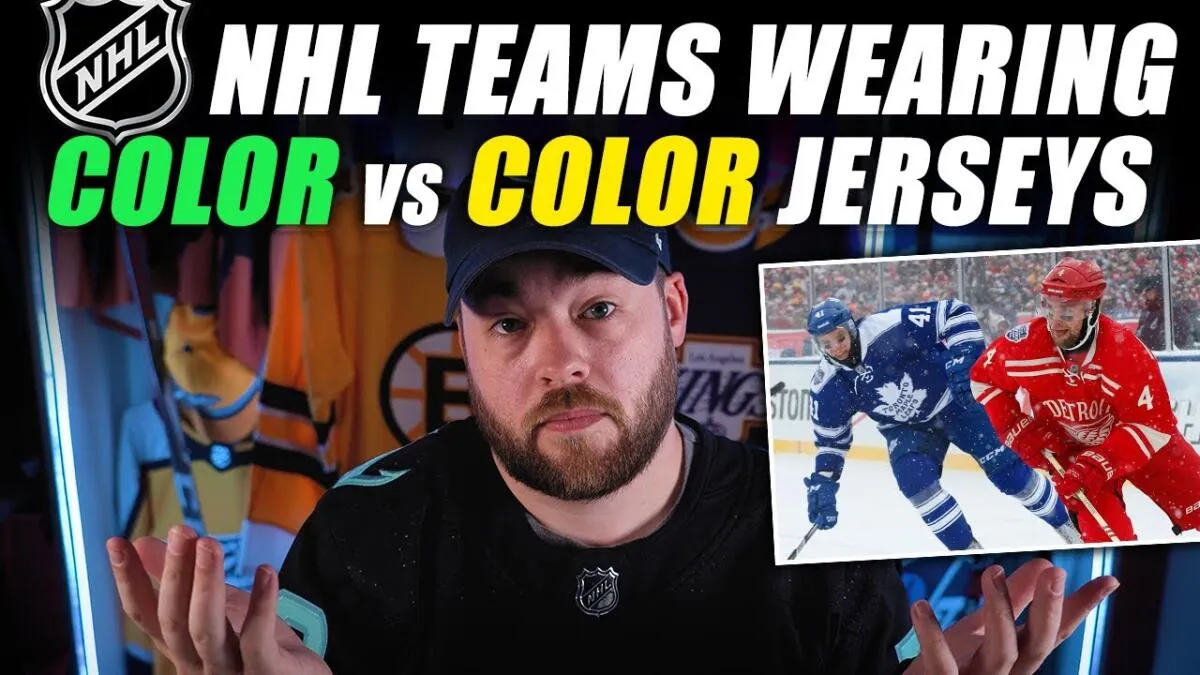
The shift to white jerseys as standard road wear emerged gradually, solidifying in the 1950s and becoming codified in league rules. Since then, color vs color games have been limited to occasional outdoor events like the 2014 Winter Classic between the Red Wings and Maple Leafs, or random one-offs such as a 2018 Hurricanes-Ducks game where Carolina wore red against Anaheim’s black. The league briefly revisited the concept during its 75th anniversary season in 1991-92, but it never stuck. For a deeper dive into how team colors and uniforms evolved during this period, our history of NHL uniforms and team colors provides comprehensive context on this fascinating journey from wool sweaters to modern high-tech jerseys.
Business drivers and logistical challenges for color vs color games
The business case for more color vs color jersey matchups is unambiguous. “If you look at our jersey sales, the majority of the jersey sales are dark-color jerseys,” Jennings told The Athletic. “And so it’s good for business on top of it being really good for the viewing audience.” Fanatics, the NHL’s uniform partner, has responded enthusiastically, as have broadcast partners who see enhanced visual appeal for their productions. The popularity of special alternate jerseys—particularly the 2020 “Reverse Retro” program—demonstrates that fans are eager to see their teams in fresh, colorful designs.
However, several logistical hurdles remain. Teams must fulfill commitments to jersey advertising partners, some of which require specific jerseys to be worn during a minimum number of home games. Gambling-related ads create additional complexity; a team with a casino advertisement on its colored jerseys cannot wear those uniforms in states where sports gambling remains illegal. Equipment staffs now routinely travel with multiple helmet sets after the 2023 rule change allowing contrasting helmets, but adding extra jersey trunks for road trips still requires coordination, especially for teams on extended travel.
The league estimates that when problematic combinations are eliminated—such as black versus navy, or matchups that challenge colorblind viewers—approximately 60 percent of the NHL schedule could theoretically support color vs color games. This doesn’t mean 60 percent will become color vs color overnight, but it shows the substantial opportunity for growth without compromising visual clarity.
What NHL color vs color jersey matchups mean for the future fan experience
Looking ahead to the 2026-27 season, the NHL plans to introduce a league-wide jersey refresh in the vein of the Reverse Retro program, this time spearheaded by Fanatics. Jennings indicated the league will suggest color vs color possibilities for nationally televised games and encourage teams to consider them for local broadcasts as well. The goal isn’t to eliminate white jerseys entirely—that would quickly diminish the specialness of color vs color games. Instead, the league wants to curate matchups where contrasting colors create the most compelling visual product.
The key is balancing novelty with practicality. As Jennings noted, “If we could have it all be color-on-color, it would quickly lose (specialness).” The Rangers’ blue and Red Wings’ red provide ideal contrast, but not every combination works as well. Blue versus black can be problematic, while red versus green is avoided entirely due to colorblindness concerns. Teams like the Minnesota Wild, with their dark green jerseys, have fewer natural clash partners and might need to introduce alternate colors to participate fully in the program.
Equipment managers have adapted surprisingly well to the changes. Since the 2023 helmet rule modification, traveling staffs are already accustomed to packing multiple helmet sets. The additional jersey trunk for occasional color vs color games represents a manageable increase in workload, especially when teams coordinate ahead of time. As one equipment manager noted in the DetroitHockey.Net analysis, collegial courtesy goes a long way—a simple phone call between equipment staffs can resolve potential clash issues and give both teams the flexibility to wear their preferred looks.
The NBA’s 2017 abolition of home and road jersey designations provides a loose template, though hockey’s unique equipment challenges mean the NHL will likely maintain more structure. Still, the principle remains: let teams wear their colors whenever visual clarity allows. For fans, this means more vibrant, visually distinctive games that showcase team identities in their purest form. For the business of hockey, it means more jersey sales, stronger brand identity, and a better television product.
Hockey’s earliest days featured nothing but color vs color games, and the league’s careful, methodical approach suggests we’re witnessing the beginning of a return to that tradition—albeit with modern testing and technology ensuring the on-ice product remains as clear as it is colorful.
Frequently Asked Questions

Par Mike Jonderson
Mike Jonderson is a passionate hockey analyst and expert in advanced NHL statistics. A former college player and mathematics graduate, he combines his understanding of the game with technical expertise to develop innovative predictive models and contribute to the evolution of modern hockey analytics.