












In 2025, Canada fielded a veteran-laden team at the IIHF world championship, featuring stars like Sidney Crosby, Nathan MacKinnon and Marc-Andre Fleury. Despite the experience, they stumbled in the quarterfinals with a shocking loss to Denmark, finishing fifth overall.[1][2] Meanwhile, the United States rolled out a youthful squad that captured gold, proving that a fresh, energetic roster can dominate on the international stage. This contrast raises an intriguing question: what if Canada went all-in on players 25 and under for the next tournament?[1]
The idea, floated by Ken Campbell in a recent The Hockey News column, envisions a compelling lineup drawn from NHLers whose clubs miss the playoffs or get bounced early. Such a team would pulse with speed, skill and hunger, potentially turning heads and contending for medals. With the NHL regular season winding down and playoffs looming, the pool of available talent is taking shape.[1]
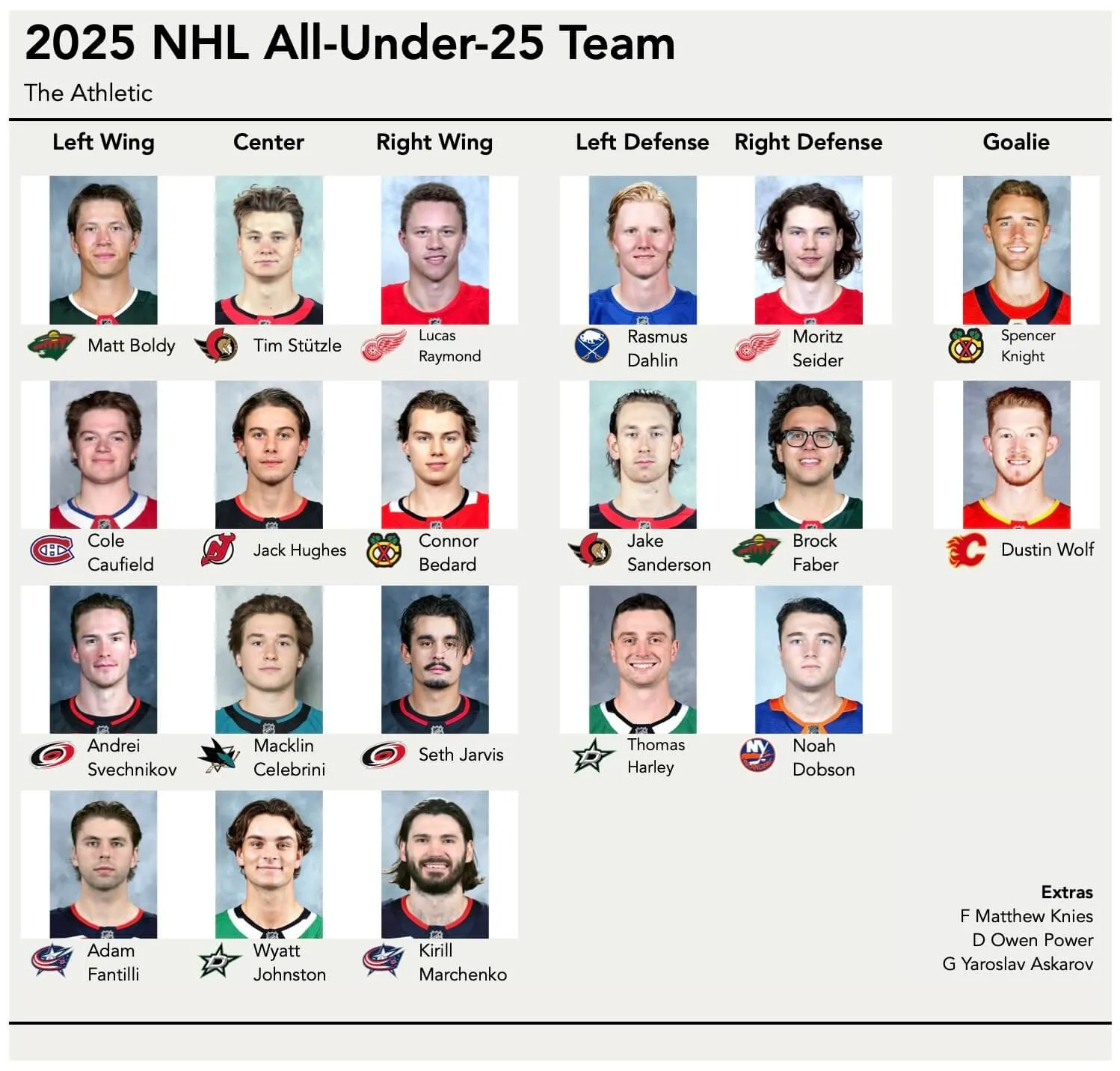
Building the current 25-and-under roster
Right now, the hypothetical roster pulls from players on teams already eliminated from playoff contention, excluding those on AHL rosters. This group forms a solid foundation, blending established NHL contributors with rising stars. Forwards like Connor Bedard of the Chicago Blackhawks and Macklin Celebrini of the San Jose Sharks headline the attack, bringing elite scoring and playmaking.[1]
Defensively, young blue-liners such as Noah Dobson and Lane Hutson offer mobility and puck-moving ability, crucial for transitioning play in high-stakes games. In net, options like Dylan Garand provide promise, though depth here remains a work in progress. The full chart, visualized via Datawrapper, showcases around 20-22 players across positions, emphasizing Canada’s depth in forward talent.[3]
This snapshot reflects the mid-season reality, where non-playoff teams like the Blackhawks and Sharks free up their top young guns. Bedard’s dynamic style, paired with Celebrini’s Calder-contending prowess, could form a lethal top line. Add in prospects like Matthew Schaefer, and the offensive firepower rivals any national team.[1]
The defense holds strong with players like Ryker Evans and Adam Fantilli’s linemates from past Worlds, ensuring balance. Goalie stability comes from NHL backups ready for the spotlight. Overall, this group promises excitement, mirroring the US’s 2025 success but amplified by Canadian pedigree.
Campbell notes these players would create “a hell of a lot of fun to watch,” highlighting the shift from grizzled vets to a high-octane unit. Early elimination of more clubs could only enhance this core.
Potential upgrades after the first playoff round
As the Stanley Cup playoffs unfold starting mid-April, additional stars could join if their teams falter in round one. A second Datawrapper projection outlines this expanded roster, incorporating eliminations from matchups like the first-round battles.[4] Players from deep-run teams like Toronto or Edmonton might become available, supercharging the lineup.
Imagine adding Dylan Guenther or Logan Cozens if Arizona or Buffalo bow out early—their shot volume and two-way play fit perfectly. Defensemen like Cole Hutson or Oliver Ekman-Larsson? No, stick to U25: think Kaiden Guhle or Lane Hutson for shutdown prowess. Forwards such as Trevor Zegras? American. Focus Canadian: Rickard Rakell no, young like Fraser Minten or past World juniors standouts.
The chart likely features updated lists, with positions filled by playoff losers. Goalies might include Joseph Woll if Toronto exits swiftly. This evolution turns a good team into a wagon, as Campbell puts it.
With the tournament slated for May 15, timing aligns perfectly for maximum availability. Historical precedents, like the 2025 Worlds where Celebrini and Porter Martone debuted young, show integration works.[5] The result? A squad blending 2025’s young contributors with 2026 draft hopefuls like Schaefer.
This post-playoff version addresses any gaps, creating three balanced lines and a mobile blue line. Energy levels would soar, pressuring opponents relentlessly.
Why a youth movement makes sense for Canada
Canada’s 2025 roster included only about 10 players under 26, like Celebrini (18), Fantilli (20) and Dobson (25), amid veterans like Crosby (37).[5] That mix underperformed, lacking the legs to match pacesetting foes. A pure U25 team flips the script, leveraging the NHL’s deepest young Canadian pipeline.
Prospects from recent World juniors and U18s, plus NHL rookies, bring cohesion from shared reps. Bedard-Celebrini-Schaefer alone could dominate, evoking memories of McDavid’s junior dominance. Defensively, Evans and Dobson pair offense with grit.
Injuries and fatigue plague vets at Worlds; youth stays fresh across the grueling schedule. USA’s 2025 gold, driven by under-25 stars, validates the approach—Canada has even more talent.[1]
Campbell urges taking “a page from its southern neighbors,” arguing this roster would be “compelling, energetic.” For full details and charts, check the original piece at The Hockey News.[1]
Risks exist—inexperience in clutch moments—but upside outweighs. Pair with sharp coaching, and gold beckons.
Lessons from 2025 and path forward
Reviewing 2025’s actual roster reveals untapped youth: forwards like Kent Johnson (22), Tyson Foerster (23) and Will Cuylle (23) mixed with elders.[5] Hockey Canada could have leaned harder young, avoiding the Denmark upset. For more on past rosters, see the IIHF archive.[2]
Implementing this U25 experiment demands bold selection. Prioritize NHL availability, fitness and chemistry. Training camps could simulate Worlds intensity, building bonds.
Fans crave this shift—youthful flair over safe vets. As playoffs progress, watch non-contenders’ kids; they might don the maple leaf.
Ultimately, this roster might not just compete—it could win, injecting new life into Canada’s Worlds dominance quest. Who knows, it becomes the blueprint for Olympics too.
Frequently Asked Questions

Par Mike Jonderson
Mike Jonderson is a passionate hockey analyst and expert in advanced NHL statistics. A former college player and mathematics graduate, he combines his understanding of the game with technical expertise to develop innovative predictive models and contribute to the evolution of modern hockey analytics.