






Now I have enough information to write a comprehensive blog post about the Boston Bruins No. 6 jersey curse. Let me create the article.
The Boston Bruins have one of the most storied franchises in NHL history, with six Stanley Cup championships and a tradition that spans over a century. Yet among their retired numbers honoring legends like Bobby Orr, Ray Bourque, and Johnny Bucyk, one single-digit number remains conspicuously absent from the TD Garden rafters: No. 6. This isn’t simply an oversight or a matter of waiting for the right player to come along. For over 70 years, the No. 6 jersey has been passed between nearly three dozen players, yet none have worn it long enough or performed well enough to make it truly their own. What was once just an oddity has evolved into what many fans and observers now call the Boston Bruins No. 6 jersey curse.
The pattern is undeniable. Since 1950, 28 different players have donned the No. 6 sweater for the Bruins, and with few exceptions, their tenures have been marked by injury, underperformance, or premature departures. It’s the only single-digit skater’s number besides No. 1 that hasn’t been retired by the organization, and the reasons behind this curious phenomenon have fascinated fans for decades. Whether you believe in hockey superstition or simply see it as statistical coincidence, the history of this number tells a compelling story about expectations, pressure, and the unpredictable nature of professional sports.
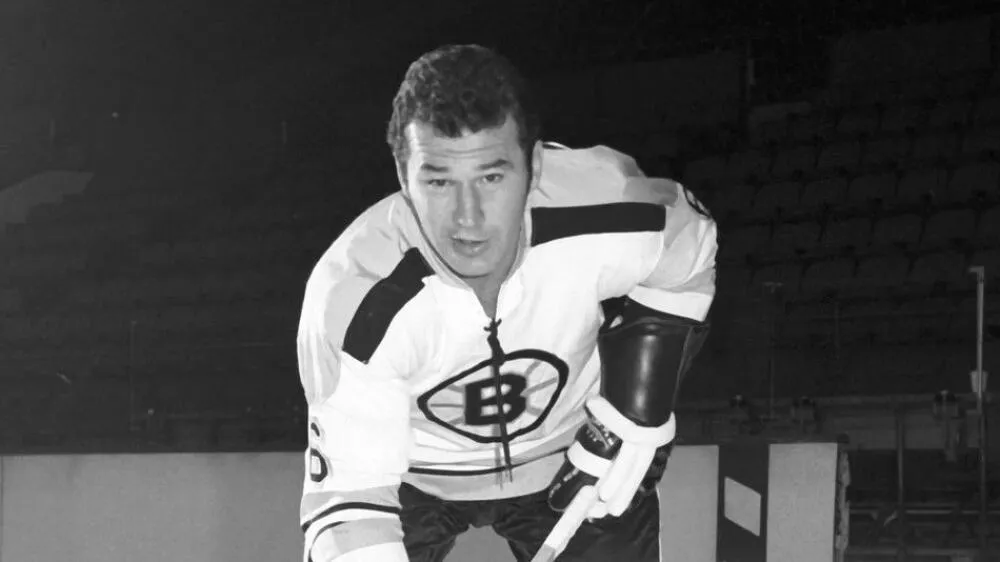
The legend begins with Ted Green and the Boston Bruins No. 6 jersey curse
When discussing the Boston Bruins No. 6 jersey curse, the conversation must begin with Ted Green, the player who came closest to making the number legendary. From 1961 to 1972, Green wore No. 6 with distinction, establishing himself as a cornerstone of the Bruins’ defense during the Bobby Orr era. Standing just 5-foot-10 and weighing 200 pounds, Green was known for his physical play and defensive reliability, accumulating 48 goals, 206 assists, and an impressive 902 shots on goal over 621 games in a Bruins sweater.
Green’s tenure with the team coincided with one of the franchise’s greatest triumphs. However, even his success story carries the shadow of the curse. During the legendary 1969-70 season when Bobby Orr scored his famous flying goal to clinch the Stanley Cup, Green was sidelined with injuries for the entire campaign. He watched from the sidelines as his teammates hoisted hockey’s ultimate prize, his name conspicuously absent from that year’s celebrations despite being a crucial part of the team’s core.
Green did eventually win a Stanley Cup with Boston in 1972, cementing his place as arguably the greatest player to ever wear No. 6 for the franchise. Yet even his story reflects the curse’s pattern: a career defined by what could have been, punctuated by injury and missed opportunities. His 11-year tenure remains the longest any player has continuously worn the number, a record that speaks volumes about the transient nature of those who followed.
The Hockey Gods, as superstitious fans like to call them, seemed to favor Green just enough to let him achieve greatness, but not enough to make No. 6 immortal. It’s been over 50 years since Green made the number his trademark, and in that time, no one has come close to matching his legacy while wearing it. According to The Hockey Writers, this lengthy drought has only strengthened the belief that something about this particular number prevents Boston players from reaching their full potential.
High draft picks and unfulfilled promise in the Boston Bruins No. 6 jersey curse
The Boston Bruins No. 6 jersey curse seems to have a particular appetite for highly touted prospects. Two first-overall draft picks have worn the number, and both saw their Boston careers end in disappointment despite flashes of brilliance. Gord Kluzak, selected first overall in 1982, wore No. 6 from 1983 to 1991, appearing poised to become a franchise defenseman. The expectations were enormous, but injuries derailed what could have been a Hall of Fame career.
Kluzak managed just 299 games over seven seasons, notching 25 goals and 98 assists before being forced to retire at only 26 years old. His body simply couldn’t withstand the physical demands of NHL hockey, with knee injuries particularly devastating his playing time. He did win the Bill Masterson Memorial Trophy during the 1989-90 season, an award recognizing perseverance and sportsmanship, but it served as bittersweet recognition of a career defined more by what he overcame than what he achieved.
The Kluzak story alone might have been dismissed as unfortunate timing, but then came Joe Thornton. The 1997 first-overall pick initially wore No. 6 before switching to 19, and his time with the Bruins ended in one of the franchise’s most regrettable trades. After a rocky start with just seven points in 55 games as a rookie, Thornton developed into exactly what Boston had hoped for: a franchise center capable of elite offensive production.
Then came the devastating decision. During the 2005-06 season, with Thornton finally reaching his potential, the Bruins traded him to the San Jose Sharks. That same season, split between both teams, he totaled 125 points with 96 assists, leading the league in both categories. He went on to play 1,714 NHL games, accumulating 430 goals and 1,109 assists, becoming one of the game’s all-time greats. Yet he remains, according to Bleacher Report, one of the most deserving players to never win a Stanley Cup. Even his post-Boston success couldn’t escape the curse’s long shadow.
These two first-overall picks represent the most painful chapters in the Boston Bruins No. 6 jersey curse saga. Both arrived with championship expectations, both showed the talent to fulfill them, and both saw their Boston careers end in frustration. The pattern is too consistent to ignore: the number seems to extract its toll regardless of pedigree or potential.
The revolving door and the Boston Bruins No. 6 jersey curse
Beyond the high-profile failures, the Boston Bruins No. 6 jersey curse manifests most obviously in the sheer number of players who have briefly worn it. Since Ted Green’s departure, the jersey has become a revolving door, with players rarely lasting more than a couple of seasons before moving on. The list of names reads like a trivia question: Vic Lynn, Gus Kyle, Warren Godfrey, Buddy Boone, Dick Redmond, Glen Featherstone, and Darryl Ederstrand among them.
After Joe Thornton switched to a different number, the pattern accelerated. From 2002 to 2010, four different players wore No. 6: Gord Murphy (2002), Dan McGillis (2003-04), Brad Stuart (2006-07), and Dennis Wideman (2007-2010). None made a lasting impact, with most serving as depth players or short-term solutions to roster needs. The number became associated with transience, with players who were either on their way up or on their way out of the organization.
Perhaps most tellingly, No. 6 wasn’t worn at all when the Bruins won their most recent Stanley Cup in 2011. It’s as if the organization subconsciously avoided assigning it during their championship run, letting the number sit dormant while players like Zdeno Chara, Patrice Bergeron, and Tim Thomas led the team to glory. This absence during Boston’s greatest recent triumph only reinforced the superstition surrounding the jersey.
Since 2011, the parade of short-term tenants has continued: Greg Zanon (2012), Wade Redden (2013), Corey Potter (2014), Colin Miller (2017), and Mike Reilly (2021-2023). Reilly actually showed promise, working his way into an important role and proving reliable during injury spells on the blue line. But even he couldn’t break the curse. During the 2022-23 season, he was sent down to the AHL’s Providence Bruins before being picked up by the Florida Panthers and later becoming a New York Islander.
The consistency of these short tenures defies simple explanation. Other jersey numbers see similar turnover with replacement-level players, but No. 6 has burned through promising prospects and proven veterans alike. Each new wearer arrives with hope that they’ll be the one to finally make the number their own, and each eventually departs having failed to do so.
Mason Lohrei and the future of the Boston Bruins No. 6 jersey curse
The latest player to confront the Boston Bruins No. 6 jersey curse is Mason Lohrei, a young defenseman who represents the franchise’s hope that talent and determination can finally overcome decades of disappointment. The 2024-25 season marked Lohrei’s first full-time leap to the NHL level, and expectations were cautiously optimistic that he could develop into a reliable contributor on the Bruins’ blue line.
Lohrei showed flashes of the offensive ability that made him an exciting prospect, finishing the 2024-25 regular season with five goals and 33 points across 77 appearances. His shot generation was impressive, recording 92 shots on net while also contributing defensively with 103 blocked shots. These numbers suggested a well-rounded game beginning to take shape. At the 2025 IIHF World Championship, he helped the United States win its first gold medal at the tournament in years, collecting one goal and two assists in five games.
However, the curse’s familiar patterns emerged quickly. Despite his offensive production, Lohrei posted a troubling minus-43 rating during the 2024-25 season, ranking among the worst on the team. The defensive struggles suggested he wasn’t quite ready for the responsibilities being placed on him. His inconsistent play led to him being sent down to Providence at various points, with the organization clearly believing he needed more development time before becoming a reliable NHL regular.
The pressure of wearing No. 6 may not be conscious, but the weight of history is real. Every mistake gets magnified when you’re wearing a cursed number, every slump becomes evidence of the pattern continuing. Lohrei has the talent to break through, but at just 23 years old, he faces an uphill battle against both his own development curve and the psychological burden of decades of disappointment. Whether he can become the player to finally retire No. 6 to the rafters remains one of the Bruins’ most intriguing storylines to watch.
Understanding superstition and the Boston Bruins No. 6 jersey curse
Hockey culture is steeped in superstition more than perhaps any other sport. Players refuse to shave during playoff runs, follow elaborate pre-game rituals, and speak reverently of “The Hockey Gods” as if they’re tangible forces influencing outcomes. In this context, the Boston Bruins No. 6 jersey curse fits perfectly into the sport’s mythology, offering an explanation for patterns that might otherwise seem like random misfortune.
The appeal of curses and superstitions in hockey stems partly from the sport’s chaotic nature. A puck bouncing unpredictably off the boards, a last-second deflection changing a game’s outcome, a career-altering injury from an awkward collision—these elements make hockey feel governed by forces beyond pure skill. When unexplainable events pile up around a single jersey number over 70-plus years, the human mind naturally seeks patterns and meaning.
Yet skeptics would argue that the Boston Bruins No. 6 jersey curse is simply confirmation bias at work. The number has primarily been worn by depth players, prospects, and veterans at the end of their careers—exactly the type of players who wouldn’t be expected to have Hall of Fame tenures regardless of their jersey number. The exceptions like Ted Green and Joe Thornton actually had considerable success, which should theoretically disprove the curse rather than confirm it.
What makes the curse compelling isn’t that every player who wore No. 6 failed catastrophically, but rather that none achieved the kind of sustained excellence that would make the number unmistakably theirs. No player wore it for their entire prime, no player made it synonymous with Bruins greatness the way Bobby Orr did with No. 4 or Ray Bourque with No. 77. The curse isn’t about dramatic failures—it’s about an inexplicable ceiling that prevents greatness from taking root.
Whether rooted in reality or perpetuated by belief, the curse now exists as a psychological factor. Young players assigned No. 6 will inevitably hear about its history, and that awareness could subtly affect their confidence and performance. Fans watching will scrutinize every mistake more closely, media will reference the curse in coverage, and the pressure builds with each passing season. In this way, the superstition becomes self-fulfilling, creating the very conditions that prevent someone from breaking through.
The Boston Bruins No. 6 jersey curse remains one of hockey’s most fascinating unsolved mysteries. For over seven decades, the number has passed through the hands of dozens of players, from first-overall picks to journeymen, from promising rookies to fading veterans. Yet none have worn it with enough distinction to earn its retirement, to make it forever synonymous with Bruins excellence. Whether you attribute this to supernatural forces, statistical anomaly, or the subtle psychological weight of expectation, the pattern is impossible to deny.
As Mason Lohrei continues his development and future players inevitably inherit the number, the question remains: will anyone finally break the Boston Bruins No. 6 jersey curse? Or will this number continue its strange journey through franchise history, forever tantalizingly close to greatness but never quite achieving it? Only time—and perhaps The Hockey Gods—will tell. Until then, No. 6 stands as a reminder that in hockey, some patterns defy simple explanation, and sometimes the most interesting stories are about the legends that never were.

Par Mike Jonderson
Mike Jonderson is a passionate hockey analyst and expert in advanced NHL statistics. A former college player and mathematics graduate, he combines his understanding of the game with technical expertise to develop innovative predictive models and contribute to the evolution of modern hockey analytics.