












The Boston Bruins made a significant lineup decision on October 28, benching young defenseman Mason Lohrei as a healthy scratch against the New York Islanders. The move came as veteran Hampus Lindholm returned from injury, forcing head coach Marco Sturm to make a difficult choice about his defensive pairings. Rather than shuffling veterans or rookies lower in the lineup, Sturm opted to sit Lohrei, a player the organization signed to a two-year, $6.4 million contract in the offseason with expectations of him taking on a larger role this season.
The decision wasn’t made lightly, but it reflects both the immediate needs of a struggling team and a longer-term investment in Lohrei’s development. Through 11 games, the young defenseman has shown flashes of the offensive skill that made him an intriguing prospect, registering a goal and five points. However, his defensive metrics tell a more concerning story, as he’s been on the ice for 11 goals against and continues to struggle with the consistency required at hockey’s highest level.
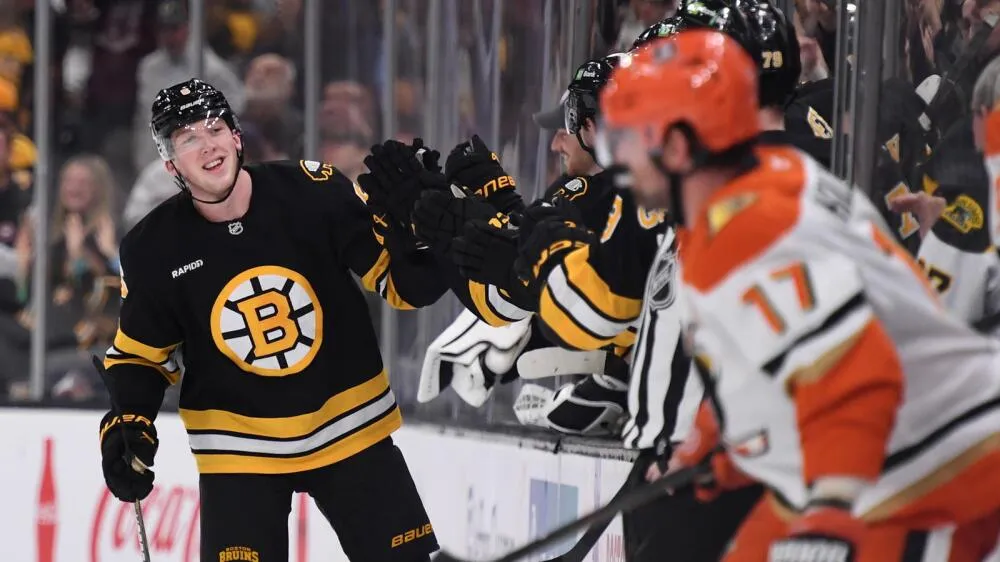
Why the Boston Bruins Mason Lohrei healthy scratch reset was necessary
Sturm’s decision to make Lohrei a healthy scratch stems from a troubling pattern of defensive miscues that have cost the Bruins in crucial moments. The young blueliner has posted the second-highest expected goals against on the team with 10.19, and opponents have consistently found success in high-danger areas when he’s on the ice. These aren’t just statistical anomalies—they’re visible mistakes that have directly led to goals against.
The most glaring examples came in recent games against elite competition. During the October 21 matchup against the Florida Panthers, two Panthers goals came directly off Lohrei’s defensive errors. Just two days later, against the Anaheim Ducks in a game the Bruins should have controlled, more costly mistakes from the young defenseman contributed to a disappointing loss. These aren’t the growing pains of a player adjusting to increased ice time; they’re fundamental breakdowns that needed to be addressed.
Sturm addressed the decision head-on in his pre-game comments, showing both accountability and support for his player. “We expect more from him, and sometimes you have to press that reset button,” Sturm explained. “It’s not like we want to bury him. No, I want to help him, and that’s part of the process. And again, you get some good things, but too many mistakes lately.”
The timing of the healthy scratch coincided with Lindholm’s return from a lower-body injury that had sidelined him for five straight games. With Lindholm back and rookie Johnathan Aspirot making his NHL debut, the roster numbers simply didn’t work in Lohrei’s favor. But make no mistake—this wasn’t purely a numbers game. If Lohrei had been playing well, Sturm would have found a way to keep him in the lineup.
The struggling partnership with Charlie McAvoy
One of the most significant challenges for Lohrei this season has been his deployment alongside star defenseman Charlie McAvoy on the Bruins’ top pairing. The organization envisioned this partnership as a way to accelerate Lohrei’s development, giving him the opportunity to learn from one of the league’s elite defenders while facing top competition. In theory, it made sense. In practice, it’s been a disaster.
The McAvoy-Lohrei pairing has been systematically dismantled by opposing teams. While they’ve generated offensive opportunities—posting 5.1 expected goals for—their defensive coverage has been porous, surrendering 7.1 expected goals against. More importantly, they’ve been outscored 9-6 at five-on-five, a damning statistic for a duo that’s supposed to anchor the team’s defense. The defensive struggles highlighted in the Bruins’ top pair shakeup have become impossible to ignore.
Communication breakdowns and lack of synchronization have plagued the pairing from the start. McAvoy, accustomed to playing with more defensively reliable partners, has found himself constantly covering for Lohrei’s positional mistakes. The chemistry simply isn’t there, and forcing it hasn’t yielded positive results. Sturm did briefly separate the duo during the October 25 game against the Colorado Avalanche, but reunited them shortly after with no improvement in their performance.
The issue isn’t solely Lohrei’s fault—pairing chemistry is a two-way street—but the young defenseman has clearly struggled with the responsibility of playing against opponents’ top lines. The step up from third-pairing duties, where he thrived alongside Andrew Peeke last season, to top-pair responsibilities has proven too steep too quickly. The healthy scratch provides an opportunity to reassess this deployment strategy entirely.
Understanding the developmental philosophy behind the Boston Bruins Mason Lohrei healthy scratch reset
Marco Sturm has demonstrated throughout his young coaching tenure that he’s not afraid to make tough decisions when players aren’t meeting expectations. Seven games into the season, he scratched center Casey Mittelstadt after a stretch of poor on-ice results and a particularly ineffective performance against Colorado where his line generated zero offense. Mittelstadt responded by returning to the lineup and posting a multi-point game against Florida, exactly the kind of response coaches hope for when they press the reset button.
This precedent is precisely what Sturm hopes to replicate with Lohrei. The healthy scratch isn’t meant as punishment or a vote of no confidence in the player’s long-term future. Rather, it’s a strategic pause designed to help a young player step back, observe from a different perspective, and return with renewed focus and determination. At 23 years old, Lohrei has plenty of time to develop into the top-four defenseman the Bruins believe he can become.
The timing actually works in Lohrei’s favor in some respects. The Bruins have implemented a new defensive system under Sturm, and there’s an undeniable learning curve for all players adapting to these changes. Veterans with years of NHL experience are still finding their footing, so it’s reasonable that a younger player thrust into a prominent role might need additional time to adjust. The reset allows him to study the system from the press box, see how teammates are successfully implementing it, and mentally prepare for his return.
There’s also value in humility for young players. Last season’s league-worst minus-43 rating should have been a wake-up call, but the new contract and elevated role might have created unrealistic confidence. Sometimes talent isn’t enough—especially in a defensive system that prioritizes positioning, communication, and discipline over individual skill. The healthy scratch serves as a reminder that playing time must be earned regardless of contract status or organizational expectations.
What comes next for Mason Lohrei’s role with Boston
When Lohrei does return to the lineup, the Bruins need to seriously reconsider his deployment. The top-pairing experiment with McAvoy has failed, and continuing to force that partnership would be detrimental to both players’ development and the team’s success. The most logical solution would be returning Lohrei to a pairing with Peeke, where he found success last season, while allowing Nikita Zadorov to slide up alongside McAvoy on the top pair.
This adjustment would accomplish multiple objectives. First, it puts Lohrei in a position to succeed by reducing the quality of competition he faces nightly and pairing him with a defensively responsible partner who can cover for occasional mistakes. Peeke’s steady, stay-at-home style complements Lohrei’s offensive instincts and transition game far better than McAvoy’s more aggressive approach. Second, it strengthens the top pair by giving McAvoy a physically imposing partner in Zadorov who can handle the defensive responsibilities while McAvoy activates offensively.
The Bruins also need to manage expectations for Lohrei’s offensive production. His greatest strength is his ability to transition the puck and contribute to breakouts, but the organization shouldn’t pressure him to be an offensive catalyst at this stage of his development. Allowing him to focus on defensive fundamentals—gap control, stick positioning, and board battles—will provide a stronger foundation for future growth than expecting him to quarterback power plays or create offense from the blue line.
Lohrei’s response to this healthy scratch will reveal much about his character and mental fortitude. Professional athletes face adversity throughout their careers, and how they handle setbacks often determines whether they become stars or cautionary tales. The Bruins need him to approach this situation with maturity, using the time to study film, work on specific aspects of his game in practice, and return with a chip on his shoulder ready to prove he belongs.
The broader implications for Boston’s defensive struggles
The decision to healthy scratch Lohrei is symptomatic of larger defensive issues plaguing the Bruins early this season. Through their first dozen games, Boston has allowed an alarming average of 4.75 goals per game during a seven-game stretch where they lost seven times in regulation. These aren’t the numbers of a legitimate contender, and the return of Lindholm alone won’t solve all their problems.
Lindholm’s presence should help, as he’s proven himself as a reliable top-four defender capable of matching up against elite competition. His absence was clearly felt—the Bruins missed nine of ten games during his injury absence—but expecting him to single-handedly stabilize a defense corps that has struggled with systematic breakdowns is unrealistic. The entire unit needs to improve their communication, positioning, and commitment to team defense according to recent analysis of Boston’s defensive issues.
The healthy scratch also signals to the rest of the locker room that accountability matters regardless of age, contract status, or draft pedigree. Veterans and rookies alike have seen Sturm willing to make difficult decisions when performance doesn’t meet standards. This establishes a culture where complacency isn’t tolerated and every player understands their ice time must be earned through consistent effort and execution.
Looking ahead, the Bruins need to find defensive stability quickly. The Eastern Conference is brutally competitive, and every point matters in the playoff race. They can’t afford to continue surrendering nearly five goals per game while hoping offensive firepower will bail them out. Defensive structure must become the foundation of their identity, and that starts with every defenseman—from McAvoy to Lohrei to Aspirot—buying into their roles and executing the system properly.
The Mason Lohrei healthy scratch represents more than just a single lineup decision. It’s a calculated risk by Marco Sturm to help a talented young player reset mentally and return stronger. Whether this approach works depends largely on Lohrei’s response, but the coaching staff has shown they’re willing to make uncomfortable decisions in pursuit of both short-term success and long-term player development. As the season progresses, how Lohrei handles this adversity and what adjustments the Bruins make to his role upon his return will significantly impact both his career trajectory and Boston’s defensive fortunes.

Par Mike Jonderson
Mike Jonderson is a passionate hockey analyst and expert in advanced NHL statistics. A former college player and mathematics graduate, he combines his understanding of the game with technical expertise to develop innovative predictive models and contribute to the evolution of modern hockey analytics.