












The Buffalo Sabres have pulled the trigger on a major front-office overhaul, firing general manager Kevyn Adams after five and a half seasons of mounting frustration and replacing him with Jarmo Kekalainen, the NHL’s first European-born general manager. The move comes as the team stumbles through yet another disappointing campaign, extending their league-record playoff drought to 14 years despite recent flashes of promise.
Owner Terry Pegula didn’t mince words in his statement announcing the change. “We are not where we need to be as an organization, and we are moving forward with new leadership within our hockey operations department,” Pegula said. “We are dedicated to building an organization that is competitive year after year, and we have fallen short of that expectation.” The decision, while sudden, reflects years of pent-up disappointment from a fan base that has watched the franchise become synonymous with futility.
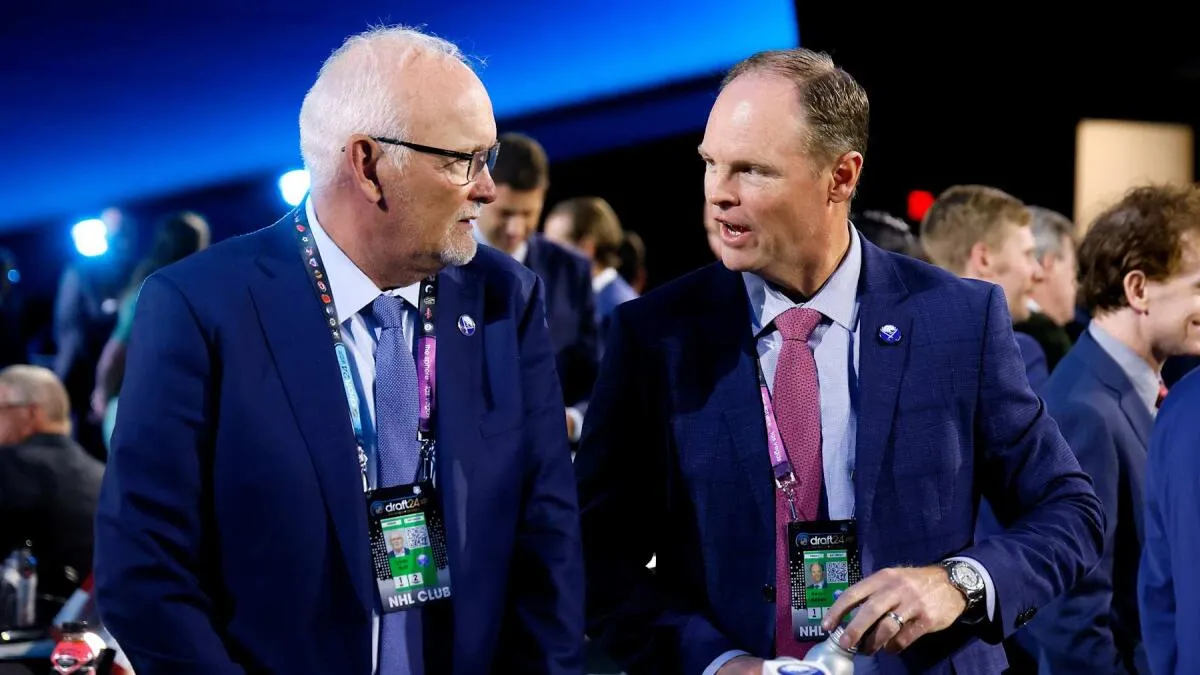
Inside Kevyn Adams’ tumultuous tenure as Sabres GM
Adams’ time at the helm was marked by bold moves that rarely translated to on-ice success. Over five-plus seasons, the Sabres compiled a record of 178-196-42 and never finished above 20th in the league standings. The team failed to qualify for the postseason in every season under his watch, turning what was once a proud franchise into a perennial punchline.
The 48-year-old former NHL defenseman became a lightning rod for fan anger, with “Fire Adams” chants echoing through KeyBank Center on multiple occasions this season alone. That frustration boiled over during a devastating 13-game winless streak in December that effectively torpedoed the season before the calendar turned to 2025. Adams’ trade deadline inactivity—particularly during that freefall—drew sharp criticism from those who felt a short-term jolt was necessary to salvage the campaign.
Adams’ legacy will be defined by blockbuster trades that had mixed results. He sent franchise cornerstones Jack Eichel to Vegas and Sam Reinhart to Florida, moves that still haunt Sabres fans today. His acquisition of Josh Doan and Michael Kesselring from Utah for JJ Peterka this past summer showed promise, but ultimately proved too little, too late. Pegula acknowledged Adams’ dedication, calling him “a reliable presence” and thanking him for his “enduring care and commitment,” but the results demanded change.
Who is Jarmo Kekalainen? A look at Buffalo’s new architect
Jarmo Kekalainen arrives with a pedigree Adams never possessed. The Finnish executive spent 11-plus seasons as the Columbus Blue Jackets’ general manager, guiding the team to five playoff appearances despite operating in one of the league’s smallest markets. He built a reputation as a shrewd evaluator of talent and a patient builder of competitive rosters, qualities the Sabres desperately need as they navigate their rebuild.
What’s particularly notable is that Kekalainen was already embedded within the Sabres’ front office. Buffalo hired him as a senior advisor in May 2025, and over the past eight months, he impressed ownership with his strategic vision and professional approach. “Jarmo has distinguished himself over the last eight months, and his experience, professionalism, and drive speaks for itself,” Pegula said. “I am looking forward to him leading our organization to the next level.”
The timing of the announcement carried personal weight for Kekalainen, who revealed on Instagram Monday morning that his father, Kari, had passed away Sunday at age 82. Despite the family loss, the 58-year-old was ready to take on arguably the NHL’s toughest job. “It is a great honor to be named general manager of the Buffalo Sabres,” Kekalainen said in a statement. “I would like to extend my thanks to Terry and Kim Pegula for this opportunity. I am humbled to be the steward of this team and look forward to experiencing the passion that Sabres fans bring to every game.”
Critical decisions await new Sabres GM Jarmo Kekalainen
Kekalainen inherits a roster with intriguing pieces but significant question marks. The Sabres boast elite talent in Rasmus Dahlin and Tage Thompson, yet neither has tasted playoff hockey during their NHL careers. The team’s goaltending remains a sore spot—Buffalo’s team save percentage ranks second-worst in the league this season, a dramatic fall from Ukko-Pekka Luukkonen’s breakout campaign a year ago. The Sabres score goals (ranking seventh in the NHL) but surrender them at an alarming rate (fourth-most in the league).
The new GM’s most immediate challenge involves pending unrestricted free agent Alex Tuch. The 29-year-old native of nearby Syracuse grew up a Sabres fan and has expressed interest in staying long-term, but contract talks stalled as the season began. Kekalainen must decide whether to extend Tuch or trade him for assets, a decision that will signal his vision for the team’s timeline.
Furthermore, the Sabres’ youth movement needs direction. While having the NHL’s youngest roster sounds appealing, inexperience has shown in their NHL-worst minus-32 goal differential in second and third periods. The power play ranks 25th and the penalty kill 23rd, exposing systemic issues that go beyond talent. Kekalainen must determine whether to accelerate the rebuild with veteran additions or stay the course with internal development.
What this means for Buffalo’s future and playoff drought
The franchise’s NHL-record 14-year playoff drought weighs heavier than any single roster decision. Buffalo hasn’t played a postseason game since April 2011, a span during which every other franchise—including expansion Seattle Kraken—has played at least 14 playoff games. Thirty teams have played at least 25, and seven have played over 100. The gap between Buffalo and the rest of the league has grown from disappointing to historically embarrassing.
Kekalainen’s five playoff appearances in Columbus provide a roadmap, but the Blue Jackets never reached the conference finals under his watch. Still, that level of competence would represent a massive upgrade for a franchise that hasn’t even sniffed contention. The Sabres currently sit tied for the fewest points in the Eastern Conference (32) despite entering the season with playoff expectations and “win-now” proclamations from coach Lindy Ruff.
Owner Terry Pegula’s commitment remains the X-factor. He’s employed four general managers and seven coaches during his 14 full seasons of ownership, with zero playoff appearances. The Pegulas haven’t spent to the salary cap ceiling since the COVID-shortened 2019-20 season, and attendance has cratered to second-worst in average capacity. For Kekalainen to succeed, he’ll need both financial support and patience—two commodities that have been scarce in Buffalo’s front office.
Frequently Asked Questions

Par Mike Jonderson
Mike Jonderson is a passionate hockey analyst and expert in advanced NHL statistics. A former college player and mathematics graduate, he combines his understanding of the game with technical expertise to develop innovative predictive models and contribute to the evolution of modern hockey analytics.