







The Buffalo Sabres and Carolina Hurricanes are set to clash at Lenovo Center in Raleigh on November 8, 2025, with both teams dealing with significant lineup changes due to injuries and personal matters. The Sabres enter this Metropolitan-Atlantic matchup with a 5-5-4 record, having seen their point streak snapped and dealing with the absence of captain Rasmus Dahlin, who has returned to Sweden due to a personal matter. Meanwhile, the Hurricanes look to extend their winning streak to three games with a 9-4-0 record, benefiting from the potential return of two key forwards while still managing multiple defensive injuries.
This Friday night contest features two teams heading in different directions. Carolina has found its rhythm after a challenging start to the season, while Buffalo continues to navigate through a difficult period marked by inconsistency and mounting injuries. The projected lineups reveal interesting adjustments on both sides, with the Hurricanes potentially getting healthier at forward while the Sabres scramble to fill gaps throughout their roster.
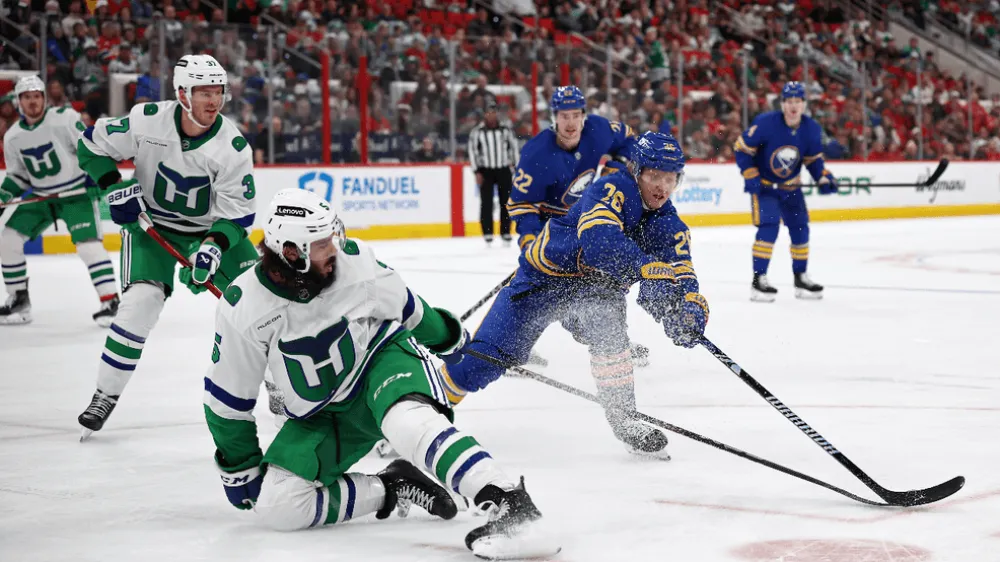
Buffalo Sabres vs Carolina Hurricanes projected lineup 11/8/2025: forward configurations
The Sabres’ forward group has undergone significant shuffling due to illness and injury. The top line features Josh Doan alongside Ryan McLeod and Alex Tuch, a combination that represents Buffalo’s attempt to generate offense without several key contributors. Doan, thrust into a more prominent role, will need to elevate his game alongside the versatile McLeod and the physical presence of Tuch on the right side.
The second line presents an intriguing mix with Isak Rosen and Noah Ostlund flanking franchise cornerstone Tage Thompson. Thompson remains the focal point of Buffalo’s offensive strategy, and the young Swedish duo will need to provide adequate support. With Jason Zucker and Jiri Kulich both sidelined with illness, the Sabres are leaning heavily on their depth and younger players to step up in crucial roles.
Buffalo’s third line features Jordan Greenway, Tyson Kozak, and Jack Quinn, a group that blends size, speed, and skill. Quinn continues his development as a key piece of the Sabres’ future, while Greenway provides the physicality needed against Carolina’s structured defensive system. The fourth line of Josh Dunne, Peyton Krebs, and Beck Malenstyn will focus on energy and defensive responsibility.
For the Hurricanes, the return of William Carrier and Eric Robinson significantly bolsters their forward depth. Both players have been sidelined since October 23 and are expected to flank Jesperi Kotkaniemi on the fourth line. Their return allowed Carolina to reassign Bradly Nadeau to Chicago of the AHL, restoring the roster to full strength up front.
Carolina’s top line remains intact with Andrei Svechnikov, Sebastian Aho, and Taylor Hall. This trio has been Carolina’s most consistent offensive weapon, with Aho continuing to drive play from the center position. The chemistry between Svechnikov and Aho, developed over several seasons, gives the Hurricanes a legitimate top-line threat that Buffalo will struggle to contain given their current defensive personnel.
The second line features Nikolaj Ehlers, Logan Stankoven, and Jackson Blake, a speedier configuration designed to exploit matchups. The third line of Jordan Martinook, Jordan Staal, and Seth Jarvis combines veteran presence with youthful energy, giving head coach Rod Brind’amour multiple options to deploy in various situations. As detailed in the Carolina Hurricanes host Buffalo Sabres in Raleigh: Metropolitan-Atlantic clash, the Hurricanes’ depth has been a significant factor in their recent success.
Buffalo Sabres vs Carolina Hurricanes projected lineup 11/8/2025: defensive pairings and adjustments
The defensive situation for Buffalo presents serious concerns heading into this matchup. With captain Rasmus Dahlin absent due to a personal matter, the Sabres lose their most important defender and primary offensive catalyst from the blue line. Owen Power will shoulder increased responsibility alongside Conor Timmins on the top pair, a significant step up in competition for both players.
The second pairing features Bowen Byram and Michael Kesselring, two mobile defenders who will need to handle difficult matchups against Carolina’s potent forward group. Byram brings offensive instincts and skating ability, while Kesselring provides a steadier, more defensive-minded approach. The chemistry between these two will be tested against the Hurricanes’ cycling game and net-front presence.
Mattias Samuelsson and Jacob Bryson round out the Sabres’ defensive corps on the third pair. Bryson is expected to return to action after missing time since October 18 with a concussion, adding another layer of uncertainty to Buffalo’s back end. The Sabres also recalled Zac Jones from Rochester of the AHL, though he’s listed as a scratch, providing insurance depth in case of further injuries or if Bryson cannot go.
Carolina’s defensive situation is equally complicated but better managed given their organizational depth. With Jalen Chatfield placed on injured reserve following Thursday’s scary incident, the Hurricanes have shuffled their pairings significantly. The top pair of Alexander Nikishin and Sean Walker remains the team’s most reliable combination, with Nikishin continuing to impress in his rookie campaign.
K’Andre Miller will partner with Joel Nystrom on the second pair, a new combination necessitated by Chatfield’s injury. Nystrom, called upon to fill a larger role, must rise to the occasion against Buffalo’s top offensive threats. The third pair features Mike Reilly alongside Charles-Alexis Legault, who draws back into the lineup after being scratched in recent games.
Shayne Gostisbehere participated in morning skate but will miss his fifth consecutive game, while Jaccob Slavin remains out with a lower-body injury that has kept him sidelined since mid-October. Despite these absences, Carolina has maintained strong defensive play, a testament to their system and depth. Gavin Bayreuther was recalled from Chicago of the AHL on Saturday, providing additional insurance on the blue line.
Buffalo Sabres vs Carolina Hurricanes projected lineup 11/8/2025: goaltending matchup
Between the pipes, the goaltending matchup heavily favors Carolina. Pyotr Kochetkov is expected to make his second start of the season after a spectacular performance against the New York Rangers on Tuesday night. The 26-year-old Russian netminder stopped all 25 shots he faced for his 11th career shutout, demonstrating the form that has made him a reliable option behind starter Frederik Andersen.
Kochetkov’s perfect night against the Rangers showcased his athleticism and positioning. His ability to track pucks through traffic and control rebounds will be crucial against a Buffalo team that, despite its struggles, still possesses offensive firepower in players like Tage Thompson. The Hurricanes’ structured defensive system plays to Kochetkov’s strengths, allowing him to see shots clearly and make timely saves when the system breaks down.
For Buffalo, the projected starter is either Alex Lyon or Ukko-Pekka Luukkonen, with the Sabres not revealing their choice due to not holding a morning skate. Both netminders have experienced mixed results this season, reflecting the defensive challenges in front of them. Whichever goaltender draws the assignment will face a significant test against Carolina’s balanced attack and strong possession game.
The goaltending position represents one of the starkest contrasts in this matchup. Carolina enters with confidence in net following Kochetkov’s shutout, while Buffalo’s goaltenders have been forced to make numerous high-danger saves due to defensive breakdowns. The difference in team structure and defensive support could prove decisive in determining the outcome, as detailed in similar matchups like the Carolina Hurricanes vs Boston Bruins projected lineup preview for November 1, 2025.
Buffalo Sabres vs Carolina Hurricanes projected lineup 11/8/2025: special teams and key factors
Special teams will play a critical role in this contest, particularly for a Sabres team searching for ways to generate offense without several key players. Buffalo’s power play has been inconsistent this season, and facing Carolina’s structured penalty kill presents a significant challenge. Without Dahlin quarterbacking the power play from the blue line, the Sabres will need to rely on different looks and more movement to create scoring chances.
Carolina’s first power-play unit features Sebastian Aho, Nikolaj Ehlers, Seth Jarvis, and Andrei Svechnikov with K’Andre Miller manning the point. This configuration offers multiple shooting threats and high-end playmaking ability. The second unit includes Jackson Blake, Taylor Hall, and Logan Stankoven with Alexander Nikishin and Sean Walker, maintaining offensive pressure even when the top unit rests.
According to official NHL coverage, the Hurricanes have capitalized on their home-ice advantage this season, and their special teams have been a significant contributor. The power play’s effectiveness stems from Carolina’s ability to maintain possession, rotate players, and create multiple scoring chances per opportunity.
Buffalo’s penalty kill will be tested repeatedly if they continue their pattern of taking unnecessary penalties. Shorthanded situations strain an already depleted roster, forcing key players into extended ice time. Jordan Staal’s presence on Carolina’s penalty kill also creates opportunities for shorthanded offense, adding another dimension the Sabres must account for.
The faceoff battle represents another crucial element in this matchup. Sebastian Aho and Jordan Staal give Carolina advantages in the circle, allowing them to control possession from the opening draw. For Buffalo, McLeod and Krebs will need to win their share of faceoffs to provide the Sabres with offensive zone time and limit the Hurricanes’ ability to cycle the puck and wear down Buffalo’s defense.
Physicality will be evident throughout this contest. Carolina’s system emphasizes wearing down opponents through relentless forechecking and cycling, while Buffalo needs to play with desperation given their recent results. Players like Jordan Greenway and Jordan Martinook will engage in battles along the boards, setting the tone for their respective teams.
Buffalo Sabres vs Carolina Hurricanes projected lineup 11/8/2025: injury impact and lineup depth
The injury situations facing both teams dramatically shape the narrative of this matchup. Buffalo’s absence of captain Rasmus Dahlin cannot be overstated—he’s not only their best defender but also a primary offensive driver and emotional leader. His absence due to personal reasons leaves a void that cannot be adequately filled by committee, forcing multiple players to expand their roles beyond their typical comfort zones.
Beyond Dahlin, the Sabres are without Jason Zucker and Jiri Kulich due to illness, Zach Benson with a lower-body injury, Justin Danforth with a lower-body injury, and Josh Norris with an upper-body issue. This wave of absences has decimated Buffalo’s forward depth, forcing players like Tyson Kozak and Josh Dunne into more prominent roles than initially planned when the season began.
Carolina’s injury situation, while significant, has been better managed through superior organizational depth. The potential returns of William Carrier and Eric Robinson restore two veteran forwards who understand Rod Brind’Amour’s system and can contribute immediately. Their return shifts Mark Jankowski to extra forward status and allowed the team to send Bradly Nadeau back to Chicago for continued development.
On defense, the Hurricanes are without three regulars—Jalen Chatfield placed on injured reserve following his upper-body injury, Jaccob Slavin out long-term with a lower-body issue, and Shayne Gostisbehere continuing to recover from a midsection injury. Despite these absences, Carolina has maintained defensive structure through next-man-up contributions from players like Joel Nystrom and Charles-Alexis Legault.
The depth disparity between these organizations becomes apparent when examining how each team handles adversity. Carolina’s system remains intact even with lineup changes, while Buffalo’s performance drops noticeably when key players miss time. This difference reflects organizational philosophy, player development, and coaching effectiveness.
Brandon Bussi serves as the backup goaltender for Carolina after being recalled earlier in the season, while Colten Ellis backs up Buffalo’s tandem. The quality of organizational depth extends beyond the NHL roster to the American Hockey League affiliates, where Carolina’s Chicago Wolves provide more NHL-ready replacements than Buffalo’s Rochester Americans currently offer.
The Hurricanes’ power play configuration benefits from having multiple players capable of filling different roles, while Buffalo’s units become more predictable without their full complement of weapons. This flexibility allows Carolina to adjust to opponent tendencies and exploit weaknesses, whereas Buffalo must rely more heavily on individual talent to create opportunities rather than systematic advantages. As teams navigate the season’s physical demands, the ability to maintain performance despite roster changes often determines playoff positioning and success. This November contest provides a clear example of how different organizations handle the inevitable injury challenges every team faces, with Carolina’s depth and system proving superior to Buffalo’s more star-dependent approach.
With puck drop scheduled for 7:00 PM ET at Lenovo Center, the Sabres face an uphill battle against a Hurricanes team finding its groove at the right time. Buffalo needs a complete effort from all 18 skaters and strong goaltending to overcome their personnel disadvantages and snap their recent struggles. Carolina, conversely, looks to build momentum heading into a challenging portion of their schedule, using home ice and superior depth to secure two valuable points in the Metropolitan Division race.

Par Mike Jonderson
Mike Jonderson is a passionate hockey analyst and expert in advanced NHL statistics. A former college player and mathematics graduate, he combines his understanding of the game with technical expertise to develop innovative predictive models and contribute to the evolution of modern hockey analytics.