




Calgary Flames 5-2 victory over Vancouver Canucks: complete game recap and analysis
The Calgary Flames delivered a commanding 5-2 victory over their Pacific Division rivals, the Vancouver Canucks, in a game that showcased their offensive depth and defensive discipline. From the opening puck drop at Rogers Arena, the Flames established their presence with a relentless forecheck and clinical finishing that left the home team struggling to find answers. The result extended Calgary’s recent dominance in the head-to-head series and provided a crucial two points in the tight Western Conference playoff race.
This matchup carried extra significance beyond the traditional rivalry, as both teams entered the night separated by just a handful of points in the standings. The Flames’ victory demonstrated their ability to perform under pressure, particularly in hostile road environments where crowd noise and travel fatigue can test even the most veteran-laden rosters. For Vancouver, the loss exposed ongoing concerns about defensive zone coverage and penalty kill effectiveness that have plagued them throughout the season.
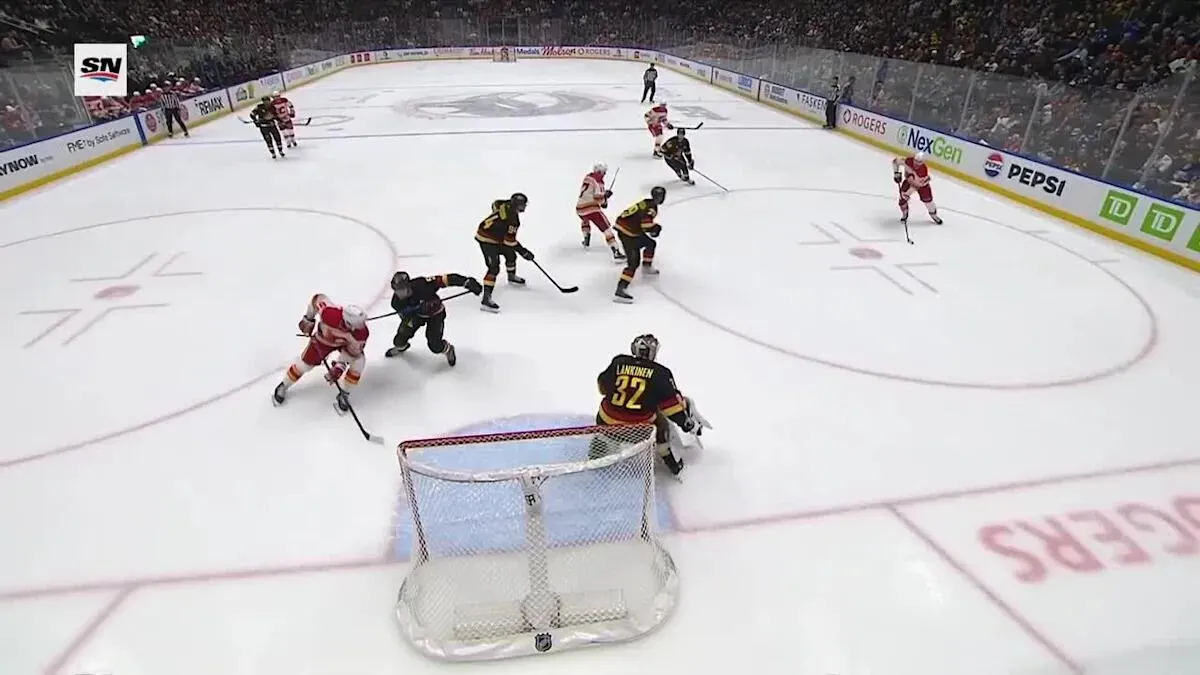
First period fireworks set the tone for calgary flames 5-2 triumph
The opening twenty minutes proved decisive as Calgary jumped out to an early 2-0 lead that they would never relinquish. The first goal came midway through the period during a sustained offensive zone cycle, with the Flames’ second line generating havoc around the Canucks net. A point shot from the blue line created a rebound that was pounced on for the game’s opening tally, silencing the Vancouver crowd and establishing early momentum.
Vancouver pushed back with increased urgency, generating several quality scoring chances off the rush. Their top line featuring Elias Pettersson and J.T. Miller created a two-on-one break that forced Calgary’s goaltender into a spectacular glove save, momentarily shifting momentum back to the home side. However, the Flames’ penalty kill unit stood tall during a late first-period minor penalty, aggressively challenging puck carriers and clearing the zone with efficiency.
The period’s closing minutes saw Calgary double their advantage through a transition play that exposed Vancouver’s defensive gap control. A turnover at the Canucks’ blue line led to an odd-man rush, with the Flames’ forwards executing a perfect give-and-go that ended with a top-corner finish. The 2-0 scoreline after twenty minutes reflected Calgary’s superior execution in high-danger areas and their ability to convert limited opportunities.
Vancouver’s coaching staff clearly emphasized better puck management during the first intermission, recognizing that defensive zone giveaways were gifting Calgary easy offensive zone time. The underlying analytics told a concerning story for the home team, who were being outshot and out-chanced despite controlling possession for stretches. The expected goals metric heavily favored the Flames, suggesting the 2-0 deficit could have been even larger without some timely saves from their goaltender.
Second period surge secures calgary flames 5-2 advantage
Calgary came out of the locker room with the same intensity that defined their first period performance, extending their lead to 4-1 by the midway point of the game. The third goal arrived just three minutes into the period during a well-executed power play sequence. Following a Vancouver penalty for tripping, the Flames’ top unit moved the puck with precision, utilizing the half-wall passer to find an open shooter in the slot for a one-timer that beat the screened goaltender clean.
Vancouver finally broke through shortly after, with their fourth line providing a much-needed energy shift that resulted in a gritty goal from the crease area. A point shot created a scramble in front of the net, and a Canucks forward outmuscled his check to poke the loose puck across the goal line. The 3-1 scoreline briefly ignited the crowd and gave the home team hope that they could claw their way back into the contest.
However, any momentum gained from the goal evaporated quickly as Calgary responded just 97 seconds later with another transition strike. A defensive zone faceoff win by the Flames triggered a three-on-two rush, with the winger driving wide and cutting to the net for a backhand finish that restored the three-goal cushion. This immediate answer demonstrated the Flames’ mental toughness and their refusal to let Vancouver build any sustained pressure.
The period concluded with both teams exchanging power play opportunities, though neither special teams unit could find the back of the net. Vancouver’s penalty kill showed improved structure after the early goal against, aggressively pressuring puck carriers and forcing dump-ins rather than clean entries. Calgary’s goaltender made several key saves during a late Vancouver man-advantage, including a cross-crease robbery on a one-timer from Pettersson that preserved the 4-1 advantage heading into the final intermission.
Third period shutdown completes calgary flames 5-2 road victory
Calgary’s experienced roster demonstrated excellent game management in the final twenty minutes, protecting their lead while still generating occasional offensive pressure to prevent Vancouver from gaining any rhythm. The Flames’ checking line saw increased ice time, matching up against Vancouver’s top offensive unit and winning crucial puck battles along the boards to kill valuable seconds off the clock. This strategic deployment limited the Canucks to just a handful of quality scoring chances during five-on-five play.
Vancouver’s coaching staff pulled their goaltender for an extra attacker with just under four minutes remaining, desperate to generate offense and make the final score respectable. The gamble initially paid dividends when a point shot from Quinn Hughes found its way through traffic and into the net, making the score 4-2 with 3:42 left on the clock. The goal injected life into the building and forced Calgary to defend with renewed urgency.
Rather than sitting back, the Flames responded to the pressure by maintaining their aggressive forecheck even while protecting the lead. This approach paid off when an empty-net goal sealed the victory with 1:15 remaining, as a Flames forward intercepted a careless pass at the Canucks blue line and deposited the puck into the vacant cage. The 5-2 final scoreline accurately reflected Calgary’s superiority across all facets of the game.
The closing minutes featured some post-whistle scrums and exchanged words between division rivals, a common occurrence when frustration builds late in lopsided contests. Officials handed out matching minor penalties for roughing after one particularly heated exchange, sending both teams to four-on-four hockey for the final minute. The special teams faceoff saw Calgary controlling possession and running out the clock, preventing any late dramatics from the desperate home side.
Player performances that defined the calgary flames 5-2 win
Several Flames players stood out with multi-point contributions that powered the offensive outburst. The second line center posted a goal and two assists, controlling play through the neutral zone and consistently making smart decisions with puck distribution in the offensive end. His chemistry with his linemates was evident on multiple sequences where they cycled the puck for extended zone time, wearing down Vancouver’s defenders and creating passing lanes for high-danger chances.
On the blue line, Calgary’s top pairing logged heavy minutes against Vancouver’s star forwards, finishing the night with a combined plus-three rating and contributing the primary assist on the game’s opening goal. Their ability to gap up effectively at their own blue line disrupted Vancouver’s speed game, forcing turnovers that transitioned quickly into offensive opportunities. The physical element they brought, landing several clean, hard hits in the defensive zone, set an early tone that Vancouver struggled to match throughout the evening.
In goal, the Flames’ netminder stopped 28 of 30 shots for a .933 save percentage, with several saves coming during high-danger situations that could have swung momentum. His rebound control was particularly impressive, consistently directing pucks into the corners rather than leaving juicy second-chance opportunities in the slot. The two goals against came on a rebound scramble and a screened point shot, neither of which could be faulted to the goaltender.
For Vancouver, despite the loss, their captain showed characteristic determination with a primary assist and several created scoring chances. His line generated the most consistent offensive pressure for the Canucks, posting a combined 12 shots on goal and controlling puck possession metrics during their shifts. However, the lack of secondary scoring support proved costly, as the depth forwards failed to generate meaningful offensive zone time against Calgary’s checking lines.
Strategic implications of calgary flames 5-2 victory over vancouver canucks
This result carried significant weight in the Pacific Division standings, with Calgary leapfrogging Vancouver into a more favorable playoff position. The two points earned on the road demonstrated their ability to win in challenging environments, a crucial trait for any team with postseason aspirations. For the Flames, the victory validated recent lineup adjustments and reinforced their identity as a structured, defensively responsible team that capitalizes on opponent mistakes.
Vancouver’s coaching staff now faces difficult questions about their defensive system, particularly regarding zone entries against and penalty kill effectiveness. The team has allowed four or more goals in seven of their last twelve games, a trend that threatens to derail their season if not addressed quickly. Potential lineup changes could be forthcoming, with younger defensemen possibly earning more ice time at the expense of veterans who have struggled with foot speed and decision-making.
The special teams battle proved decisive, with Calgary converting one of three power play opportunities while killing both Vancouver advantages. This efficiency contrasted sharply with the Canucks’ struggles, as their man-advantage unit managed just three shots across four minutes of power play time. The inability to generate offensive pressure during these crucial moments prevented Vancouver from building any sustained momentum throughout the contest.
Looking ahead to the next meeting between these rivals, the Flames enter with psychological advantage and a clear tactical blueprint for success. Their ability to neutralize Vancouver’s speed through the neutral zone and win puck battles along the walls will likely be replicated in future matchups. For the Canucks, adjustments must be made quickly, as the two teams face each other twice more in the coming month, offering little time to dwell on this disappointing performance.
The intensity of this rivalry matchup never disappoints, and fans looking ahead can find projected lineups and roster updates for the next installment of this Western Canada showdown. Recent high-scoring affairs involving the Canucks, including their 8-5 loss to the Florida Panthers, suggest defensive adjustments remain a priority for the coaching staff as they prepare for another offensive test from Calgary’s deep forward group.
What this victory means for the Flames extends beyond the standings points. The road win against a division rival demonstrates their readiness for playoff-style hockey, where every shift matters and mistakes are magnified. Their ability to maintain composure while protecting a lead, combined with the offensive firepower to extend advantages rather than simply defending them, makes them a dangerous opponent as the season progresses.
Frequently Asked Questions

Par Mike Jonderson
Mike Jonderson is a passionate hockey analyst and expert in advanced NHL statistics. A former college player and mathematics graduate, he combines his understanding of the game with technical expertise to develop innovative predictive models and contribute to the evolution of modern hockey analytics.