







The Calgary Flames erupted for six goals against the Buffalo Sabres on Wednesday night, skating to a decisive 6-2 victory at KeyBank Center that snapped their own losing skid while halting Buffalo’s budding momentum. The offensive outburst represented a season-high goal total for Calgary, with contributions up and down the lineup that showcased both individual brilliance and collective resilience. For a team mired at the bottom of the NHL standings, the performance offered a glimpse of potential that has too often remained dormant.
Wednesday’s result wasn’t just about the final score—it revealed several compelling storylines that deserve closer examination. From a defenseman boosting his trade value to a goaltender finding redemption in familiar territory, the Flames’ dominant display provided plenty of material for analysis. Here are three critical takeaways from Calgary’s impressive road victory.
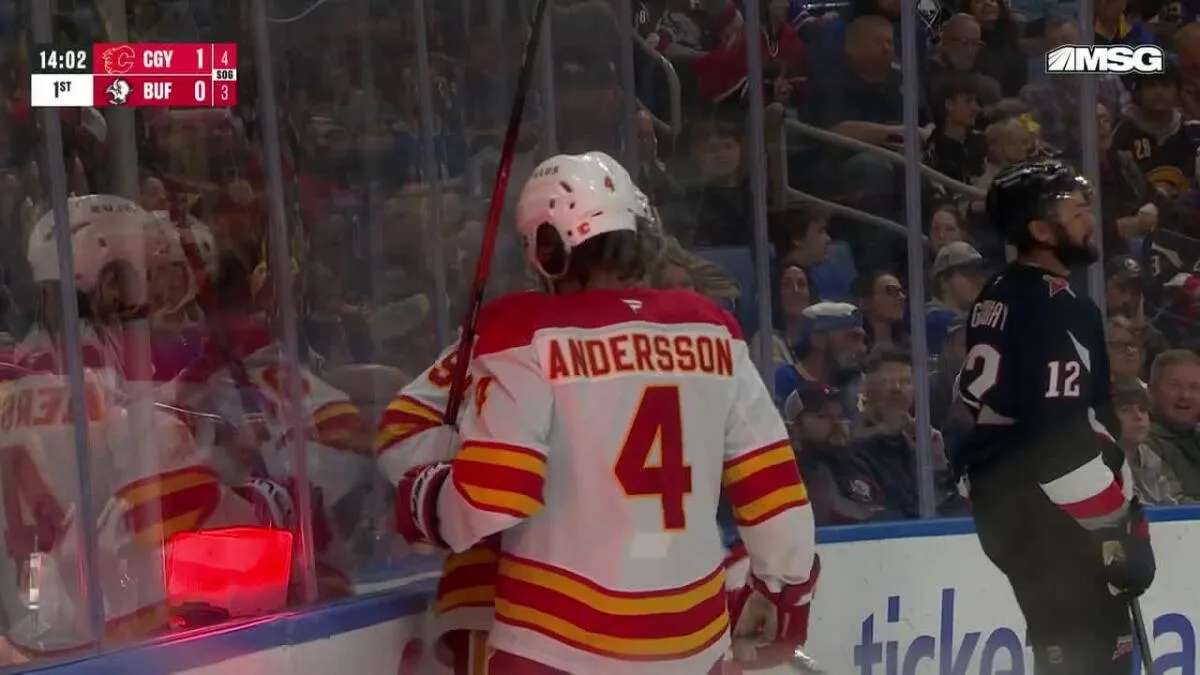
Rasmus Andersson’s offensive surge strengthens trade appeal
Rasmus Andersson continues to prove why he might be the most valuable trade asset available at the upcoming deadline, and his performance against Buffalo only added to his impressive résumé. The 29-year-old defenseman opened the scoring with a first-period marker, his fifth goal of the season, and finished the night with three points total. That offensive production places him among the league’s elite blueliners—only Matthew Schaefer, Cale Makar, and Zach Werenski have scored more goals among NHL defensemen this season.
What makes Andersson particularly attractive to contending teams isn’t just his scoring touch, but his comprehensive skill set. He’s logged heavy minutes against top competition while maintaining an affordable contract, making him an ideal target for playoff-bound franchises looking to bolster their blue line without crushing their salary cap structure. Calgary’s management must be smiling as his value continues to climb, even as they face difficult decisions about his future with the organization.
The Swedish defenseman’s trademark goal celebration—staring down front-row spectators with an intensity that’s become his signature—was on full display in Buffalo. While fans might enjoy the showmanship, rival executives are undoubtedly more interested in his ability to contribute in all situations. His performance on this two-game road trip, which included a goal in Chicago and multiple points against Buffalo, demonstrates the consistency that makes him such a coveted commodity.
For a Flames team that appears to be heading toward a rebuild, maximizing Andersson’s return in any potential trade could accelerate the retooling process significantly. The challenge for general manager Craig Conroy will be timing the move perfectly to extract maximum value while still providing some on-ice product for Calgary’s loyal fanbase.
Devin Cooley’s Buffalo homecoming delivers first Flames victory
Sometimes sports stories write themselves, and Devin Cooley’s return to Buffalo perfectly fits that narrative. The 28-year-old goaltender spent most of the 2023-24 season as the Sabres’ fourth-string option, essentially serving as the backup for their AHL affiliate in nearby Rochester. On Wednesday, he returned to KeyBank Center as Calgary’s starter and delivered a performance that finally earned him his first win in a Flames uniform.
Cooley’s statistics entering the game told a bizarre story—he owned a sparkling 1.75 goals-against average and an impressive .935 save percentage, but had zero victories to show for his efforts. Those numbers reveal a goaltender who had been performing at a high level but receiving precious little goal support from his teammates. Against Buffalo, everything finally clicked, as he turned aside 28 of 30 shots for a .933 save percentage that actually lowered his season GAA slightly.
The emotional significance wasn’t lost on Cooley, who understood the unique circumstances of this particular start. “Our team was just so good tonight—I thought probably our best game of the year,” he gushed in his post-game interview. “That helps so much. And then when they score, it’s like, ‘Oh, yes. You don’t relax. You don’t chill out at all. But you kind of breathe a little bit. It’s like, ‘OK, now I just dial in and make the saves I need to and hopefully we should come away with the ‘W,’ and thankfully we did. It was awesome.’”
His goaltending coach must have been pleased with Cooley’s positioning and composure, particularly during Buffalo’s second-period push when the Sabres briefly tied the game at 2-2. Rather than letting the momentum swing rattle him, Cooley remained steady and gave his team the stability needed to respond with four unanswered goals in the final frame. This type of mental fortitude is exactly what Calgary needs as they navigate through a challenging season.
Special teams excellence and complete team buy-in
Calgary’s dominance extended beyond even-strength play, with the Flames showcasing impressive discipline and execution on special teams. The penalty-kill unit went a perfect 3-for-3 against Buffalo’s power play, effectively neutralizing one of the Sabres’ primary offensive weapons. While the Calgary power play had only one opportunity and couldn’t convert, the team’s overall approach to special teams situations demonstrated a level of preparation that had been missing in previous outings.
The underlying numbers tell the story of a team that finally executed its game plan to near perfection. Calgary generated 34 shots on goal—good for the sixth-highest total in any game this season—while converting at a 17.65 percent shooting rate that ranked as their second-best mark of the year. Defensively, they limited Buffalo to just 22 scoring chances and nine high-danger opportunities, both representing the sixth-lowest totals they’ve surrendered all season.
This comprehensive performance represented a complete 180 from their effort the previous night in Chicago, where defensive lapses and inconsistent effort plagued the Flames. Against Buffalo, every player seemed to understand their role and executed it with precision. The coaching staff’s message clearly resonated, as Calgary won the crucial 50-50 puck battles in all three zones and capitalized on second-chance opportunities around the net.
The four-goal third-period explosion highlighted the team’s offensive depth, with contributions coming from Morgan Frost, Mikael Backlund, and Joel Farabee’s second of the night. This balanced attack makes Calgary more difficult to defend and takes pressure off their top line to produce every shift. When the secondary scoring kicks in like it did in Buffalo, the Flames become a much more dangerous opponent, regardless of their position in the standings.
What this means for both franchises moving forward
For Calgary, this victory serves as a reminder that talent exists within their roster, even if results have been disappointing overall. The challenge now becomes consistency—can they replicate this level of effort and execution on a nightly basis? Their next test against the Dallas Stars on Saturday will provide an immediate answer. If the Flames can build on this performance, they might salvage some pride from what has otherwise been a difficult campaign.
The game also reinforced that several Calgary players could help contending teams, with Andersson leading that list but others potentially drawing interest as the trade deadline approaches. General manager Craig Conroy faces a delicate balancing act between securing future assets and maintaining a competitive environment for his current players.
Buffalo, meanwhile, must grapple with a harsh reality check. After impressive comeback wins against Detroit and Edmonton had the Sabres feeling optimistic, this loss exposed lingering issues. As Tage Thompson candidly admitted, “I think we get a little too high on ourselves after a couple of wins; we think we’re better than we are, instead of remembering what got us those wins.” That self-awareness must translate into better preparation and effort, particularly in first periods where Buffalo has been consistently outplayed.
Coach Lindy Ruff’s assessment was even more direct: “We had the opportunity in that first 10 minutes really to just try to outwork the other team; we got outworked, it’s as simple as that.” His comment that the Sabres “didn’t respect them enough” suggests a locker room that may have overlooked a struggling opponent—a dangerous mindset in today’s parity-driven NHL.
The overturned first-period goal due to goaltender interference proved controversial, with Thompson calling it “a horrible call” and arguing there was minimal contact. While that decision certainly impacted momentum, it doesn’t excuse Buffalo’s overall performance. The Sabres allowed four third-period goals and lost too many battles in critical areas of the ice.
Looking ahead, Calgary must prove this offensive explosion wasn’t a one-night anomaly. Their projected lineup for the Buffalo game featured some youth movement, and those players responded admirably. The Flames will need similar contributions as they face tougher competition. For Buffalo, the focus turns to Friday’s matchup with Chicago, where proving they can bounce back from disappointment will be crucial for a team still trying to establish its identity.
As both teams navigate the remainder of their seasons, Wednesday’s game will likely be remembered very differently in each city—for Calgary, perhaps as a turning point that validated their competitive spirit; for Buffalo, hopefully as a learning experience about respecting every opponent and maintaining intensity regardless of recent success.
Frequently Asked Questions

Par Mike Jonderson
Mike Jonderson is a passionate hockey analyst and expert in advanced NHL statistics. A former college player and mathematics graduate, he combines his understanding of the game with technical expertise to develop innovative predictive models and contribute to the evolution of modern hockey analytics.