







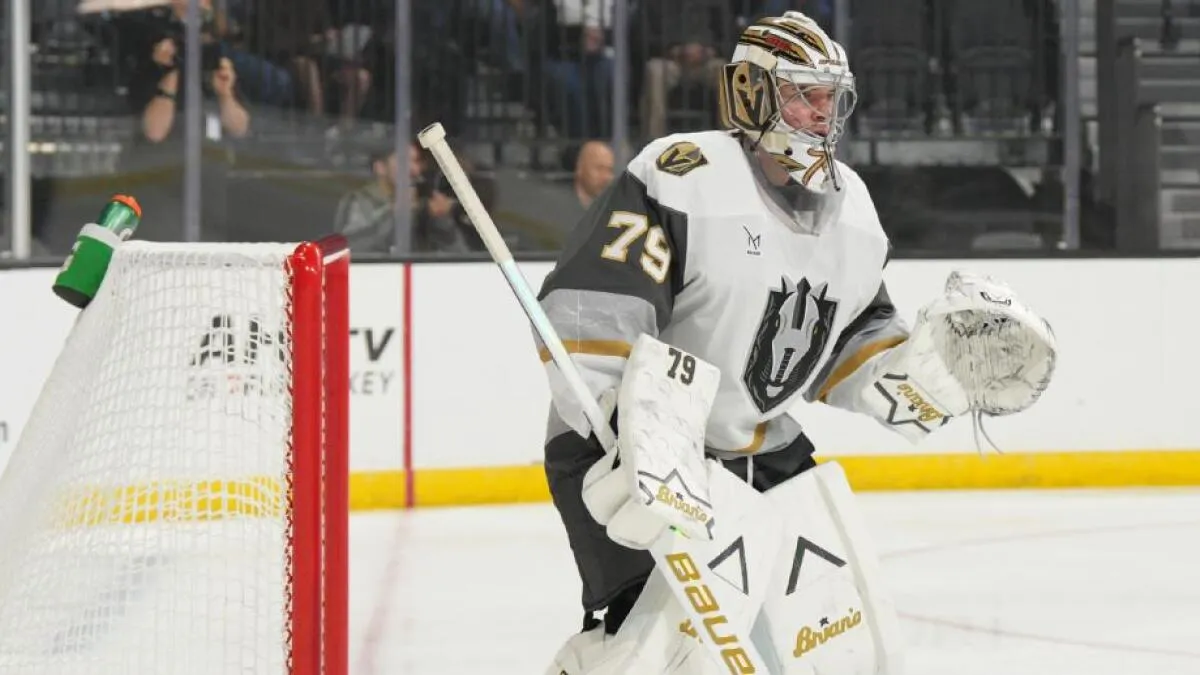
The Vegas Golden Knights’ locker room at City National Arena has been unusually quiet for the past month. While his new teammates finished practice and headed for the showers, Carter Hart would linger on the ice, taking extra shots and playing pucks behind the net. When he finally entered the empty room, the silence spoke volumes about his journey back to the NHL. Nearly two years after his last appearance in the league, the 27-year-old goaltender is eligible to make his Golden Knights debut after being acquitted of sexual assault charges stemming from a 2018 incident involving Canada’s World Junior championship team.
This moment represents one of the most controversial player acquisitions in recent NHL history. The Golden Knights signed Hart to a two-year, $4 million contract in October following his acquittal, making him the only one of the five charged players to secure an NHL contract. His debut, which could come as early as Tuesday against the Chicago Blackhawks, will mark the culmination of a legal saga that rocked Canadian hockey and sparked intense debate about second chances, accountability, and the standards to which professional athletes should be held.
The legal journey from charges to acquittal
The path to Hart’s return began in January 2024 when he and four teammates—Alex Formenton, Cal Foote, Dillon Dubé, and Michael McLeod—were charged with sexual assault related to events following Canada’s World Junior championship celebration in June 2018. The charges stemmed from an encounter at a London, Ontario hotel where a woman, identified only as E.M. due to a publication ban, testified that she had consensual sex with McLeod before other players entered the room. What followed was nearly two years of legal proceedings that would ultimately determine Hart’s hockey future.
Ontario Superior Court Justice Maria Carroccia handed down a not guilty verdict on July 25, 2025, after twice declaring mistrials in previous attempts to prosecute the case. In her ruling, Carroccia stated that “given the issues relating to the credibility and reliability of the complainant’s evidence, I conclude that I cannot rely on it.” The judge specifically accepted Hart’s testimony that he had received consent for oral sex, which he said lasted between 30 to 60 seconds, and found no evidence of other wrongdoing on his part.
Timeline of the 2018 incident
The events that led to the charges began on June 18, 2018, when Team Canada gathered at the Delta Hotels London Armouries for a championship gala. Players attended an open bar event before heading to Jack’s bar in downtown London. Surveillance footage showed E.M. and McLeod holding hands around 1:30 a.m. before taking a cab to the hotel. McLeod then sent a group text message at 2:10 a.m. asking, “Who wants to be in a 3 way quick.”
According to Hart’s trial testimony, he arrived at McLeod’s room after receiving the text message and found multiple teammates present. He testified that E.M. said, “Can somebody (have sex with me)?” and that he asked for oral sex, which she performed for 30 to 60 seconds. Hart was the only one of the five accused players to testify at trial. His lawyer, Megan Savard, later stated that “the public narrative of this event, until this trial, was one-sided and untested. Now the criminal process has shown it to be false.”
The NHL’s response and suspension
Despite the acquittal, the NHL determined that the conduct described during the trial did not meet its “highest level of moral integrity” standard. The league issued a statement expressing that “the allegations made in this case, even if not determined to have been criminal, were very disturbing, and the behavior at issue was unacceptable.” Commissioner Gary Bettman suspended all five players, making them eligible to sign contracts starting October 15 and to play in games beginning December 1, 2025.
Hart’s agent had spent months working behind the scenes to prepare for his client’s potential return. The goaltender met with league representatives, including Bettman himself, to discuss the situation. Golden Knights general manager Kelly McCrimmon later said he was told these meetings went well and that Hart was “impressive in those meetings.” The NHL’s decision to reinstate the players, while emphasizing future conduct expectations, created the opening for Vegas to make its controversial move.
Vegas’ decision to sign a controversial player
When the Golden Knights announced Hart’s signing on October 16, the reaction was immediate and largely negative. The team’s social media post about the signing generated more than 2,200 replies, with the majority opposing the move. One fan replied, “If you have to put out a statement justifying your move, it probably wasn’t a good move to make.” Another wrote, “Maybe signing a player that requires a club to put out a statement such as this is a (expletive) stupid idea.”
The Knights’ front office took a calculated risk in signing Hart. General manager Kelly McCrimmon defended the decision, stating that “it went through the Canadian court process. The judgment that came down was really decisive in terms of acquitting those players and exonerating them.” The organization released a statement claiming alignment with the NHL and NHLPA’s assessment, while reaffirming their commitment to core values. However, the team declined to announce Hart’s contract signing on social media, an unusual move that suggested awareness of the potential backlash.
Mixed reactions from the fanbase
The polarized response extends beyond social media. Kevin Brogan, a Philadelphia Flyers season ticket holder, and his 16-year-old daughter Julianna plan to attend Hart’s return to Philadelphia on December 11. Julianna, who suffers from severe anxiety and wears Hart’s jersey number, developed a bond with the goaltender through multiple interactions at Flyers practices. Brogan believes that based on his personal experience, Hart deserves a second chance.
On the other side of the debate, a change.org petition titled “Urge the Vegas Golden Knights to not sign Carter Hart” has gathered more than 2,400 signatures. One female fan who signed the petition told the Las Vegas Review-Journal that the team’s decision represented “a bad look for the team, (which) claims to be ‘the protectors of the unprotected,’ to be so OK with this behavior.” She added that “hiding behind the not guilty verdict assumes that the admitted behavior is acceptable.” Several other fans opposed to the signing declined to speak on the record, highlighting the sensitivity of the conversation.
Preparing for his Golden Knights debut
Hart spent the final weeks of his suspension on a conditioning assignment with the Henderson Silver Knights, Vegas’ AHL affiliate. He played three games, going 1-2-0 while stopping 47 of 56 shots for a .839 save percentage. The results were less important than the experience of facing live competition after nearly two years away from game action. “It’s just like riding a bike,” Hart said after his first start on November 16. “I hadn’t had a ton of working practice being the third goalie.”
During his time in Henderson, Hart stopped 12 of 14 shots in a 5-2 win over Calgary, made 23 saves in a 4-2 loss to Milwaukee, and allowed four goals on 16 shots in a 4-3 defeat to Ontario. The Golden Knights coaching staff focused less on the statistics and more on his adjustment to game speed, traffic in front of the net, and unpredictable scenarios that can’t be replicated in practice. Coach Bruce Cassidy noted that “the purpose of Henderson was to get him back into live reps” and that they were “less worried about the results, and more about getting reps and getting used to that stuff.”
The goaltending rotation situation
Vegas finds itself with three NHL-caliber goaltenders once Adin Hill returns from his lower-body injury sustained on October 20. Hill, who signed a six-year, $37.5 million contract extension in March, has been the team’s primary starter when healthy. In his absence, Akira Schmid and rookie Carl Lindbom have shared duties, with the team posting a 6-6-6 record and .876 save percentage. The recall of Hart and reassignment of Lindbom to Henderson sets up a tandem of Schmid and Hart until Hill’s return.
This creates a complex roster management situation for McCrimmon. NHL teams typically carry only two goaltenders on their active roster, meaning a decision will eventually need to be made. “You deal with the situation at hand, so we haven’t had (all three available),” McCrimmon explained. “When you read the document, when you follow it, when you looked at the decision that the judge made, I think there was an expectation coming out of that that, in some fashion, (the players) would be cleared by the National Hockey League. And that is, in fact, what happened.”
The broader implications for hockey and second chances
Hart’s return raises fundamental questions about how professional sports leagues handle players involved in serious off-ice controversies, even those resulting in acquittal. The NHL’s approach—suspending players while emphasizing future conduct expectations—attempts to balance due process with maintaining league standards. However, the decision to allow Hart back has drawn criticism from those who believe his admitted actions, regardless of legal culpability, should disqualify him from representing an NHL franchise.
The case has also highlighted the challenges of navigating public opinion when legal outcomes don’t align with broader moral expectations. The Golden Knights’ careful handling of Hart’s introduction—limiting media availability and avoiding celebratory announcements—reflects an understanding that his presence will remain controversial regardless of his on-ice performance. As one fan noted, the team’s statement justifying the signing itself suggested awareness that the move required defense.
What success looks like moving forward
For Hart, success will be measured not just by saves and wins, but by his ability to navigate the scrutiny that will follow him throughout his Golden Knights tenure. His every start will be analyzed, his every interaction with media carefully managed, and his reception in visiting arenas closely watched. The ESPN decision to broadcast his return to Philadelphia on December 11 demonstrates the sustained public interest in his story, whether he wants that attention or not.
The Golden Knights have bet that Hart’s talent justifies the controversy surrounding his signing. In his six seasons with Philadelphia, Hart posted a 96-93-29 record with a .906 save percentage. At his best, he’s shown the ability to be a franchise goaltender. Whether he can regain that form after nearly two years away remains uncertain. What is certain is that his debut will mark a new chapter in one of hockey’s most divisive stories, one that will continue to spark debate long after the final horn sounds.
Carter Hart’s journey back to the NHL represents a case study in second chances, the limits of legal accountability, and the difficult decisions teams face when talent intersects with controversy. As he prepares to take the crease for the Golden Knights, the hockey world will be watching—not just to see if he can stop pucks, but to see what his presence means for a league grappling with its own standards of conduct and forgiveness. The silence that accompanied his practices will be replaced by the roar of the crowd, and how he responds to that noise will define the next phase of his career.
Frequently Asked Questions

Par Mike Jonderson
Mike Jonderson is a passionate hockey analyst and expert in advanced NHL statistics. A former college player and mathematics graduate, he combines his understanding of the game with technical expertise to develop innovative predictive models and contribute to the evolution of modern hockey analytics.