




















The 2025-26 NHL season has officially crossed its first-quarter checkpoint, with every team having played at least 20 games and the playoff picture beginning to take shape. As we approach American Thanksgiving, traditionally a crucial marker for postseason positioning, it’s time to evaluate each organization’s performance with comprehensive report cards. From the record-breaking Colorado Avalanche to the struggling Nashville Predators, the first quarter has delivered surprises, disappointments, and everything in between.
Division breakdown and top performers
The Western Conference has emerged as the dominant force early in the season, with Central Division powerhouses leading the charge. The Colorado Avalanche have been nothing short of spectacular, while the Pacific Division features one of the season’s biggest surprises in the Anaheim Ducks. Meanwhile, the Eastern Conference has been characterized by tight races and parity, particularly in the Metropolitan Division where just a few points separate playoff contenders from lottery hopefuls.
The elite tier: A+ and A grades
Colorado Avalanche: Setting the standard
The Avalanche have established themselves as the NHL’s premier team through the first quarter. Leading the league in goals per game while simultaneously allowing the fewest goals per game, they’re generating the most scoring chances and shots per 60 minutes in 5-on-5 play. Nathan MacKinnon has been otherworldly, positioning himself for a potential second Hart Trophy, while Cale Makar continues his Norris-caliber dominance.
At their current 137.9-point pace, they threaten to surpass the Boston Bruins’ record of 135 points from the 2022-23 season. The only blemish has been a bottom-10 power play converting at just 15.7%, creating a minor weakness for opponents to exploit.
Anaheim Ducks: Youth movement surges
Perhaps the most pleasant surprise of the season, the Ducks are legitimate Pacific Division contenders. Chris Kreider’s 14 points in 15 games provided veteran leadership, but it’s Leo Carlsson’s development that has scouts buzzing. Projected to finish with 108 points, Carlsson threatens Teemu Selanne’s franchise record of 109 points, a mark few thought would ever be challenged.
However, there’s concern about overworking goaltender Lukas Dostal, who has started 17 of 22 games. The underlying numbers reveal vulnerability, as the Ducks rank near the bottom in scoring chances and shots allowed per 60 minutes, making them heavily reliant on Dostal’s 5.42 goals saved above expected.
Dallas Stars: Efficient excellence
Glen Gulutzan’s second tenure has the Stars performing efficiently despite ranking in the bottom ten in scoring chances and shots per 60. Their second-ranked power play and top-10 offense demonstrate a team that makes the most of its opportunities. The loss of three key forwards in the offseason hasn’t derailed their 111.8-point pace, though their penalty kill’s 75.7% success rate ranks in the bottom ten.
Detroit Red Wings: Yzerman’s vision realized
Steve Yzerman’s rebuild is bearing fruit as the Red Wings enjoy their best start in a decade. Dylan Larkin leads the team in goals and points while providing invaluable leadership, and rookies Emmitt Finnie and Nate Danielson have exceeded expectations. The goaltending duo of Cam Talbot and John Gibson has been solid, though Gibson hasn’t delivered the savior performance many anticipated when he was acquired.
New York Islanders: Rookies shine bright
The Calder Trophy race runs through Long Island, where Matthew Schaefer has been electric in over 22 minutes per game. Maxim Shabanov’s emergence alongside veteran producers Bo Horvat, Mathew Barzal, and Kyle Palmieri has the Islanders ranking top-10 in goals despite a woeful power play. The loss of Alexander Romanov to shoulder surgery for five to six months presents a significant challenge to their defensive depth.
Pittsburgh Penguins: Surprise contenders
Few predicted the Penguins would be Eastern Conference playoff contenders, yet here they are with a 97.6-point pace. Dan Muse’s system has unlocked top-10 offense and the league’s best power play while surrendering the second-fewest goals. Arturs Silovs and Tristan Jarry form a formidable goaltending duo, though the team’s 0-4 record in overtime and shootouts has cost valuable points.
Solid B-tier: Overachievers and steady performers
Carolina Hurricanes: Structure still works
Rod Brind’Amour’s defensive system continues delivering results despite the team’s worst power play in the league. Seth Jarvis leads the team in goals while Sebastian Aho tops the points chart, and Pyotr Kochetkov has excelled in net amid Frederik Andersen’s struggles with concussion issues.
New Jersey Devils: Star power remains
Jack Hughes’ freak restaurant accident requiring finger surgery has cast a shadow over an otherwise solid start. The star-studded offense featuring Hughes, Jesper Bratt, and Nico Hischier was producing well, and Jake Allen has been excellent in net. Without Hughes for multiple weeks, the depth will be tested severely.
Boston Bruins: Sturm’s structure succeeds
First-year coach Marco Sturm has transformed the Bruins into defensive stalwarts despite Elias Lindholm missing most of the season. Nikita Zadorov brings bruising presence while Jeremy Swayman has returned to form. However, injuries to Charlie McAvoy, Casey Mittelstadt, Viktor Arvidsson, and Jordan Harris threaten their sustainability.
Chicago Blackhawks: Bedard’s brilliance
Connor Bedard is answering all questions about his sophomore season, projecting for 116 points that would rank among Blackhawks history. Spencer Knight’s .911 team save percentage represents massive improvement from last season’s .894 mark. However, youth on defense creates problems, with the Blackhawks ranking bottom four in scoring chances and high-danger chances allowed per 60.
Montreal Canadiens: Goaltending gamble pays off
Jakub Dobes has outperformed Sam Montembeault to become a backbone of Montreal’s success, supported by stronger defensive structure. Cole Caufield’s 13 goals and Nick Suzuki’s 22 points in 20 games demonstrate top-end production. Recent regression and injuries to Kaiden Guhle, Kirby Dach, Patrik Laine, and Alex Newhook have created concerns.
Philadelphia Flyers: Defensive foundation
Rick Tocchet’s squad ranks near top 10 in goals against per game and penalty kill success. Dan Vladar has emerged as a reliable starter, Travis Sanheim commands the blue line, and Trevor Zegras leads the offense with over a point per game. However, the 26th-ranked offense and 20% power play conversion rate limit their ceiling.
San Jose Sharks: Celebrini’s historic pace
Macklin Celebrini isn’t just a rookie sensation—he’s on pace for 121 points, which would surpass Joe Thornton’s franchise record of 114. After an 0-6-0 start, the Sharks have been the fourth-best team since October 23, showcasing the young core’s development alongside veterans.
Seattle Kraken: Goaltending galore
Investing heavily in goaltending has paid dividends as the Kraken rank first in team save percentage in 5-on-5 play. Joey Daccord, Philipp Grubauer, and Matt Murray provide continuity that complements Lane Lambert’s defensive structure. However, scoring just 2.55 goals per game—third-fewest in the league—creates razor-thin margins.
Vegas Golden Knights: Defensive without Pietrangelo
Losing Alex Pietrangelo to bilateral femur reconstruction hasn’t derailed their defensive structure, as they rank top three in limiting high-danger chances and shots per 60. However, goaltending inconsistency leaves them middle-of-the-pack in save percentage, prompting the controversial signing of Carter Hart, currently with their AHL affiliate awaiting reinstatement.
Columbus Blue Jackets: Youth movement
Zach Werenski continues delivering as the franchise cornerstone, while Kirill Marchenko, Dmitri Voronkov, and Adam Fantilli showcase the future. Jet Greaves has exceeded expectations in net, but the Blue Jackets rank bottom seven in power play and penalty kill effectiveness.
Los Angeles Kings: Defensive consistency
After giving up 20 goals in four games against Edmonton last postseason, the Kings’ defensive structure has been rebuilt. Allowing the fifth-fewest goals per game demonstrates improvement, but bottom-six offense and power play struggles limit their ceiling to just 2.68 goals per game.
Minnesota Wild: Healthy roster advantage
Injury luck has reversed from last season, with eight players appearing in every game and 13 skaters playing 20+ contests. However, the Wild rank bottom 10 in goals per game despite top-half underlying metrics in scoring chances and shots per 60, revealing a finishing problem.
Ottawa Senators: Structure adjustment
After a shaky start, Travis Green’s defensive structure has transformed the Senators into Atlantic contenders. They’re giving up the third-fewest shots per game, with Drake Batherson leading the offense. However, Linus Ullmark’s subpar performance—allowing 3+ goals in 10 of 16 starts—has forced the team to outscore mistakes.
Tampa Bay Lightning: Injury adversity
Only six skaters have appeared in every game as Jon Cooper patches together lineups amidst massive injury issues. Brad Marchand is having his best season in years, but Brayden Point’s struggles (3 goals, 11 points in 20 games) and Victor Hedman’s recent injury create uncertainty.
Winnipeg Jets: Hellebuyck’s absence
The Jets’ top-12 offense and top-10 power play have been impressive, but Connor Hellebuyck’s six-week absence presents a crisis. Eric Comrie and Thomas Milic must maintain top-five team save percentage while the defense allows the ninth-most high-danger chances per 60.
The struggling middle: B- and C grades
Florida Panthers: Championship hangover
Injuries have devastated the back-to-back Stanley Cup champions. Aleksander Barkov’s season-ending ACL/MCL tear, Eetu Luostarinen’s bizarre barbecuing accident burns, and Matthew Tkachuk’s ongoing recovery have created unprecedented challenges. Brad Marchand’s career resurgence has kept them competitive, but their depth is being severely tested.
Utah Mammoth: Jekyll and Hyde
The expansion Mammoth opened 8-2-0 with a seven-game winning streak, ranking top five in both goals scored and allowed per game. Since October 28, they’ve lost nine of 12, ranking bottom four in goals scored and bottom 10 in goals allowed. The early success may have been fool’s gold.
Washington Capitals: Ovechkin’s encore
Alex Ovechkin continues defying age with 20 points in 20 games and regular highlight-reel goals. Logan Thompson has been outstanding in net, but the Capitals lack consistency in their scoring attack beyond their veteran core. Their power play and penalty kill both rank in the bottom third, suggesting a team without clear identity.
Buffalo Sabres: Playoff drought continues
Despite the league’s best penalty kill at 89.8% and the emergence of waiver claim Colten Ellis (3-1-0, .914 save percentage), the Sabres remain at the bottom of the Atlantic. Injuries have decimated the roster, leaving Lindy Ruff searching for answers as the playoff drought threatens to extend further.
Edmonton Oilers: Defensive disaster
The two-time defending Western Conference champions are allowing the most goals in the NHL, both overall and at 5-on-5, with the lowest team save percentage. Leon Draisaitl and Connor McDavid continue producing, but they’ve given up four or more goals in 13 of 22 games. Their slow starts have become an annual tradition, but this defensive bleeding may be too severe to overcome.
New York Rangers: Defensive but toothless
Mike Sullivan’s defensive system has New York allowing just 2.65 goals per game, but they rank 30th in offense at 2.48 goals per game. J.T. Miller, Mika Zibanejad, and Artemi Panarin have all underperformed, and Miller’s upper-body injury compounds the scoring crisis. The Rangers lack identity beyond their stifling defense.
Toronto Maple Leafs: Marner’s shadow
Mitch Marner’s absence has created a void beyond just offensive production. Toronto ranks top five in goals scored and second in 5-on-5 goals, but they’re top three in goals allowed per game and struggle mightily against the rush. Injuries to Auston Matthews, Anthony Stolarz, Matthew Knies, and the entire defense corps have Craig Berube patching together lineups lacking chemistry.
The basement: D and F grades
Calgary Flames: Historically challenged
The Flames rank top four in limiting scoring chances and high-danger chances, yet they’re averaging just 2.38 goals per game—second-lowest in the NHL. This would place them among the bottom 200 teams in NHL history for single-season scoring offense. A recent three-game winning streak averaging 4.66 goals provides hope, but the sample size remains small.
Vancouver Canucks: Injury avalanche
Thatcher Demko looked like his Vezina-finalist self during a 4-2-0 start, but since October 21, the Canucks have endured three three-game losing streaks and required 29 skaters and three goaltenders through 23 games. They’re bottom-10 in every offensive metric and dead last in allowing shots, scoring chances, and high-danger chances per 60.
St. Louis Blues: Goaltending sinkhole
Despite limiting scoring chances effectively, the Blues give up the third-most goals per game at 3.64. Their goaltending sports the fourth-lowest team save percentage in all situations, undermining their defensive structure. Offensively, they rank bottom five in goals and shots per game, creating a perfect storm of underperformance.
Nashville Predators: Offensive catastrophe
The Predators were the last team to reach 50 goals this season, averaging a league-worst 2.29 goals per game—a pace that would rank in the bottom 125 offensive seasons in NHL history. Steven Stamkos is on track for his first sub-20-goal season in a non-injury campaign, and they’re giving up the sixth-most goals per game despite an above-average penalty kill.
Looking ahead: What the first quarter tells us
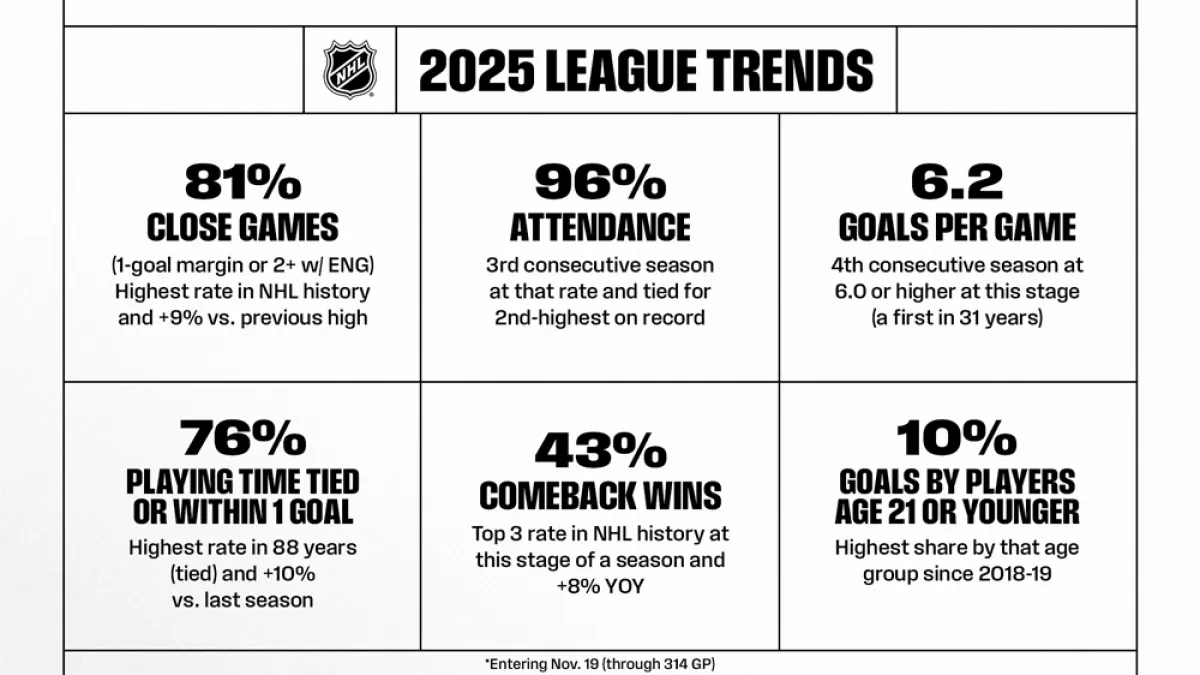
The quarter mark reveals several key trends that will shape the remaining 60+ games. First, Western Conference dominance is real, with Central Division teams combining elite offense and structured defense. The Colorado Avalanche’s historic pace sets a standard that may be unattainable but creates compelling drama.
Second, goaltending depth has never been more critical. Teams like Seattle, Vegas, and Pittsburgh have thrived through goaltending stability, while injuries to Connor Hellebuyck and inconsistency from Linus Ullmark have derailed playoff hopefuls.
Third, youth movements are accelerating across the league. From Matthew Schaefer in New York to Leo Carlsson in Anaheim to Macklin Celebrini in San Jose, rookies aren’t just contributing— they’re leading. This generational shift is reshaping competitive balance.
Finally, special teams remain the great differentiator. Teams like Carolina and Colorado struggle with power play consistency despite even-strength dominance, while Pittsburgh’s league-best power play has masked other deficiencies. As teams adjust and health improves, these units will determine playoff seeding.
The first quarter has provided clarity for some and confusion for others, but with standings tighter than ever—a four-point gap spanning fourth to 15th place in some divisions—the next three quarters promise even more intrigue. The foundation has been set; now we watch which teams build upon it and which crumble under pressure.
For more detailed analysis of individual team performances and expert insights throughout the season, check out our comprehensive coverage at NHL Insight’s first-quarter analysis and continuing coverage at quarter-season grades.
Frequently Asked Questions

Par Mike Jonderson
Mike Jonderson is a passionate hockey analyst and expert in advanced NHL statistics. A former college player and mathematics graduate, he combines his understanding of the game with technical expertise to develop innovative predictive models and contribute to the evolution of modern hockey analytics.