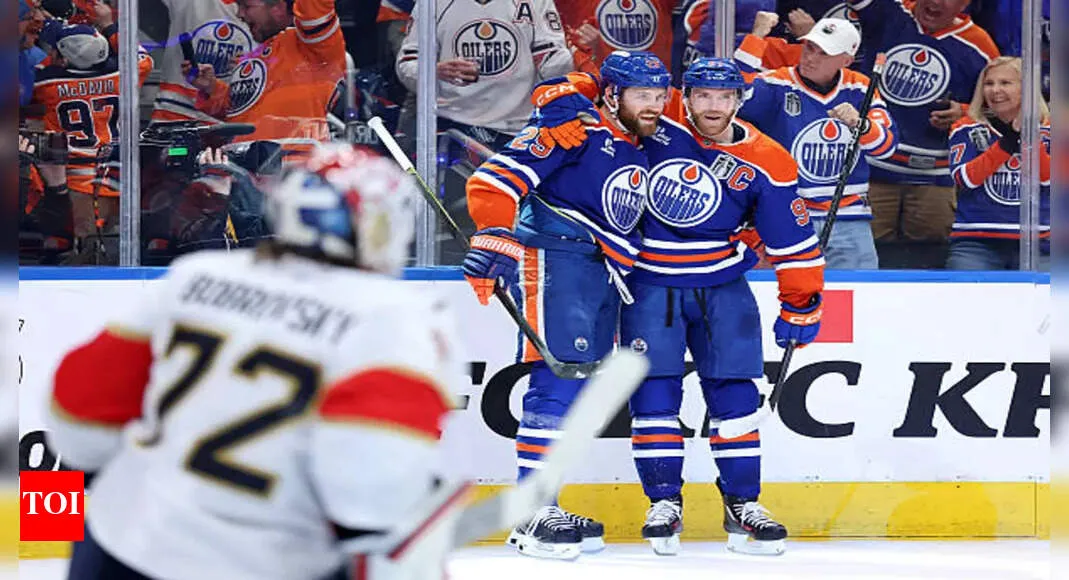
The Edmonton Oilers entered the 2025-26 NHL season with sky-high expectations. After reaching back-to-back Stanley Cup finals, fans and pundits alike anticipated another deep playoff run. Instead, the team stumbled to a first-round exit at the hands of the Anaheim Ducks in six games.[1][2] Superstars Connor McDavid and Leon Draisaitl delivered brutally honest assessments during exit interviews, highlighting a loss of fire and steps backward from prior glory.
This season marked a frustrating regression. The Oilers finished with a 41-30-11 record, good for 93 points and second place in the Pacific Division.[3][4] While McDavid and Draisaitl shone individually, team-wide inconsistencies plagued the campaign from start to finish.
Regular season highs and lows
The Oilers kicked off the year with a rocky stretch. They stumbled through their first 10 games, grappling with defensive lapses and a lack of depth scoring. Early losses, like a humiliating 9-1 defeat to the Colorado Avalanche at home, exposed goaltending vulnerabilities and bottom-six struggles.[1]
Management responded with call-ups from the AHL’s Bakersfield Condors to bolster the forward lines. Veterans departed in the offseason, leaving gaps that rookies and mid-tier additions like Jack Roslovic tried to fill. For a deeper dive into those opening struggles, check our analysis of the Oilers’ early-season woes.
Midway through, the dynamic duo of McDavid and Draisaitl ignited a turnaround. McDavid clinched his sixth Art Ross Trophy with a dominant regular-season performance, including his 400th career goal against the Utah Mammoth. Draisaitl hit 1,000 career points, becoming one of the fastest active players to reach the milestone.
Yet, injuries derailed momentum. Draisaitl missed the final 14 games with a lower-body issue sustained against Nashville. The team leaned heavily on stars, with forward depth failing to produce consistently.
Goaltending rotated through Stuart Skinner, Calvin Pickard, Tristan Jarry, and Connor Ingram, lacking stability. This instability foreshadowed playoff woes and highlighted management’s failure to land a top-tier netminder.
Playoff flameout vs. the Ducks
The postseason began with hope as Edmonton edged Anaheim 4-3 in Game 1. But the Ducks, a younger and hungrier squad, seized control, winning the next three to push the Oilers to the brink. Edmonton staved off elimination with a 4-1 Game 5 win at home before falling 5-2 in Game 6.[4]
Anaheim’s power play exploited Edmonton’s shoddy penalty kill, going 8-for-16 (50%). The Oilers managed just 4-for-14 on their own man advantage, despite leading the league at 30.6% in the regular season. Defensive turnovers led to odd-man rushes, and the Ducks’ speed overwhelmed a fatigued core.Read the full NHL recap here.[2]
Draisaitl led all playoff scorers with 10 points (3 goals, 7 assists) in six games, despite not being at full strength post-injury.[5] McDavid tallied six points (1 goal, 5 assists), but an ankle tweak in Game 2 hampered his explosiveness.
The series exposed playoff fatigue. Edmonton had logged 81 postseason games since 2022, more than any team, including two finals losses. For a detailed breakdown, see our Oilers post-mortem on the first-round exit.
McDavid and Draisaitl’s honest reflections
Leon Draisaitl didn’t mince words after the loss. “I am concerned because we’re not trending in the right direction. We’ve taken big steps backwards, and we got to get a grip of this and head back in the right direction,” he said.[1]
He also noted a dip in intensity: “I think maybe we lost a little bit of that fire that we had the last two years… there’s many parts that somehow we took a little step back.” Draisaitl led playoff scoring but couldn’t carry the load alone.
Connor McDavid echoed the sentiment, taking responsibility. “It starts with me, it starts with Leon. We all could be better, we all need to be better,” the captain stated. He called the team “an average team with high expectations,” frustrated by a lack of consistency all year.[2]
McDavid reaffirmed his commitment: “I want to win, and I want to win here in Edmonton.” With two years left on his deal, the pressure mounts to surround him and Draisaitl with better support.
Their candor underscores the urgency. Despite individual brilliance—McDavid’s Art Ross and Draisaitl’s milestones—the duo can’t overcome systemic flaws indefinitely.
Key issues that derailed the season
Injuries struck at critical junctures. Draisaitl’s late absence and McDavid’s mid-series ankle issue, plus ailments to Zach Hyman, Adam Henrique, and Mattias Ekholm, thinned the lineup.[6]
Goaltending was a revolving door. Ingram posted a 3.86 GAA and .876 SV% in five starts; Jarry fared little better at .895. No clear No. 1 emerged, contrasting Anaheim’s Lukas Dostal’s clutch play.
Depth scoring evaporated in playoffs. Third- and fourth-liners like Roslovic managed one point combined, while offseason moves like Trent Frederic’s long-term deal yielded minimal returns.
Special teams faltered badly. The PK allowed goals in every game, and defensive lapses—puck mishandling and net-front battles—proved costly.
Here’s a quick list of major red flags:
- Penalty kill efficiency: Dropped to allow 50% PP conversion by Ducks.
- Goaltending SV%: Team average under .880 in series.
- Forward depth points: Bottom six combined for handful of playoff tallies.
- Turnover count: Led to multiple odd-man rushes per game.
Path forward for 2026-27
Offseason priorities are clear: stabilize the crease with a proven starter, perhaps via trade. Bolster forward depth without crippling the cap, eyeing UFAs like Kasperi Kapanen who stepped up in playoffs.
Health management becomes paramount after three straight deep runs. Retooling around McDavid and Draisaitl means smarter acquisitions, not cap dumps.
Fans remain optimistic with the core intact. McDavid’s extension provides a window, but as Draisaitl noted, “We have to get significantly better.”
The 2025-26 season ends in disappointment, but it’s a wake-up call. Address the cracks now, or risk squandering prime years. What it means for the championship: Edmonton must rediscover that finals fire to contend again.
Frequently Asked Questions

Par Mike Jonderson
Mike Jonderson is a passionate hockey analyst and expert in advanced NHL statistics. A former college player and mathematics graduate, he combines his understanding of the game with technical expertise to develop innovative predictive models and contribute to the evolution of modern hockey analytics.