




The Edmonton Oilers entered the 2025-26 campaign with championship aspirations after consecutive Stanley Cup Finals appearances. Yet as the season unfolds, one of their most reliable defenders has become a source of concern. Mattias Ekholm, the Swedish veteran who transformed the Oilers’ blue line upon his arrival from Nashville in 2022-23, is navigating one of the most challenging stretches of his tenure in Edmonton. His struggles have coincided with the team’s inconsistent start, raising questions about whether age, injuries, or systemic issues are behind his declining performance.
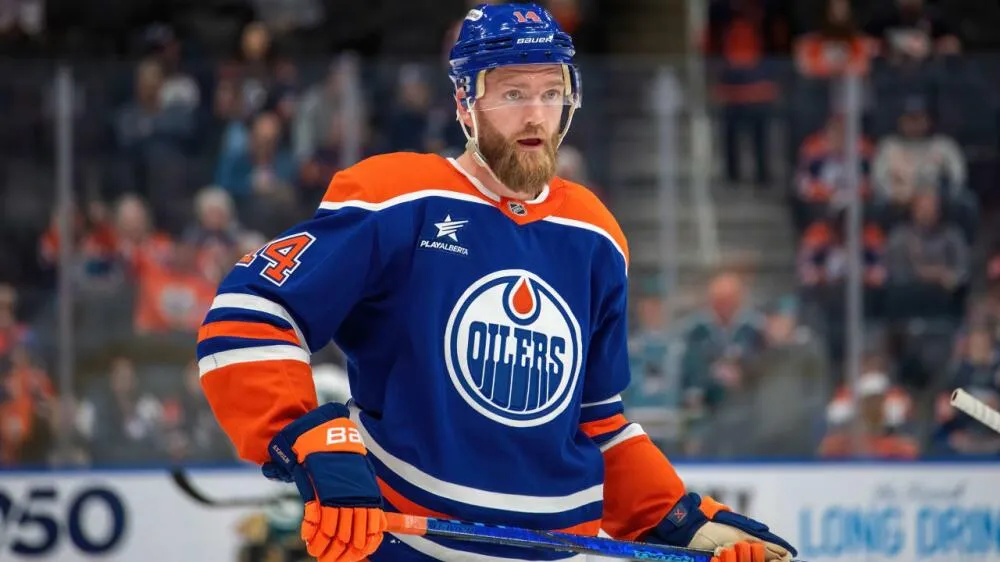
How Mattias Ekholm struggles Edmonton Oilers 2025-26 season reveal defensive concerns
Through the opening 15 games of the 2025-26 season, Ekholm’s statistical profile tells a troubling story. With one goal and five assists for six points, he carries a minus-six rating that stands among the worst on the roster. His ice time remains substantial at over 20 minutes per game, but the quality of his shifts has noticeably deteriorated compared to previous seasons.
The contrast to his 2023-24 campaign is striking. That season, Ekholm dominated possession metrics and finished with a league-leading plus-44 rating while contributing 45 points. He averaged nearly 22 minutes per game and provided the steady presence that allowed Evan Bouchard to take calculated offensive risks. The partnership between Ekholm and Bouchard became one of the NHL’s most effective defensive pairings, blending veteran savvy with youthful creativity.
This season, however, that chemistry has evaporated. According to Yardbarker’s analysis, Ekholm has joined Darnell Nurse and Bouchard among the Oilers defenders delivering “sub-optimal performances to begin the 2025-26 season.” The defensive structure that head coach Kris Knoblauch implemented—a 1-3-1 system designed to limit high-danger chances—hasn’t compensated for individual struggles on the back end.
Advanced metrics paint an even grimmer picture. Edmonton’s high-danger chance percentage at five-on-five sits at 45.83%, ranking fifth-worst in the league during Ekholm’s ice time. The Oilers are being outshot and out-chanced regularly, a dramatic departure from previous seasons when poor results masked strong underlying numbers. Unlike the 2023-24 campaign, when Edmonton possessed a league-best 62.07% high-danger chance share during their early struggles, this year’s defensive corps simply isn’t generating the same defensive dominance.
The plus-minus statistic, while imperfect, underscores Ekholm’s difficulties. His minus-six rating through 15 games puts him on pace for the worst plus-minus of his career. For a player who built his reputation on defensive reliability and puck-moving efficiency, such numbers represent a significant red flag for a team banking on defensive stability to support its offensive firepower.
The injury factor: how a groin tear continues to impact performance
Mattias Ekholm’s current struggles cannot be divorced from the injury that derailed his 2024-25 playoffs. The veteran defender tore his adductor late in the regular season and missed the Oilers’ first three playoff rounds entirely. When he attempted to return for the Stanley Cup Finals, he was far from full strength, playing through obvious discomfort as Edmonton battled for hockey’s ultimate prize.
“Now, I’m excited (healthy again). If I lose the puck, at least I know I can get it back,” Ekholm told The Sporting News before the season began. His comments revealed both optimism and the extent to which the injury had compromised his game. The ability to recover defensively—to chase down forecheckers, break up odd-man rushes, and transition the puck quickly—defines Ekholm’s value. Without that mobility, his effectiveness plummets.
While Ekholm claims to be fully recovered, the early-season evidence suggests lingering effects. His skating lacks the crispness that characterized his first two seasons in Edmonton. His gap control has suffered, allowing opposing forwards to generate more zone entries with speed. The first step that once allowed him to angle attackers wide now arrives a fraction of a second late, creating dangerous scoring chances.
Groin injuries are notoriously difficult for defensemen, particularly those in their mid-30s. The explosive movements required—lateral pushes, pivots, backward skating with power—place immense stress on the adductor muscles. Even after the tear heals, players often report lingering tightness or hesitation in movements that once came instinctively. This hesitation can be the difference between a clean breakout pass and a turnover, between closing a shooting lane and allowing a quality chance.
The Oilers’ medical staff cleared Ekholm for full duty, but game conditioning differs vastly from practice readiness. The cumulative toll of an 82-game season, combined with three consecutive deep playoff runs, may have left Ekholm without the physical reserves necessary to overcome the injury’s aftereffects. His body, despite a full summer of rehabilitation, might simply need more time to rediscover the form that made him elite.
Chemistry breakdown with Evan Bouchard and defensive pairings
One of the most concerning aspects of Mattias Ekholm’s struggles in the 2025-26 season involves his fractured partnership with Evan Bouchard. For two seasons, this pairing functioned as Edmonton’s shutdown duo, combining Ekholm’s defensive acumen with Bouchard’s offensive creativity. Bouchard flourished under Ekholm’s mentorship, developing into a Norris Trophy candidate while Ekholm provided the defensive foundation that allowed such offensive freedom.
Bleacher Report noted that “the lack of chemistry between Evan Bouchard and Mattias Ekholm is troubling” as part of their analysis of concerning NHL storylines. The synchronicity that once defined their shifts has disappeared. Bouchard pinches at the blue line expecting Ekholm to cover, but the veteran arrives late. Ekholm attempts outlet passes to spaces Bouchard no longer occupies. The result is defensive zone chaos and odd-man rushes against.
Head coach Kris Knoblauch has experimented with different defensive combinations to jumpstart Ekholm’s game. Pairing him with younger, more mobile partners like Troy Stecher or splitting up the Ekholm-Bouchard duo entirely have yielded mixed results. None of these adjustments have restored the defensive stability Edmonton requires from its top-four blue liners, as shown in the team’s early season struggles.
The Oilers’ defensive depth has been tested by injuries to Jake Walman, whose absence forces greater reliance on Ekholm to shoulder defensive responsibilities he once shared across multiple pairings. With Darnell Nurse also underperforming relative to his substantial contract, Edmonton lacks the internal options to shelter Ekholm or reduce his minutes without exposing less capable defenders to tougher matchups.
Communication breakdowns have become increasingly common. Ekholm and Bouchard occasionally end up covering the same forward in the defensive zone, leaving dangerous shooters open. Their breakout patterns, once crisp and automatic, now feature hesitation and miscommunication. These micro-failures compound over the course of games, turning manageable situations into scoring chances against and transforming Edmonton’s defensive zone coverage into a liability.
Contract year pressure and the uncertain future
Mattias Ekholm enters the 2025-26 season in the final year of the four-year, $25 million contract he originally signed with Nashville in 2021. At 35 years old and coming off an injury-plagued campaign, his future with the Oilers—and potentially his NHL career—hangs in the balance. The pressure of a contract year, combined with declining performance, creates a difficult psychological dynamic for even the most mentally tough veterans.
“It’s a contract year, but I’m also getting up there in age. I know what I bring on the ice, but I also have a family, and I want to make sure we have security,” Ekholm admitted in his conversation with the Edmonton Journal. His comments reveal the tension between professional ambition and personal reality. He wants to remain in Edmonton, where his family has settled and where he’s been integral to championship contention, but he also needs financial security as his playing career enters its twilight.
The Oilers face a complicated decision regarding Ekholm’s extension. On one hand, his contributions since arriving from Nashville cannot be overstated—seven playoff series wins and two Stanley Cup Finals appearances in just over two seasons. His leadership, experience, and partnership with Bouchard transformed Edmonton’s defensive capabilities. On the other hand, his current struggles, age, and injury history make committing significant term or money a risky proposition.
General manager Stan Bowman must balance sentimentality with pragmatism. Does he reward Ekholm’s past contributions with a contract that might not reflect his future performance? Or does he make the difficult choice to let a beloved veteran walk, risking defensive depth and locker room chemistry? The organization’s commitment to maximizing Connor McDavid’s prime complicates matters further—every dollar committed to aging assets limits flexibility to address other roster needs.
Ekholm’s awareness of the organizational hierarchy adds another layer to his contract situation. “You’re going to be talking to a guy in a few minutes who’s the big focus. I’ve been around long enough in this league to know you take care of the big boys first,” he said, referencing the franchise’s priority of securing long-term extensions for superstars like McDavid and Leon Draisaitl. His understanding doesn’t diminish the uncertainty he faces.
The psychological weight of contract uncertainty can affect on-ice performance. Players pressing to prove their worth often make uncharacteristic mistakes, forcing plays or attempting to do too much. Whether Ekholm’s struggles stem partly from this pressure or purely from physical decline and injury remains unclear, but the timing of his worst stretch coinciding with his contract year raises questions worth considering.
What the Edmonton Oilers must do moving forward
The Oilers cannot afford prolonged struggles from a player of Ekholm’s importance and ice time allocation. As the season progresses, Edmonton must make strategic adjustments to maximize their defensive effectiveness despite Ekholm’s diminished capacity. These adjustments involve both immediate tactical changes and longer-term roster considerations.
Reducing Ekholm’s minutes represents the most obvious solution. Rather than leaning on him for 20-plus minutes per night, the coaching staff could shelter him in more favorable matchups and deployment situations. This approach requires trusting younger defensemen or less proven options with increased responsibility, a risk Edmonton may need to accept to preserve Ekholm for crucial moments and prevent further physical decline.
The return of Jake Walman from injury cannot come soon enough. Walman’s mobility and modern defensive approach would allow Edmonton to redistribute defensive zone responsibilities and provide Ekholm with a more forgiving partner. The Oilers’ defensive corps functions far more effectively with depth options that allow matchup flexibility rather than relying heavily on aging veterans playing beyond their current capabilities.
Edmonton’s coaching staff must also consider whether the newly implemented 1-3-1 defensive system suits Ekholm’s current abilities. The structure requires quick transitions and reads that may not align with his reduced mobility. Reverting to defensive schemes that leverage his hockey intelligence and positioning rather than demanding elite skating might better suit his present skillset.
Trade deadline decisions loom large for Bowman and the front office. If Ekholm’s struggles continue into December and January, the organization must consider whether acquiring a defensive upgrade becomes necessary for a legitimate championship push. Such a move would be complicated by Ekholm’s contract status and no-movement clause considerations, but championship windows demand difficult decisions.
The psychological component cannot be ignored either. Veterans often respond to direct conversations about role adjustments and expectations. Rather than allowing uncertainty to fester, management and coaching should provide Ekholm with clarity about his standing, his role, and the organization’s plans. Such transparency might alleviate performance anxiety related to contract uncertainty.
Edmonton’s commitment to developing winning habits despite October struggles extends to how they manage veteran players navigating decline. The organization’s handling of Ekholm’s situation will signal to current and future players how the Oilers balance loyalty with championship pragmatism. Getting this balance right could define whether Edmonton sustains its championship window or watches it close prematurely.
As the calendar turns toward the heart of the season, Mattias Ekholm faces the most challenging chapter of his Edmonton tenure. The defensive rock who stabilized the Oilers’ blue line now finds himself fighting Father Time, injury recovery, and contract uncertainty simultaneously. His ability to rediscover effective play—even if not returning to his peak form—could determine whether Edmonton makes a third consecutive Stanley Cup Finals appearance or falls short of expectations. The Oilers need their veteran defender to find a way forward, because their championship aspirations may depend on it.

Par Mike Jonderson
Mike Jonderson is a passionate hockey analyst and expert in advanced NHL statistics. A former college player and mathematics graduate, he combines his understanding of the game with technical expertise to develop innovative predictive models and contribute to the evolution of modern hockey analytics.