


The debate over who ranks among the greatest hockey players of all time has fueled passionate discussions in arenas, living rooms, and sports bars for generations. From the dynasty-builders of the Original Six era to the speed demons lighting up modern ice, the NHL’s century-plus history has given us an embarrassment of riches when it comes to transcendent talent. This conversation goes beyond mere statistics—though the numbers certainly matter—and encompasses championships, innovation, dominance over peers, and the ability to change how the game is played. Whether you’re drawn to the artistry of a perfectly executed play, the raw determination that wins championships, or the records that seem untouchable, evaluating hockey’s elite requires considering multiple dimensions of greatness.
As the sport continues to evolve with faster skating, advanced analytics, and global talent influx, comparing players across different eras becomes increasingly challenging yet endlessly fascinating. The criteria for greatness shift depending on perspective: some value longevity and consistency, others prize peak performance and hardware accumulated. What remains constant is that certain names rise above the rest, forming a pantheon of legends whose impact resonates far beyond their playing days.
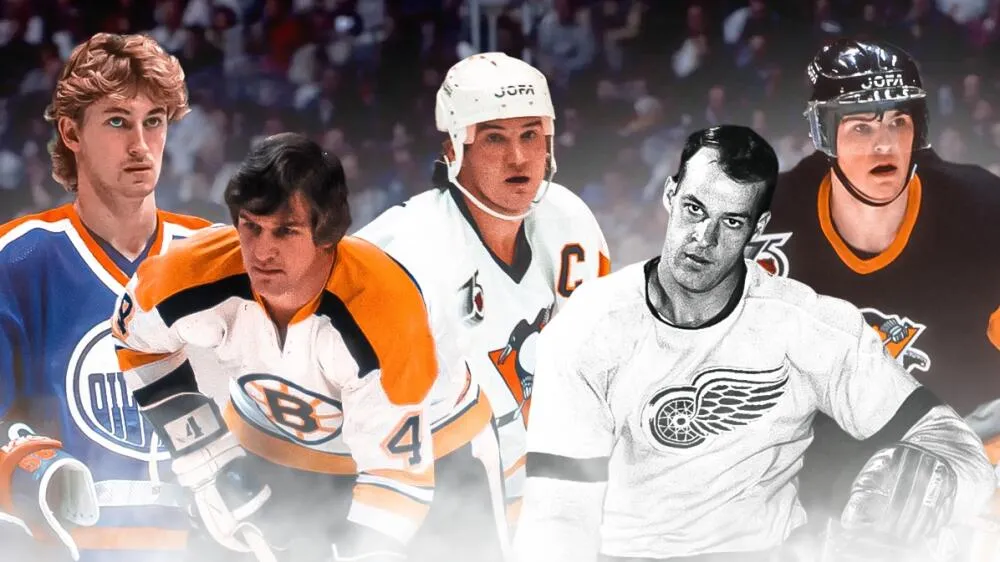
Wayne Gretzky: the undisputed great one among the greatest hockey players of all time
When discussing the greatest hockey players of all time, Wayne Gretzky’s name sits atop virtually every credible list for good reason. “The Great One” didn’t just break records—he shattered them so completely that many remain untouchable decades after his retirement. His 2,857 career points stand 936 ahead of the second-place holder, a gap so massive that even if you removed all 894 of his goals, his assists alone would still give him the all-time points record. That mathematical impossibility speaks to a level of dominance rarely seen in professional sports.
Gretzky’s impact extended beyond his personal statistics. During his time with the Edmonton Oilers, he led the team to four Stanley Cup championships between 1984 and 1988, creating one of hockey’s most celebrated dynasties. His nine Hart Memorial Trophies as league MVP and ten Art Ross Trophies as scoring champion represent a level of sustained excellence that defies comparison. He won the scoring title for seven consecutive seasons from 1981 to 1987, often by margins that left his closest competitors looking like they were playing a different sport.
Perhaps more impressive than the hardware was how Gretzky revolutionized hockey’s tactical approach. His ability to anticipate plays before they developed, combined with his positioning behind opponents’ nets in what became known as his “office,” changed how teams thought about offensive strategy. He possessed an almost preternatural ability to find open teammates, elevating the players around him and making the entire Edmonton roster more dangerous.
When he was traded to the Los Angeles Kings in 1988, it wasn’t just a player changing teams—it was a seismic shift for the sport itself. Gretzky’s presence in Southern California helped legitimize hockey in non-traditional markets, paving the way for NHL expansion throughout the United States. His influence transformed the league’s business model and geographical reach in ways that few athletes in any sport have managed.
Even Gretzky himself has shown remarkable humility when naming other legends. In various interviews, he’s cited Bobby Orr and Gordie Howe as the two greatest players to ever play the game, placing them ahead of himself. Such graciousness only adds to his legend, but the statistical and championship evidence speaks for itself—when ranking the greatest hockey players of all time, Gretzky stands alone at the summit.
Bobby Orr: revolutionizing defense among the greatest hockey players of all time
Bobby Orr fundamentally changed what it meant to be a defenseman in hockey. Before Orr arrived in Boston in 1966, defensemen were expected to stay back, protect their zone, and make simple outlet passes to forwards. Orr threw that playbook out the window, attacking up ice with speed and creativity that transformed him into an offensive weapon unlike anything the league had seen from the blue line. His impact was so profound that every offensive defenseman who followed owes a debt to his innovation.
The numbers behind Orr’s career are staggering when you consider he accomplished them in just 657 regular season games over 12 seasons, with chronic knee injuries robbing him of what should have been many more productive years. He won eight consecutive Norris Trophies as the league’s best defenseman from 1968 to 1975, a streak that remains unmatched. More remarkably, he won the Art Ross Trophy as the league’s leading scorer in 1970 and 1975—the only defenseman in NHL history to lead the entire league in points.
Orr’s 1970-71 season represents perhaps the single greatest campaign by a defenseman in hockey history. He recorded 139 points in 78 games, including 102 assists—numbers that would be impressive for an elite forward, let alone someone also responsible for defending his own zone. That same season, he won the Hart Trophy as league MVP, the Norris Trophy, the Art Ross Trophy, and led the Bruins to a Stanley Cup championship, claiming the Conn Smythe Trophy as playoff MVP.
His impact on team success cannot be overstated. The Boston Bruins had missed the playoffs for eight consecutive seasons before Orr’s arrival. He led them to Stanley Cup championships in 1970 and 1972, with his overtime goal to clinch the 1970 Cup becoming one of hockey’s most iconic images—Orr flying through the air in celebration, having just completed one of the greatest individual playoff runs in history.
According to Britannica, Orr is widely regarded as the game’s best defenseman, and his influence extends to every modern offensive defenseman. Players like Erik Karlsson, Cale Makar, and countless others play the way they do because Orr proved it was possible. When evaluating the greatest hockey players of all time, Orr’s combination of dominance, innovation, and shortened career places him firmly in the conversation for the very top spot.
Mario Lemieux: magnificent excellence among the greatest hockey players of all time
Mario Lemieux’s story is one of extraordinary talent battling against devastating obstacles. At 6-foot-4 and possessing remarkable skating ability for his size, “Super Mario” combined power, finesse, and hockey intelligence in ways that made him nearly unstoppable at his peak. Many hockey experts, including legendary coach Scotty Bowman, have argued that Lemieux might have been the most talented player ever to lace up skates—and when someone who coached Gretzky says that, it carries significant weight.
The numbers Lemieux compiled despite chronic health issues are staggering. He finished his career with 1,723 points in just 915 games, translating to a phenomenal 1.88 points per game average—second only to Gretzky in NHL history. Had Lemieux enjoyed better health and played a full career’s worth of games, the conversation about who holds various scoring records might be very different. He led the Pittsburgh Penguins to back-to-back Stanley Cups in 1991 and 1992, winning the Conn Smythe Trophy both times.
Lemieux’s 1988-89 season showcased his complete dominance. He scored 85 goals and 199 points in 76 games, numbers that seem almost fictional in the modern era. He won three Hart Memorial Trophies as league MVP and six Art Ross Trophies as scoring champion despite missing significant portions of multiple seasons. The fact that he accomplished this while battling debilitating back pain that required frequent draining of fluid from his spine makes it all the more remarkable.
Perhaps most inspirively, Lemieux’s comeback from Hodgkin lymphoma in 1993 demonstrated his resilience and love for the game. After missing two months for radiation treatment, he returned to win the scoring title that same season. Later, when the Penguins faced bankruptcy, he converted his deferred salary into equity, becoming the team’s owner in 1999. He then came out of retirement in 2000 and played several more productive seasons, becoming the only person to win the Stanley Cup as both a player and an owner when Pittsburgh captured the 2009 championship.
When discussing the greatest hockey players of all time, Lemieux represents the ultimate “what if” scenario. Even with the years stolen by injury and illness, his achievements place him firmly in the top tier. Those who watched him play consistently describe a player who could do things on ice that seemed to defy physics—and the statistics back up those subjective impressions.
Gordie Howe: Mr. Hockey’s enduring legacy among the greatest hockey players of all time
Gordie Howe earned the nickname “Mr. Hockey” through a combination of skill, longevity, and toughness that defined an entire era of the sport. His 26 seasons in the NHL established records that seemed unbreakable at the time, and his style of play—combining elite scoring ability with physical dominance—created the template for the complete hockey player. Howe could beat you with a beautiful goal or a crushing check, and opposing players never knew which version they’d encounter on any given shift.
Howe’s statistical accomplishments are remarkable by any measure. He finished his NHL career with 801 goals and 1,850 points in 1,767 games, numbers that stood as records for decades. He won four Stanley Cups with the Detroit Red Wings between 1950 and 1955, forming part of the legendary “Production Line” alongside Sid Abel and Ted Lindsay. His six Hart Memorial Trophies and six Art Ross Trophies demonstrated sustained excellence across multiple decades.
What truly set Howe apart was his ability to remain dominant well into his 40s. He was named a First or Second Team All-Star in 21 of his 26 NHL seasons, a consistency that remains unmatched. Even after retiring from the NHL, he joined the WHA’s Houston Aeros at age 45 and proceeded to win two championships while playing alongside his sons Mark and Marty. When the WHA merged with the NHL, Howe returned for one final season at age 51, proving he could still compete at hockey’s highest level.
The “Gordie Howe hat trick”—a goal, an assist, and a fight in one game—was named after him for good reason. Standing 6 feet tall and possessing tremendous strength, Howe’s elbows were legendary weapons that kept opponents honest. He accumulated 1,685 penalty minutes alongside his scoring exploits, showing he could dominate every aspect of the game. Unlike some pure scorers who needed protection, Howe fought his own battles and earned respect throughout the league.
His longevity influenced how subsequent generations approached their careers and conditioning. When examining the NHL’s all-time goal leaders, Howe’s name remains prominent despite playing in a lower-scoring era. Among the greatest hockey players of all time, Howe’s combination of skill, toughness, and endurance creates a legacy that transcends statistics alone.
The modern era contenders among the greatest hockey players of all time
While the legends of previous eras established the foundation for greatness, contemporary players continue to add new chapters to hockey’s story. Connor McDavid has emerged as the most dominant player of his generation, posting scoring numbers that recall the Gretzky and Lemieux eras. His 153 points in the 2022-23 season marked the first time anyone had cracked 150 points in nearly three decades, and his consecutive seasons above 120 points place him in exclusive company with only five other players in history.
McDavid’s speed with the puck seems to defy physics, and his ability to create offense both for himself and his teammates has drawn inevitable comparisons to Gretzky. His 2024 playoff performance, leading the Edmonton Oilers to the Stanley Cup Final and winning the Conn Smythe Trophy despite falling short in the championship round, demonstrated his ability to elevate his game when it matters most. His triumph at the 2025 Four Nations Faceoff, where he scored the championship-winning goal for Canada, added another accomplishment to his growing resume.
Alex Ovechkin’s pursuit and surpassing of Gretzky’s all-time goals record in 2025 cemented his place among the sport’s immortals. “The Great Eight” has redefined what it means to be a pure goal scorer, using a combination of positioning, timing, and the most lethal shot of his generation to become the NHL’s all-time leading goal scorer. His 2018 Stanley Cup championship with the Washington Capitals, where he finally shed the label of being unable to win the big one, completed his legacy in ways that statistics alone couldn’t achieve.
Sidney Crosby’s career has been defined by winning at every level. Three Stanley Cups, two Olympic gold medals (including the overtime winner on home ice in 2010), and two World Championship golds have given him credentials that few can match. His leadership of Canada to victory in the 2025 Four Nations Faceoff further demonstrated his ability to perform on the biggest stages. While he may never challenge career points records due to concussion issues that cost him significant time early in his career, Crosby’s combination of skill and clutch performances places him among the elite.
These modern stars benefit from advances in training, nutrition, and sports science that previous generations couldn’t access, making direct comparisons challenging. However, dominance relative to one’s peers remains the ultimate measuring stick. McDavid, Ovechkin, and Crosby have each dominated their eras in different ways, ensuring their eventual inclusion in any comprehensive discussion of the greatest hockey players of all time.
The defensive legends among the greatest hockey players of all time
While offensive exploits tend to dominate discussions of greatness, several defensemen have earned their place among hockey’s elite through complete mastery of their position. Nicklas Lidstrom of the Detroit Red Wings represented the perfect defenseman—a player so consistently excellent that you barely noticed him on the ice during his best performances. His seven Norris Trophies and four Stanley Cups with Detroit from 1998 to 2008 came through an almost robotic level of positional perfection and decision-making.
Lidstrom’s 1,142 points in 1,564 games demonstrated that he could contribute offensively while never compromising his defensive responsibilities. According to ClutchPoints’ comprehensive ranking, Lidstrom’s style contrasted sharply with the flashier offensive defensemen but proved equally valuable. His ability to play 25-plus minutes per game while making everything look simple set a standard that few have approached.
Ray Bourque spent 22 seasons establishing himself as the highest-scoring defenseman in NHL history with 1,579 points. His 13 First-Team All-Star selections and five Norris Trophies demonstrated sustained excellence that spanned multiple decades. When Bourque finally won his first Stanley Cup with Colorado in his 22nd and final season, Joe Sakic’s gesture of handing him the Cup first created one of hockey’s most emotional moments, a recognition of everything Bourque had meant to the sport.
Paul Coffey formed the other half of the conversation with Bourque about the greatest offensive defensemen of the 1980s and 1990s. Playing much of his career alongside Gretzky in Edmonton, Coffey’s 1,531 points in 1,409 games included a then-record 48 goals in a single season by a defenseman. His four Stanley Cups and three Norris Trophies demonstrated that his offensive contributions didn’t come at the expense of team success, though his defensive play was sometimes questioned.
Doug Harvey, while less familiar to modern fans, dominated the 1950s with seven Norris Trophies and six Stanley Cups with Montreal. His control of the game’s pace from the blue line influenced how subsequent generations approached the position. When considering the greatest hockey players of all time, these defensive maestros remind us that greatness manifests in multiple forms beyond pure goal-scoring ability.
Determining the greatest hockey players of all time ultimately depends on how you weigh various factors: peak performance versus longevity, individual statistics versus team success, innovation versus consistency. What remains undeniable is that certain players transcended their eras and established standards of excellence that continue to inspire new generations. Gretzky’s records, Orr’s innovation, Lemieux’s artistry, Howe’s completeness, and the achievements of modern stars like McDavid, Ovechkin, and Crosby all represent different facets of hockey greatness.
The beauty of this debate lies in its subjectivity and the passion it generates among fans. Each era has produced transcendent talents who dominated their competition and pushed the sport forward. As the game continues to evolve with advancing technology, training methods, and global talent development, future stars will inevitably emerge to challenge these legends. But the names discussed here have already secured their immortality, their achievements serving as benchmarks against which all future greatness will be measured. Whether you favor the statistical dominance of Gretzky, the revolutionary impact of Orr, or the complete games of Howe and Lidstrom, these players have earned their places in hockey’s pantheon through extraordinary excellence sustained at the highest level.

Par Mike Jonderson
Mike Jonderson is a passionate hockey analyst and expert in advanced NHL statistics. A former college player and mathematics graduate, he combines his understanding of the game with technical expertise to develop innovative predictive models and contribute to the evolution of modern hockey analytics.