
Hilary Knight final Olympic appearance: A legendary career nears its end
As the 2026 Winter Olympics in Milan-Cortina approach, Hilary Knight prepares to write the final chapter of her remarkable Olympic journey. The 36-year-old forward, who has worn the Team USA jersey for nearly two decades, announced in May 2025 that these Games will mark her fifth and final Olympic appearance. With four medals already in her collection—including the historic gold from PyeongChang 2018—Knight stands poised to become the first U.S. hockey player, male or female, to compete in five Olympics.
The decision to make this her final Olympic appearance didn’t come easily. Knight admitted she felt “really uncomfortable” when her agent first broached the subject in 2024, prompting months of contemplation about her future. Yet ultimately, the opportunity to control her narrative and embrace the moment brought unexpected peace. “Everyone has an expiration date and you don’t know what that date is. To have an opportunity to control that? I can kind of just appreciate things,” Knight reflected in an interview with ESPN.
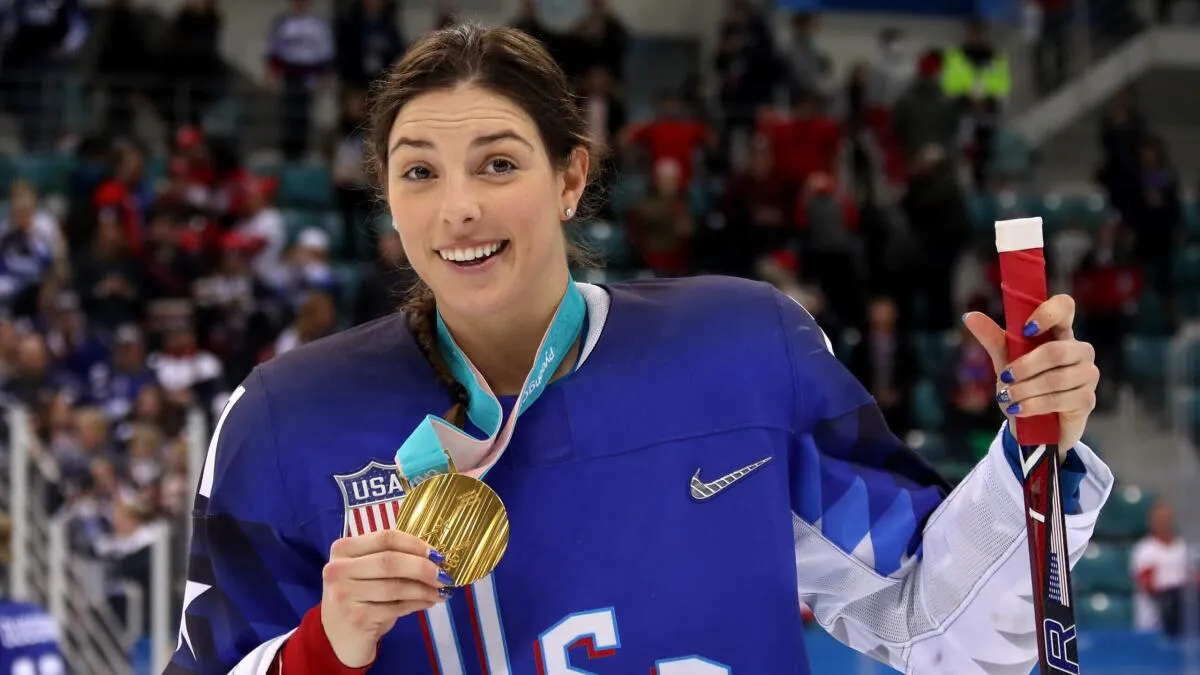
Hilary Knight’s journey to her final Olympic appearance began at age 17
The teenage phenom who changed everything
Knight joined Team USA in 2006 as a precocious 17-year-old, determined to learn from veterans like Angela Ruggiero. Her first Olympic goal against Finland at the 2010 Vancouver Games lit the fuse on a career that would redefine American women’s hockey. “I felt like a kid in the candy shop. I feel like I slept with a smile on my face permanently at the Olympics,” she told NBC Olympics about her debut experience. Even after losing the gold medal game to Canada, she knew they would return stronger.
The Wisconsin Badgers product quickly established herself as a generational talent. She left the university in 2012 as the program’s all-time leader in goals (143) for both men and women, a record that still stands. Her childhood idol, Cammi Granato, had worn No. 21 for Team USA, and Knight deliberately chose the same number when she joined the national team—a symbolic passing of the torch from one goal-scoring legend to another.
Building a legacy through adversity
Knight’s career unfolded during a crucial era for women’s hockey. She and teammates like Kendall Coyne Schofield led a landmark fight for equality in 2017, nearly boycotting the world championships until USA Hockey agreed to more equitable treatment. This victory laid groundwork for the sustainable professional landscape players enjoy today. “We are a group of really high-performance minds, stubborn individuals, and we’re not going to settle for anything less of what we think that the game deserves,” Knight explained about the movement she helped champion.
The early professional years tested her commitment. While playing in the Canadian Women’s Hockey League, her locker consisted of two milk crates stacked in a community rink bathroom. Yet she never compromised her training standards, often funding her own recovery modalities and seeking specialized coaching. This self-directed professionalism kept her elite when resources were scarce—a testament to her dedication that younger teammates still marvel at today.
What Hilary Knight final Olympic appearance means for Team USA
The veteran leader in a golden generation
Team USA enters Milan-Cortina as the favorites, ranked No. 1 by the IIHF after sweeping Canada 4-0 in the recent Rivalry Series. Knight remains the team’s offensive engine, leading the Professional Women’s Hockey League (PWHL) with 29 points in 30 games for Boston Fleet during the inaugural season. Her 10th world championship gold in April 2025—where she set records for most goals, assists, and points in tournament history—proved she’s performing at her peak when it matters most.
Her leadership style has evolved from young prodigy to mentor. Twenty-one-year-old teammate Tessa Janecke grew up with photos of herself posing with Knight and now skates alongside her idol. “She’s an icon. She essentially put women’s hockey on her back throughout her career,” Janecke told ESPN. This intergenerational bridge exemplifies Knight’s impact—she’s not just scoring goals but ensuring the sport’s future remains bright.
The quest for storybook ending
Despite her individual brilliance, Knight’s final Olympic appearance centers on one goal: gold. “Capturing a gold medal, your legacy is remembered. We celebrate those victories differently,” she told NBC Olympics. After three silver medals (2010, 2014, 2022) surrounding her 2018 triumph, she understands the stakes. A fifth Olympic medal would tie the all-time hockey record held by Canada’s Jayna Hefford and Hayley Wickenheiser.
Her training regimen reflects this singular focus. This past summer, she worked at the Olympic Oval in Utah with longtime partner Brittany Bowe, analyzing biomechanics and skating efficiency. At 36, she’s adapted her game to maximize “quiet ice” and conserve energy—subtle adjustments that maintain her dominance against younger competition. The attention to detail that defines her career has only intensified as the final chapter approaches.
Hilary Knight final Olympic appearance: Legacy beyond the ice
Impact on women’s hockey in America
Knight’s influence transcends statistics. She’s become the face of women’s hockey in a country where the sport remains niche, securing endorsement deals with Nike, Visa, and Red Bull while gracing the ESPN Body Issue. This visibility matters. “I just understand what a gold medal does for the sport of hockey in the U.S. and all those young girls just looking up to us,” she explained. Her presence has helped drive record attendance—the Seattle Torrent’s inaugural PWHL game drew 16,014 fans, setting a new U.S. standard.
The younger generation recognizes her sacrifices. “Their days are filled. It’s over our heads sometimes, as the younger girls, just how much they’ve put in,” said teammate Abby Harvey. This awareness ensures Knight’s advocacy will continue through those who follow. The Professional Women’s Hockey League, launched in 2024, exists partly because Knight’s generation refused to accept substandard conditions.
What comes after the final Olympic appearance
Knight has been clear: retiring from Olympic competition doesn’t mean retiring from hockey. She’ll continue playing in the PWHL, potentially representing the U.S. at future world championships, and has left the door open for other international competition. The 2026 Games represent a transition, not an ending. “I’m really proud that I’ve been a part of that group and relevant enough to have an impact now,” she reflected.
Her post-Olympic future includes starting a family and exploring life beyond the rigid structure of quadrennial training cycles. The decision to step away now reflects a calculated assessment of her “human capacity” and life goals. Yet her commitment to growing the game remains unwavering. As captain of the expansion Seattle Torrent, she’s helping establish hockey’s viability in non-traditional markets—a final form of leadership that may define her legacy as much as any goal.
As the opening puck drops on February 5, 2026, against Czechia, Knight will achieve what few athletes do—departing international competition entirely on her own terms, at the peak of her powers, with a generation of girls watching and dreaming of following her path.
Frequently Asked Questions

Par Mike Jonderson
Mike Jonderson is a passionate hockey analyst and expert in advanced NHL statistics. A former college player and mathematics graduate, he combines his understanding of the game with technical expertise to develop innovative predictive models and contribute to the evolution of modern hockey analytics.