






Ottawa Senators defenseman Jake Sanderson, the team’s most reliable blue-liner in the playoffs, left game 3 against the Carolina Hurricanes on Thursday night after sustaining a high hit and blocking a shot with his hand. The 23-year-old was reaching to clear a puck from the defensive zone when Hurricanes forward Taylor Hall delivered an illegal check to the head, knocking Sanderson’s helmet off and earning Hall a two-minute minor penalty. Sanderson stayed in briefly but exited about five minutes later when a shot from Jackson Blake struck his left hand.
Sanderson did not return for the third period, leaving the Senators shorthanded as they trail 0-2 in the best-of-seven series. This comes just three nights after he logged over 43 minutes in a double-overtime game 2 loss.[1][2] His absence highlighted the Senators’ depth issues on defense during a critical home matchup.
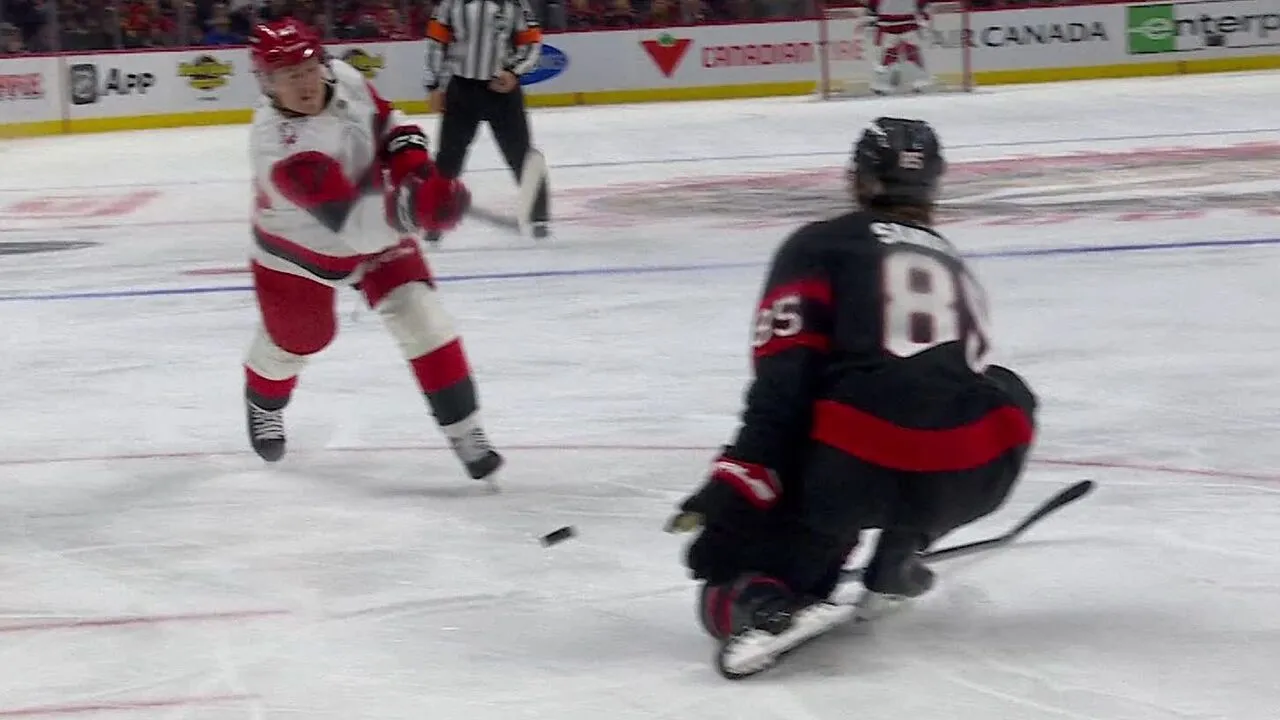
The sequence of events in the second period
Sanderson was actively defending in the Senators’ zone, attempting to poke the puck away from danger. That’s when Taylor Hall charged in, delivering a high elbow that caught Sanderson squarely in the head. The impact was severe enough to dislodge his helmet, drawing immediate attention from officials who signaled for the minor penalty on Hall.
Despite the hit, Sanderson skated off under his own power and even returned to the ice shortly after, showing his toughness. He continued to battle for a few shifts, logging time on the penalty kill and in defensive situations. However, the game turned when Jackson Blake unleashed a shot that Sanderson instinctively blocked with his left hand.
The pain from the blocked shot proved too much, forcing him to the locker room for good before the third period. Teammates and coaches watched helplessly as the training staff attended to him, underscoring the physical toll of playoff hockey.
This double whammy—head contact followed by a hand injury—raises questions about concussion protocols and hand protection in high-stakes games. The NHL’s emphasis on head safety was evident in the quick penalty call, but Sanderson’s quick exit suggests multiple concerns.
Sanderson’s critical importance to the Senators’ blue line
At just 23 years old, Jake Sanderson has emerged as the cornerstone of Ottawa’s defense in these playoffs. He leads the team in ice time, averaging over 35 minutes per game while chipping in two assists. His recent return from a suspected shoulder injury on April 4 had been a boost after nearly a month sidelined.[3]
In game 2, Sanderson shouldered an extraordinary load, playing 43:06—the highest in the game—across all situations including power play, penalty kill, and overtime.[4] His ability to quarterback the top pair and log heavy minutes has stabilized a young Senators defense.
Sportsnet analyst Kevin Bieksa captured it perfectly during the intermission: “He’s their best defenseman by a country mile.” Sanderson’s poise, physicality, and decision-making have been vital in a series against a deep Hurricanes squad.
Prior to playoffs, Sanderson posted solid regular-season numbers with 14 goals and 40 assists, showcasing his two-way game. For more on the Senators’ defensive evolution this season, check our analysis of their special teams outlook.
His exit amplifies the pressure on remaining defenders like Thomas Chabot, who also logged heavy minutes in game 2.
Immediate impact on the Senators’ defensive depth
With Sanderson out, Ottawa was forced to play with just five defensemen for the latter stages of game 3. This included series debuts for Cameron Crotty and Tyler Kleven, both thrust into high-pressure playoff action without much preparation.
Crotty, a promising prospect, showed flashes but struggled with puck management against Carolina’s forecheck. Kleven, known for his physical style, added grit but the pairing was mismatched against the Hurricanes’ speed.
The Senators’ blue line was already tested this season with multiple injuries, including Sanderson’s earlier shoulder issue. As detailed in our coverage of Linus Ullmark’s season performance, goaltending has masked some defensive lapses, but losing their top guy exposes vulnerabilities.
- Key stats without Sanderson in game 3 third period:
Player TOI Hits Blocks Thomas Chabot 25+ 4 3 Cameron Crotty 12 2 1 Tyler Kleven 11 3 0
Coaches adjusted pairings on the fly, doubling shifts for veterans and relying on rookies in limited roles.
What Sanderson’s injury means for the series outlook
Trailing 0-2 at home puts immense pressure on the Senators to claw back. Sanderson’s absence could linger if the hand injury requires evaluation, potentially shifting momentum to Carolina.
Ottawa’s home-ice advantage in game 3 was crucial, but five defensemen hampered their structure. For context on Sanderson’s workload, see this NHL.com preview ahead of game 3.
The Hurricanes capitalized on physical edges, with Hall’s hit setting a tone despite the penalty. If Sanderson misses game 4, expect more ice for Chabot and calls-ups from Syracuse.
Historically, teams down 0-2 win series about 18% of the time—steep odds, but Ottawa’s resilience shines through. Recent examples include underdogs like the 2023 Panthers rallying from similar holes.
Coach Travis Green’s post-game comments will be key; expect emphasis on depth and urgency. ESPN’s player page tracks Sanderson’s stats for ongoing updates.
The Senators must rally their depth to even the series, or risk an early exit.
Sanderson’s toughness embodies Ottawa’s young core, but his health is pivotal. A quick recovery could reignite their comeback hopes; otherwise, Carolina’s experience may prevail. Fans await injury updates, knowing this series—and Sanderson’s star—remains a playoff storyline to watch. The battle for Eastern Conference supremacy intensifies.
Frequently Asked Questions

Par Mike Jonderson
Mike Jonderson is a passionate hockey analyst and expert in advanced NHL statistics. A former college player and mathematics graduate, he combines his understanding of the game with technical expertise to develop innovative predictive models and contribute to the evolution of modern hockey analytics.