






Now I have enough information to write a comprehensive article about Kris Knoblauch potentially losing the Oilers dressing room before the season began. Let me create a well-structured blog post with the information gathered.
Kris Knoblauch lost Oilers dressing room before season began: the warning signs were there all along
The Edmonton Oilers entered the 2024-25 season with championship expectations firmly in place. After consecutive trips to the Stanley Cup Final, the franchise believed it had finally assembled the pieces necessary to end a 35-year championship drought. However, beneath the surface of those remarkable playoff runs, cracks were beginning to form in the foundation that head coach Kris Knoblauch had carefully constructed. What many dismissed as the typical adjustments of a new campaign has evolved into a troubling reality: the warning signs that Knoblauch was losing his grip on the dressing room were evident even before the puck dropped on opening night.
The evidence suggests that the disconnect between coach and players began during last season’s Stanley Cup Final loss to the Florida Panthers. Connor McDavid’s post-series comments revealed a frustration that went beyond the disappointment of falling short. His words painted a picture of a team unable to adapt, stuck in patterns that weren’t working, and seemingly powerless to change course even as their championship hopes slipped away.
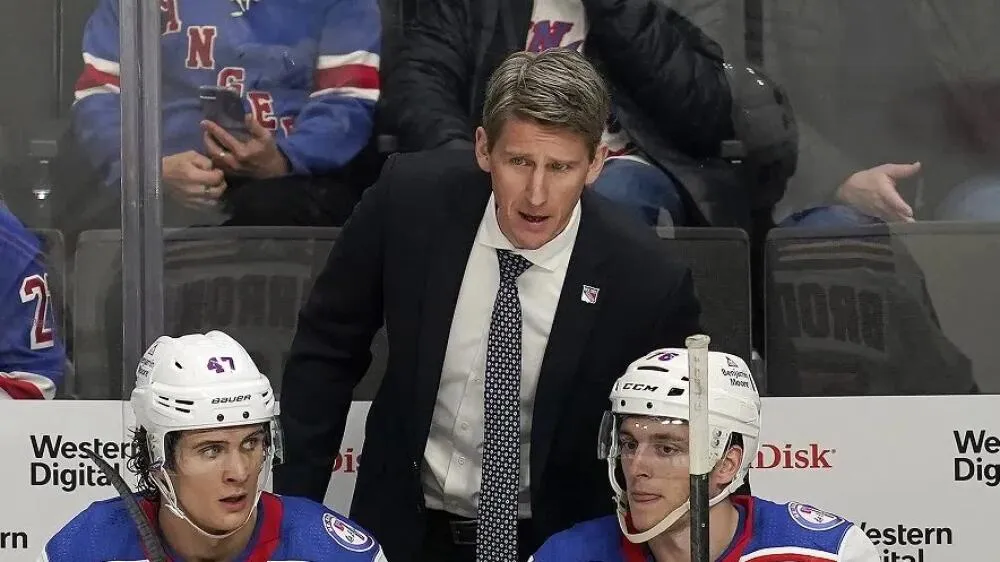
The troubling McDavid comments that foreshadowed current struggles
In the aftermath of the Oilers’ Game 7 Stanley Cup Final defeat, McDavid delivered comments that should have raised immediate red flags about the state of the team’s relationship with its coaching staff. “Their forecheck was great. They tilted the rink and were able to stay on top of us all over the place,” McDavid said. “We were never really able to generate any momentum up the ice. We kept trying the same thing over and over again, just banging our heads against the wall. Credit to them, they played well.”
The phrase “trying the same thing over and over again” is particularly damning when you consider its source. McDavid, typically measured and diplomatic in his public statements, essentially acknowledged that the Oilers made no meaningful adjustments throughout the series. For the team’s captain and best player to suggest they were simply “banging their heads against the wall” implies a coaching staff either unable or unwilling to provide solutions when they were desperately needed.
This wasn’t just frustration speaking in the heat of the moment. McDavid’s comments suggested a fundamental breakdown in the feedback loop between players and coaching staff. When a team of this caliber repeatedly fails to adjust against a specific opponent, it raises serious questions about communication and trust within the organization.
The Florida Panthers systematically dismantled Edmonton’s offensive game plan, and according to McDavid’s own words, the Oilers never found an answer. That inability to adapt didn’t just cost them a championship—it planted seeds of doubt that would bloom into full-fledged problems once the new season began.
How the off-season changes signaled deeper problems
The summer between seasons should have been a time for reflection and growth, but instead it became a period where the Oilers’ identity began to fragment. Knoblauch made significant alterations to his approach, implementing new systems that differed markedly from what had carried the team to within one game of the Stanley Cup. These changes weren’t subtle tweaks—they represented a philosophical shift that left players searching for answers.
From the opening days of training camp, something felt different. Multiple reports suggested that Knoblauch had arrived with “bizarre lineup decisions” and “system changes” that caught veteran players off guard. The chemistry and continuity that had defined the team’s late-season surge and playoff success were suddenly being dismantled in favor of experimentation.
The most visible manifestation of this disconnect has been Knoblauch’s relentless line juggling. Through the first portion of the season, he utilized more than 28 different forward line combinations—more than any other coach in the NHL. While coaches often experiment early in campaigns, this level of constant rotation suggests a deeper issue: a lack of trust, both from the coach in his players and potentially from the players in the coach’s vision.
Veterans who had found success in defined roles suddenly found themselves bouncing between lines and seeing their ice time fluctuate wildly. Young players like Matthew Savoie and Issac Howard, who should have been given opportunities to develop with consistent linemates, instead became pawns in an endless chess match that produced no clear winners.
The systemic failures that exposed the coaching disconnect
Perhaps the most damning evidence of Knoblauch losing the room comes from the on-ice product itself. Statistical analysis comparing his current system to previous coaching regimes reveals troubling similarities to approaches that had already failed in Edmonton. The expected goals per 60 minutes under Knoblauch (2.35) are nearly identical to those posted under former coach Dave Tippett (2.42)—a coach who was eventually fired for failing to maximize the team’s offensive potential.
The Oilers have reverted to a perimeter-focused attack that relies heavily on low-percentage point shots rather than creating dangerous chances near the crease. This represents a philosophical regression that flies in the face of modern hockey analytics and, more importantly, the skill sets of Edmonton’s elite forwards. When you have Connor McDavid and Leon Draisaitl on your roster, designing a system that keeps them on the outside looking in defies logic.
Defensively, the problems have been equally pronounced. Through 17 games, the Oilers have allowed 3.07 goals per game—exactly matching their offensive output and creating a precarious balance that can collapse at any moment. The defensive structure that Paul Coffey had helped establish during his time with the organization has disintegrated, with individual players looking lost in their own zone and consistently losing puck battles they should win.
The November 8th game against the Colorado Avalanche provided the most stark illustration of these systemic failures. The 9-1 shellacking wasn’t just a bad night—it was a comprehensive dismantling that exposed every weakness in Knoblauch’s approach. When Darnell Nurse, a veteran defenseman, posts a 5-on-5 Corsi For percentage of 13% (3-20) and high-danger chances against of 12-1, it’s not just individual failure. It’s systemic collapse.
The players’ subtle rebellion and loss of confidence
While NHL players rarely publicly criticize their coaches, their actions and subtle comments have revealed a growing disconnect between what Knoblauch is asking for and what the players believe will lead to success. The team’s body language during games, particularly during defensive zone coverage, suggests players who are uncertain about their responsibilities and hesitant in their decision-making.
Several players who thrived under Knoblauch’s initial system last season have seen their production crater under the new approach. The coach’s decision to constantly shuffle lines has made it nearly impossible for players to develop the chemistry necessary for consistent offensive production. When asked about the constant changes, players have offered diplomatic responses, but their on-ice performance tells a different story—one of confusion and frustration.
The goaltending situation has become another flashpoint. Stuart Skinner, who carried the team through significant stretches last season, has struggled to find consistency. While it would be unfair to blame a 9-1 loss entirely on goaltending, Knoblauch’s handling of the position has raised questions. The expectation that Skinner should make saves “he shouldn’t” at “critical times” ignores the reality that he’s being hung out to dry by systematic defensive breakdowns.
Even more telling has been the performance—or lack thereof—from McDavid and Draisaitl themselves. Both superstars have posted numbers “significantly below their usual” levels, suggesting that even the team’s best players are struggling to execute within Knoblauch’s framework. When your elite talent can’t produce, it’s rarely because they’ve suddenly forgotten how to play hockey. It’s typically because the system isn’t putting them in positions to succeed.
Why coaching changes become inevitable in Edmonton
The Oilers organization has developed a troubling pattern when it comes to coaching longevity. Jay Woodcroft was fired in his third season behind the bench. Dave Tippett met the same fate in his third year. Now Knoblauch, entering his third season with the team, finds himself facing similar questions about his future. This pattern suggests something deeper than mere coincidence—it points to organizational impatience and a roster that may require periodic sparks to maintain its motivation.
There’s an uncomfortable truth that Edmonton’s front office must confront: this group of players, despite its immense talent, has never sustained excellence under a single voice for an extended period. Whether this speaks to the coaching or the players themselves remains an open question, but the pattern is undeniable. The shelf life of an NHL coach is notoriously short, particularly in markets with championship expectations and generational talent on expiring timelines.
The pressure on Knoblauch extends beyond wins and losses. The Oilers are acutely aware that their window with McDavid and Draisaitl in their prime is finite. Every season that passes without a championship increases the urgency and decreases patience with anything perceived as an obstacle to success. Fair or not, Knoblauch has become that perceived obstacle for many within and around the organization.
After the Avalanche debacle, Knoblauch addressed the media with candor, calling the performance “rock bottom” and demanding change. But his words rang hollow to those who have watched this team struggle to find its identity all season. When a coach must publicly declare that a team has hit rock bottom just 17 games into a season, it often signals that his ability to reach that team has deteriorated beyond repair.
The path forward and what comes next for the Oilers
The Oilers find themselves at a crossroads that will define their season and potentially their championship window. The organization must decide whether Knoblauch deserves more time to work through these issues or whether a change is necessary to salvage what remains of the campaign. History suggests that in these situations, organizations typically err on the side of change, particularly when the stakes are this high.
If Knoblauch is to save his job, he must quickly identify a lineup and system that maximizes his team’s strengths while addressing its glaring weaknesses. The constant line changes must stop, allowing players to develop chemistry and trust with their linemates. The defensive system needs a complete overhaul, potentially requiring the swallowing of pride and a return to structures that worked previously. Most importantly, he needs to rebuild trust with his core players, particularly McDavid, whose body language and comments suggest a disconnect that may already be beyond repair.
The alternative—a coaching change—would mark another reset for a franchise desperate for stability. But it may be the necessary medicine for a team that appears to have tuned out its current voice. The question isn’t whether Knoblauch is a good coach; his resume speaks for itself. The question is whether he’s still the right coach for this particular group at this particular moment. Based on the evidence, the answer appears to be no.
What makes this situation particularly tragic is that it was foreseeable. The warning signs were there in McDavid’s post-Finals comments, in the off-season changes that altered a winning formula, and in the early-season struggles that have only intensified as the calendar has turned. The Oilers didn’t suddenly lose their way in November—they’ve been lost since before the season began, searching for an identity under a coach who may have already lost the ability to provide one.
The coming weeks will determine Knoblauch’s fate and potentially the trajectory of the Oilers’ season. But one thing is already clear: the relationship between this coach and this team has fractured, and fractured relationships in professional sports rarely repair themselves. Whether through dramatic improvement or inevitable change, the status quo cannot hold. The only question is how much longer the Oilers will wait before acknowledging what many have already concluded—that Kris Knoblauch lost this dressing room before the season ever began.

Par Mike Jonderson
Mike Jonderson is a passionate hockey analyst and expert in advanced NHL statistics. A former college player and mathematics graduate, he combines his understanding of the game with technical expertise to develop innovative predictive models and contribute to the evolution of modern hockey analytics.