


Milan-Cortina 2026 Olympic hockey rink dimensions vs NHL standard 200x85: What players need to know
When NHL players return to Olympic ice this February for the first time since 2014, they’ll face an unprecedented challenge that has coaches and executives scratching their heads. The Milano Santagiulia Ice Hockey Arena, host venue for both men’s and women’s tournaments at the Milan-Cortina 2026 Winter Games, will feature a playing surface that’s actually smaller than the standard NHL rink—a reversal of the typical Olympic format that traditionally emphasizes more wide-open play. This surprising development threatens to fundamentally alter strategies, player selection, and the very style of hockey fans will witness when the world’s best converge on Italy.
The International Ice Hockey Federation (IIHF) has approved a rink measuring 196.85 feet by 85.3 feet, according to reporting from The Athletic’s Chris Johnston and Michael Russo. This creates a unique dilemma for players, coaches, and fans expecting the standard Olympic experience. Team Canada assistant coach Peter DeBoer expressed his bewilderment during a recent radio appearance, stating, “The ice surface, it looks like it’s going to be smaller than NHL rink standard by it looks like three or four feet. I don’t understand how that happened.” The dimension shortfall represents approximately 3.15 feet in length compared to NHL specifications—a seemingly minor difference that will dramatically impact the world’s biggest hockey tournament.
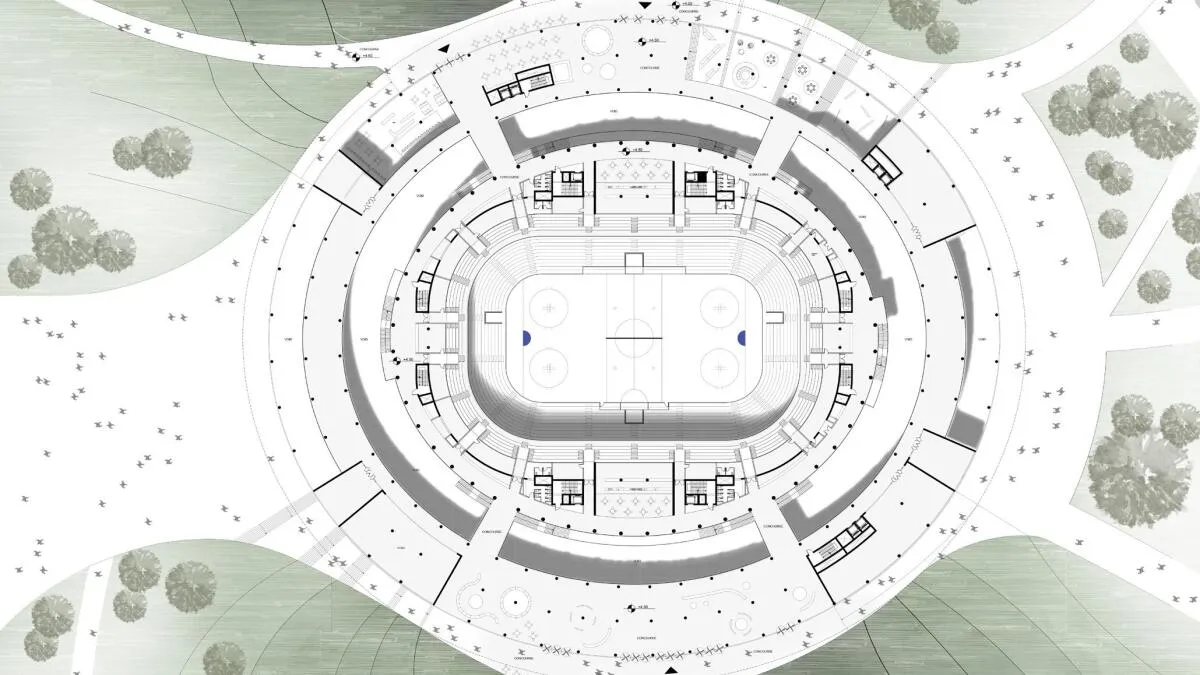
Milan-Cortina 2026 Olympic hockey rink dimensions vs NHL standard 200x85: The shocking difference
The approved dimensions for Milan-Cortina 2026 break from nearly every precedent in modern Olympic hockey history. At 196.85 feet long and 85.3 feet wide, the rink falls short of the NHL’s established 200-by-85-foot standard that governs professional play across North America. This marks the first time Olympic hockey will be played on a surface smaller than NHL specifications, rather than the traditionally larger international ice that players have navigated for decades.
NHL rinks have maintained consistent 200-by-85-foot dimensions for generations, creating a playing environment where speed, physicality, and quick transitions define the style of play. The slightly longer NHL rink accommodates the league’s emphasis on end-to-end action and provides adequate space behind the nets for goaltenders to handle the puck within the trapezoid zone. Every element—from faceoff circle placement to blue line positioning—is calibrated to these exact measurements, creating a standardized environment where players develop muscle memory over thousands of professional games.
The traditional Olympic or IIHF standard rink measures approximately 197 by 98.5 feet, providing substantially more width than its NHL counterpart. This additional 13.5 feet of lateral space has historically allowed for more east-west puck movement, emphasizing possession and cycling strategies over the north-south directness common in NHL play. European players grew up on these larger surfaces, giving them familiarity advantages in previous Olympics that won’t exist in Milan-Cortina.
The decision to use a smaller-than-NHL surface contradicts the formal agreement between the NHL, NHLPA, and International Olympic Committee that specified NHL-sized ice for the 2026 Games. This agreement was crucial in bringing NHL players back to the Olympics after the league’s withdrawal from the 2018 PyeongChang Games. The unexpected dimension change raises questions about venue planning and whether the compromises were avoidable.
Coaches are particularly concerned about how this unprecedented scenario will affect team selection and tactics. A smaller rink typically favors more physical, defensive-minded players with less emphasis on speed and skating ability. This could force coaching staffs to reconsider their roster construction mere months before the tournament begins, potentially altering the competitive balance between hockey powers.
How Milan-Cortina 2026 Olympic hockey rink dimensions vs NHL standard 200x85 will impact gameplay
The compressed playing surface at Milan-Cortina will fundamentally alter the game’s flow in ways both subtle and obvious. With three to four fewer feet of length, the neutral zone becomes significantly more congested, reducing the time and space players have to build speed through the center of the ice. This compression rewards teams that excel at quick, short passes and punishes those dependent on stretch passes and breakaway opportunities.
Physical play will inevitably increase as players have less room to maneuver away from contact. Forechecking becomes more dangerous when opposing defensemen have reduced space to operate behind their own net and along the boards. The Milan-Cortina 2026 Olympic hockey rink dimensions vs NHL standard 200x85 comparison reveals a surface that will force puck carriers into traffic much sooner than they’re accustomed to, potentially leading to more turnovers and transition opportunities.
The shortened rink particularly impacts goaltender puck-handling abilities. NHL goaltenders have perfected their craft within the 200-foot framework, using the space behind the net to buy time for their defensemen and initiate breakouts. With less room to work, goalies who excel at playing the puck—like Montreal’s Carey Price or Tampa Bay’s Andrei Vasilevskiy—may find their effectiveness reduced, while those who prefer to stay in their crease could see their relative value increase.
Offensive zone strategies must adapt to the reduced real estate. Power-play formations, cycling patterns, and net-front presence tactics all assume certain spatial relationships that won’t exist in Milan. Teams may need to deploy more bumper-position players and rely on quicker shot releases rather than extended puck possession. The premium on accurate shooting rises dramatically when there’s less space to create high-danger chances.
Defensive systems could become more aggressive as well. With less ice to cover, defensemen might play tighter gaps against opposing forwards, knowing there’s minimal risk of getting beaten wide. This could lead to more physical, grinding hockey reminiscent of the NHL’s “dead puck era” rather than the speed-and-skill showcase Olympic hockey traditionally provides. Coaches may emphasize shot-blocking and lane-clogging over transition speed.
Construction chaos behind Milan-Cortina 2026 Olympic hockey rink dimensions vs NHL standard 200x85 controversy
The unusual rink dimensions stem directly from the construction nightmare unfolding at the Milano Santagiulia Ice Hockey Arena. With less than 90 days until competition begins, the 16,000-seat venue remains incomplete and behind schedule, forcing organizers to make compromises that wouldn’t be necessary with proper planning and execution.
Construction delays have already forced officials to move test events to smaller, alternative rinks—a concerning development for a facility that has never hosted major competition. According to Associated Press reporting, there is no Plan B if the arena fails to meet completion deadlines, putting the entire hockey tournament at risk. The Milan-Cortina 2026 Olympic hockey arena readiness situation has become a race against time, with organizers admitting the timeline is “very tight.”
The construction delays threatening the Milan-Cortina 2026 hockey schedule have forced compromises at every level. Ice-making equipment installation, board system assembly, and spectator seating completion all face compressed timelines that increase the risk of operational failures during the Games. Players might literally be competing on “untested ice” if testing protocols cannot be completed before competition begins.
Andrea Varnier, CEO of the Milan-Cortina local organizing committee, acknowledged the severity of the situation while attempting to project confidence. “It’s going to be very close to the start of the games, the timeline is very tight. But we knew that,” he told the Associated Press. However, knowing about delays doesn’t solve the fundamental problem: every day of construction risk compounds the chances of a catastrophic failure.
The rink size controversy may represent the most visible symptom of deeper organizational challenges. When venues fall behind schedule, contractors and organizers must make cost-saving decisions that affect final specifications. The slightly smaller rink could result from foundation limitations, board system availability, or simply a miscalculation that became too expensive to correct once discovered. Whatever the cause, players and coaches must now prepare for conditions that deviate from the agreed-upon standards.
NHL vs Olympic hockey rink dimensions: A historical perspective
Understanding the Milan-Cortina 2026 Olympic hockey rink dimensions vs NHL standard 200x85 controversy requires historical context about how these standards evolved and why they typically differ. North American hockey developed in smaller, multi-purpose venues during the early 20th century, with the Victoria Skating Rink in Montreal—site of the first organized indoor game in 1875—measuring just 204 by 80 feet. These practical constraints shaped the NHL’s approach to rink design, emphasizing efficiency and spectator proximity.
International hockey, particularly in Europe, developed with different architectural traditions and more spacious arenas. The IIHF settled on a 60-by-30-meter specification (approximately 197 by 98.5 feet) that provides substantially more width than the NHL standard. This extra lateral space encourages a puck-possession style emphasizing cycling, east-west passing, and creative offensive zone movement that differs markedly from North America’s direct, north-south approach.
Previous Olympics featuring NHL players showcased this contrast dramatically. At the 2010 Vancouver Games, organizers used NHL-sized ice as is standard for North American Olympic host cities, giving Canadian and American players a home-ice familiarity advantage. The 2014 Sochi Games employed international dimensions, contributing to the tactical chess match that saw Canada dominate through possession-based play despite the larger surface favoring European styles.
The 2026 agreement specifically mandated NHL dimensions to create competitive balance and accommodate players’ preferences after a 12-year Olympic absence. NHL stars had grown frustrated with the larger ice surface’s impact on the game’s physicality and intensity. The league wanted its showcase event played on familiar terms, making the Milan-Cortina compromise particularly galling for executives who negotiated specific terms.
This unprecedented smaller-than-NHL surface creates the worst of all possible scenarios: unfamiliar dimensions that also restrict the speed and skill that make hockey exciting. It punishes both European players accustomed to width and North American players built for NHL-length ice. The result may be a tournament defined more by mistakes and adjustments than by spectacular plays, potentially damaging the product just as NHL participation returns.
Preparing for Milan-Cortina 2026 Olympic hockey rink dimensions vs NHL standard 200x85 challenges
National teams must rapidly adapt their preparation strategies to account for the unique rink specifications. Hockey Canada and USA Hockey face particular pressure since their evaluation camps and training programs assumed standard NHL dimensions. Every drill, tactical system, and player evaluation metric must be recalibrated for a surface that reduces available space by roughly 3 percent—a small number that creates massive strategic implications.
European nations like Finland, Sweden, and the Czech Republic face their own challenges. While their domestic leagues sometimes use hybrid rink sizes, none regularly compete on surfaces smaller than NHL standards. These countries must reconsider roster selections that traditionally favored speed and skill over physicality. The reduced ice might make burly, board-battle specialists more valuable than slick-skating offensive wings who thrive in open space.
Training adjustments become critical in the limited time remaining before the Games. Teams may construct temporary rink markings with adjusted dimensions at their practice facilities, attempting to simulate the Milan-Cortina experience. However, replicating the full sensory experience—board responses, sightlines, and spatial relationships—is nearly impossible without actually skating on the authentic surface.
Equipment considerations also emerge as players adapt. Stick lengths optimized for NHL rinks might prove cumbersome in tighter quarters. Skate blade profiles could shift to favor tighter turning radius over top-end speed. Even protective gear preferences might change as players anticipate more close-quarters contact and board battles requiring maximum mobility.
Coaching strategies will undergo the most dramatic transformations. Power-play formations must condense to remain effective. Penalty-killing systems can be more aggressive knowing there’s less space for opponents to exploit. Even-strength forechecking schemes may emphasize physical confrontation over speed-based puck retrieval. The coaches who adapt fastest to these spatial constraints could gain significant competitive advantages.
NHL players have begun expressing concerns about the situation. While most maintain professional optimism publicly, private conversations reveal anxiety about performing on substandard ice with championship implications on the line. The quality of the actual ice surface—not just its dimensions—remains questionable given construction delays and insufficient testing time.
The women’s tournament, which begins February 5, faces identical challenges. Female players have even less professional experience with variable rink sizes since most women’s leagues exclusively use NHL or NHL-hybrid dimensions. The Olympic stage represents the pinnacle of women’s hockey; performing under compromised conditions diminishes that achievement for athletes who have waited their entire careers for this opportunity.
When the puck drops at the Milan-Cortina Games, players will compete not just against each other but against the constraints of their environment. The smaller rink will force mistakes, create unusual bounces, and test adaptability in ways Olympic hockey never has before. Championships may be decided by which team best masters these abnormal dimensions rather than pure hockey superiority—a compromised outcome for a tournament intended to crown the world’s best.
The hope remains that organizers can still deliver a quality competition despite these setbacks. Hockey fans worldwide eagerly awaited NHL players’ Olympic return, envisioning dream matchups and spectacular skill displays. Those expectations now face the reality of a construction project gone awry, leaving athletes to make the best of a situation no one wanted. The true measure of these Games may be how competitors overcome adversity rather than the quality of play itself—a disappointing but unavoidable consequence of the Milan-Cortina 2026 Olympic hockey rink dimensions vs NHL standard 200x85 controversy.
Frequently Asked Questions

Par Mike Jonderson
Mike Jonderson is a passionate hockey analyst and expert in advanced NHL statistics. A former college player and mathematics graduate, he combines his understanding of the game with technical expertise to develop innovative predictive models and contribute to the evolution of modern hockey analytics.