











The Minnesota Wild’s struggles continued Thursday night at Grand Casino Arena, where they fell 4-1 to the Pittsburgh Penguins in a game that saw their early promise evaporate into another frustrating defeat. This loss marked the Wild’s fifth consecutive setback, extending their longest skid of the season and raising serious questions about the team’s ability to maintain consistency for a full 60 minutes. Despite finally grabbing an early lead for the first time in nearly two weeks, the Wild couldn’t sustain their momentum as the Penguins dominated the final 40 minutes of play.
The defeat was particularly painful for Minnesota, coming in the middle of a six-game homestand where victories have proven elusive. With Bryan Rust recording a goal and an assist, and Tristan Jarry turning aside 26 shots, Pittsburgh methodically dismantled the Wild’s game plan. As the losses mount and playoff positioning becomes increasingly precarious, three critical takeaways emerged from this Minnesota Wild 4-1 loss to Pittsburgh Penguins that highlight exactly where the team is faltering.
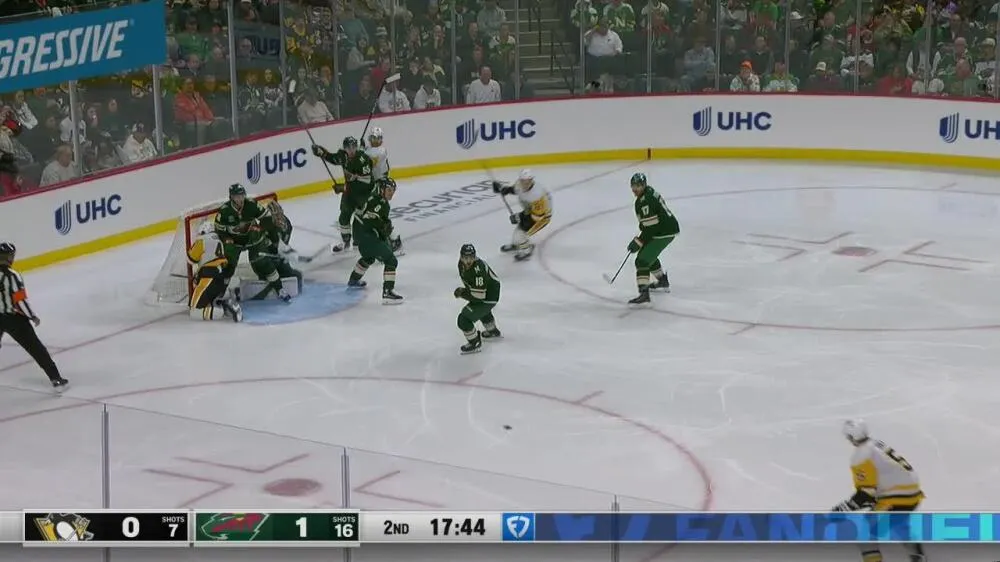
Inability to hold early advantage exposes Minnesota Wild’s fragility in loss to Pittsburgh Penguins
For the first time since their October 18 overtime loss to the Philadelphia Flyers, the Wild struck first and established an early advantage. Marcus Johansson found a net-crashing Kirill Kaprizov for a redirect past Jarry 10:16 into the opening frame, giving the home crowd something to cheer about. The goal, Kaprizov’s team-leading seventh of the season, represented everything the Wild had been trying to achieve—getting to the dirty areas and converting chances with purpose.
The promising start should have been a springboard for sustained success, but instead became another example of Minnesota’s inability to build on positive momentum. After dominating the first period and taking their 1-0 lead into the intermission, the Wild watched helplessly as Pittsburgh gradually seized control of the game. The Penguins tied it early in the second period when Ryan Shea’s shot found its way through traffic at the 2:18 mark.
Head coach John Hynes addressed the team’s struggles maintaining their game plan when asked about the fragile mindset potentially affecting his squad. “I think fragile is not a good word. I think it comes down to consistency in our game,” Hynes explained. “A lot of it comes into… why did we get outskated, why did the first period we were winning a lot of faceoffs, and then we didn’t win any faceoffs the second half?”
The collapse was complete in the third period when Pittsburgh scored three times to put the game away. Rust connected on a back-post tap-in just 6:29 into the final frame, and Ben Kindel added another barely a minute later on the power play. The sequence perfectly illustrated Minnesota’s current predicament—unable to respond to adversity and lacking the mental toughness to weather opponent pushes.
From the second period onward, the Penguins outshot the Wild 27-15 while dominating the faceoff circle throughout the night with a staggering 63% win rate on draws. These fundamental battles, which Minnesota controlled early, became the difference as Pittsburgh’s veterans demonstrated how to execute when games hang in the balance. The Wild’s failure to hold their early lead wasn’t about a single mistake or unlucky bounce—it was a systematic breakdown that speaks to deeper issues within the team’s competitive fiber.
This pattern has become all too familiar during Minnesota’s five-game losing streak. The Wild grab moments of success but cannot string together complete performances, leaving points on the table and watching opponents capitalize on their inconsistency.
Filip Gustavsson’s strong performance wasted in Minnesota Wild loss to Pittsburgh Penguins
While the final score might suggest otherwise, Filip Gustavsson delivered a performance worthy of victory, making 30 saves and keeping his team within striking distance until the third period unraveled. The Finnish netminder faced numerous high-danger chances throughout the contest, including several breakaways that resulted from defensive turnovers, yet stood tall when called upon. His efforts in the opening 40 minutes kept the Wild in position to steal two points despite being outplayed for large stretches.
Gustavsson’s most impressive work came during a shorthanded breakaway by former Wild forward Connor Dewar in the second period, robbing the speedy forward with a clutch save that preserved the 1-1 tie. These momentum-saving stops gave his teammates every opportunity to regain control and push back against Pittsburgh’s surge. The goaltender also made several key stops in transition, reading plays well and positioning himself to deny quality chances from the Penguins’ skilled forwards.
The third period saw Gustavsson face an onslaught as his defense failed to provide adequate support. While Rust’s back-post conversion and Kindel’s power-play deflection were goals he might like to have back, neither came from defensive breakdowns or poor team play in front of him. The Wild’s structure disintegrated, leaving their netminder exposed to high-percentage opportunities that even elite goaltenders struggle to stop consistently.
“Yeah, the first period was great, we did what we should do, and then the second period started drifting away a little bit,” Gustavsson reflected after the game. “They got the first goal there, and then we kind of fell apart a little bit.” His assessment was diplomatic but accurate—the team in front of him simply stopped executing the defensive details that had made them successful early.
The goaltending position hasn’t been Minnesota’s primary concern during this losing streak, but the lack of goal support and defensive structure has put both Gustavsson and Marc-André Fleury in impossible situations. When a goaltender makes 30 saves and keeps his team in the game for two periods, the skaters need to find ways to reward that effort with better play in front of him.
Minnesota’s penalty kill also let Gustavsson down, allowing Pittsburgh’s only power-play goal on the night. “It’s getting worse,” Gustavsson admitted about the penalty kill. “We’ve got to figure something out.” His frustration was palpable, and rightfully so—he’s done his part to give the Wild chances to win, but one player can’t overcome systemic issues affecting the entire roster.
Offensive inconsistency and mental fragility doom Minnesota Wild against Pittsburgh Penguins
The Wild’s offensive struggles have been magnified during this losing streak, with the team managing just four goals across their last two games combined. Against Pittsburgh, Minnesota generated only 27 shots on goal and went 0-for-4 on the power play, including two crucial opportunities in the first period when they held momentum. These missed chances to extend their early lead proved costly as the Penguins gradually took control.
Marcus Foligno, one of the team’s veteran leaders, didn’t mince words when discussing the team’s mental approach. “We gotta suck it up and just play the next game, and like I said, I don’t have an answer for you guys, it’s more of just like we gotta do it,” Foligno stated emphatically. “Action speaks, so it’s more just, it’s not even about gripping the stick at all, it’s actually just about getting your head right for a period where it’s like you know what, this is three guys on a line, this is what we have to play tonight and this is how we’re going to do it for a full 60, and for some reason we’re letting the frustration creep in our game.”
The frustration Foligno referenced has become increasingly evident as the losses pile up. After pushing Winnipeg to overtime earlier in the week in a spirited performance, the Wild seemed to revert to old habits against Pittsburgh. The team’s preparation looked solid before the game, but execution under pressure continues to plague them when opponents make adjustments.
Minnesota’s inability to generate sustained offensive pressure meant Kaprizov’s early goal stood as their lone marker. The Wild’s top players need to find ways to create more dangerous chances and convert on their opportunities, particularly on the power play where they’ve struggled mightily. When teams can shut down Kaprizov’s line, there’s little secondary scoring to pick up the slack, a troubling trend that opponents have begun exploiting.
Hynes emphasized the need for mental toughness when addressing his team’s performance. “It’s not about being fragile, it’s about doing the right things, and it’s about having some toughness to you and digging in, and understanding when we’re in those situations, they matter,” the coach stressed. His message is clear—the Wild possess the talent to compete, but talent alone won’t overcome their current mental hurdles.
The team has shown flashes of playing the right way, dominating the first period against Pittsburgh and competing hard in their recent overtime losses. However, these positive stretches disappear as quickly as they arrive, replaced by passive play and poor execution. According to reports from The Hockey Writers, this inconsistency threatens to dig a hole too deep to climb out of regarding playoff positioning if it continues much longer.
Moving forward from the Minnesota Wild’s disappointing loss to Pittsburgh Penguins
The Wild now face a critical juncture in their season, sitting with only two games remaining on their six-game homestand where they’ve yet to secure a victory. Saturday’s matchup against the Vancouver Canucks presents another opportunity to snap this five-game skid, but it will require a complete 60-minute effort that has eluded Minnesota throughout October’s final week.
What makes this losing streak particularly concerning is that the Wild aren’t losing due to a lack of talent or effort in isolated moments. They’re losing because they can’t sustain success across full games, allowing opponents to dictate pace and execution during critical stretches. As detailed in the Star Tribune’s coverage, this inconsistency has become Minnesota’s defining characteristic through 12 games, overshadowing the positivity generated by Kaprizov’s contract extension and the team’s supposed salary cap freedom.
The three takeaways from Minnesota Wild’s 4-1 loss to Pittsburgh Penguins paint a picture of a team searching for its identity and mental fortitude. They can’t hold leads, they’re wasting strong goaltending performances, and their offensive inconsistency is crippling their ability to compete with playoff-caliber opponents. Until these issues are addressed and corrected through sustained effort and attention to detail, the losses will continue to mount.
With the Canucks coming to town Saturday, the Wild have little time to feel sorry for themselves. They need to channel the first-period energy they showed against Pittsburgh for three full periods, support their goaltenders with better defensive structure, and find ways to convert power-play opportunities into goals. The season is still young, but five-game losing streaks have a way of spiraling into longer droughts if not addressed immediately. For a team with playoff aspirations, the time to turn things around is now, before this skid becomes a season-defining collapse.

Par Mike Jonderson
Mike Jonderson is a passionate hockey analyst and expert in advanced NHL statistics. A former college player and mathematics graduate, he combines his understanding of the game with technical expertise to develop innovative predictive models and contribute to the evolution of modern hockey analytics.